Get our latest staff recommendations, award news and digital catalog links right to your inbox.
Published by Wisdom Publications
Distributed by Simon & Schuster
Table of Contents
About The Book
Tibet’s philosophical tradition is on brilliant display in this anthology of works exploring the means to finding certainty in an impermanent and interdependent world. Here, descendants of the great Tsongkhapa plumb the nature of knowing to harness it in the service of awakening.
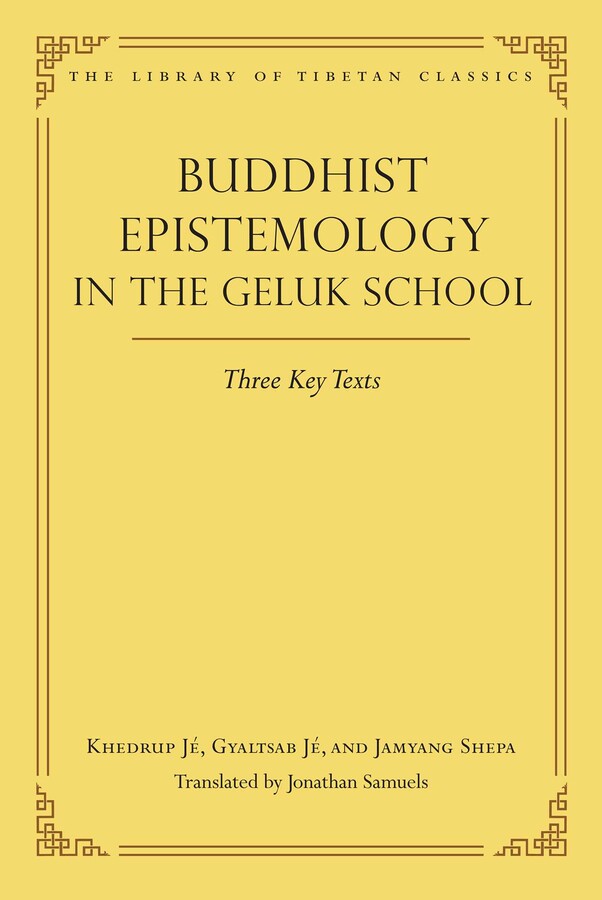
This volume includes translations of three separate Tibetan works by iconic figures in the Geluk school of Buddhism. The first work, Banisher of Ignorance, is by Khedrup Gelek Palsang (1385–1438), and the second, On Preclusion and Relationship, is by Gyaltsab Darma Rinchen (1364–1432). The authors—popularly known as Khedrup Je and Gyaltsab Je—were the foremost disciples of the Geluk-school founder, Tsongkhapa Losang Drakpa (1357–1419). The third text, Mighty Pramana Sun, is a commentary on the first chapter of Candrakirti’s Clear Words (Prasannapada) by Jamyang Shepa (1648–1721).
These works concern themselves primarily with the Buddhist theory of knowledge—the means by which we are able to know things and how we can be certain of that knowledge. Encapsulating this theory is the notion of pramana, the Buddhist understanding of which was shaped most significantly by the Indian masters Dignaga (fifth to sixth century) and Dharmakirti (seventh century). Based on their explanation, pramana is often translated as “valid cognition,” a literal reference to the kind of cognition that they proposed could be relied upon to supply indisputable knowledge.
In the Buddhist Pramana tradition, rigorous reasoning is held to play a crucial role in gaining such knowledge, and there is no better exemplar of the sophistication this endeavor achieved in Tibet than Khedrup Je’s work here. He systematically catalogs and rebuts a host of views with unmatched acumen and flair. All three works illustrate how those who follow the tradition have viewed the systematic approach as necessary not only for textual analysis—for those seeking to unravel the complexities of the Indian Buddhist scriptures and treatises—but also for practitioners aiming to progress along the spiritual path and achieve the highest Buddhist goals.
This volume includes translations of three separate Tibetan works by iconic figures in the Geluk school of Buddhism. The first work, Banisher of Ignorance, is by Khedrup Gelek Palsang (1385–1438), and the second, On Preclusion and Relationship, is by Gyaltsab Darma Rinchen (1364–1432). The authors—popularly known as Khedrup Je and Gyaltsab Je—were the foremost disciples of the Geluk-school founder, Tsongkhapa Losang Drakpa (1357–1419). The third text, Mighty Pramana Sun, is a commentary on the first chapter of Candrakirti’s Clear Words (Prasannapada) by Jamyang Shepa (1648–1721).
These works concern themselves primarily with the Buddhist theory of knowledge—the means by which we are able to know things and how we can be certain of that knowledge. Encapsulating this theory is the notion of pramana, the Buddhist understanding of which was shaped most significantly by the Indian masters Dignaga (fifth to sixth century) and Dharmakirti (seventh century). Based on their explanation, pramana is often translated as “valid cognition,” a literal reference to the kind of cognition that they proposed could be relied upon to supply indisputable knowledge.
In the Buddhist Pramana tradition, rigorous reasoning is held to play a crucial role in gaining such knowledge, and there is no better exemplar of the sophistication this endeavor achieved in Tibet than Khedrup Je’s work here. He systematically catalogs and rebuts a host of views with unmatched acumen and flair. All three works illustrate how those who follow the tradition have viewed the systematic approach as necessary not only for textual analysis—for those seeking to unravel the complexities of the Indian Buddhist scriptures and treatises—but also for practitioners aiming to progress along the spiritual path and achieve the highest Buddhist goals.
Product Details
- Publisher: Wisdom Publications (August 26, 2025)
- Length: 904 pages
- ISBN13: 9780861714605
Browse Related Books
Raves and Reviews
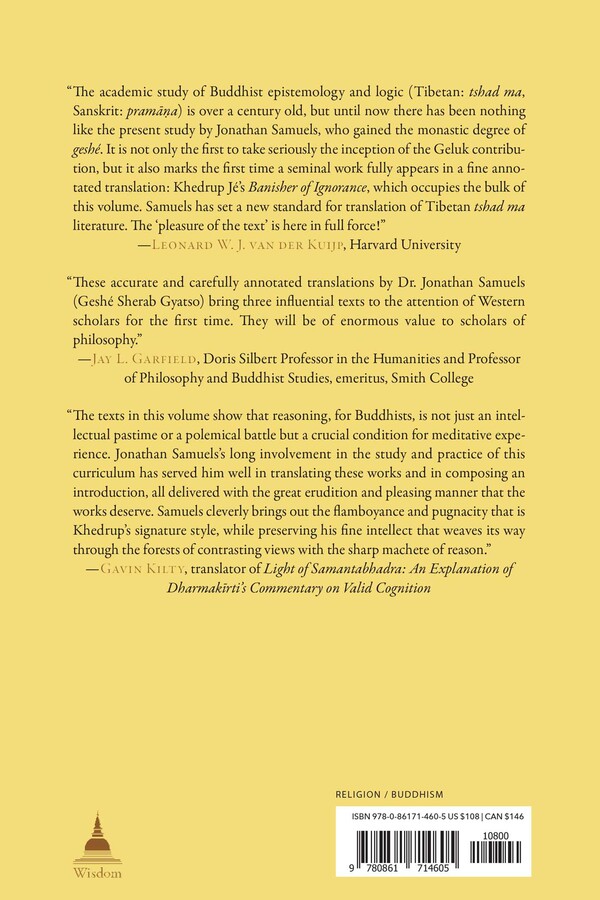
“The texts in this volume show that reasoning, for Buddhists, is not just an intellectual pastime or a polemical battle but a crucial condition for meditative experience. Jonathan Samuels’s long involvement in the study and practice of this curriculum has served him well in translating these works and in composing an introduction, all delivered with the great erudition and pleasing manner that the works deserve. Samuels cleverly brings out the flamboyance and pugnacity that is Khedrup’s signature style, while preserving his fine intellect that weaves its way through the forests of contrasting views with the sharp machete of reason.”
– Gavin Kilty, translator of Light of Samantabhadra: An Explanation of Dharmakirti’s Commentary on Valid Cognition
“These accurate and carefully annotated translations by Dr. Jonathan Samuels (Geshé Sherab Gyatso) bring three influential texts to the attention of Western scholars for the first time. They will be of enormous value to scholars of philosophy.”
“These accurate and carefully annotated translations by Dr. Jonathan Samuels (Geshé Sherab Gyatso) bring three influential texts to the attention of Western scholars for the first time. They will be of enormous value to scholars of philosophy.”
– Jay L. Garfield, Doris Silbert Professor in the Humanities and Professor of Philosophy and Buddhist Studies, emeritus, Smith College
“The academic study of Buddhist epistemology and logic (Tibetan: tshad ma, Sanskrit: pramana) is over a century old, but until now there has been nothing like the present study by Jonathan Samuels, who gained the monastic degree of geshé. It is not only the first to take seriously the inception of the Geluk contribution, but it also marks the first time a seminal work fully appears in a fine annotated translation: Khedrup Jé’s Banisher of Ignorance, which occupies the bulk of this volume. Samuels has set a new standard for translation of Tibetan tshad ma literature. The ‘pleasure of the text’ is here in full force!”
– Leonard W. J. van der Kuijp, Harvard University
Resources and Downloads
High Resolution Images
-
Book Cover Image (jpg): Buddhist Epistemology in the Geluk School
Hardcover 9780861714605
Published by Wisdom Publications
Distributed by Simon & Schuster
Join our mailing list!
By clicking 'Sign me up' I acknowledge that I have read and agree to the privacy policy and terms of use.