

Get our latest staff recommendations, award news and digital catalog links right to your inbox.
What Are Historian Toby Lester's Books? Find Out Now!
Historian Toby Lester Reveals His Favorite Movie
Historian Toby Lester Reveals His Favorite History Book!
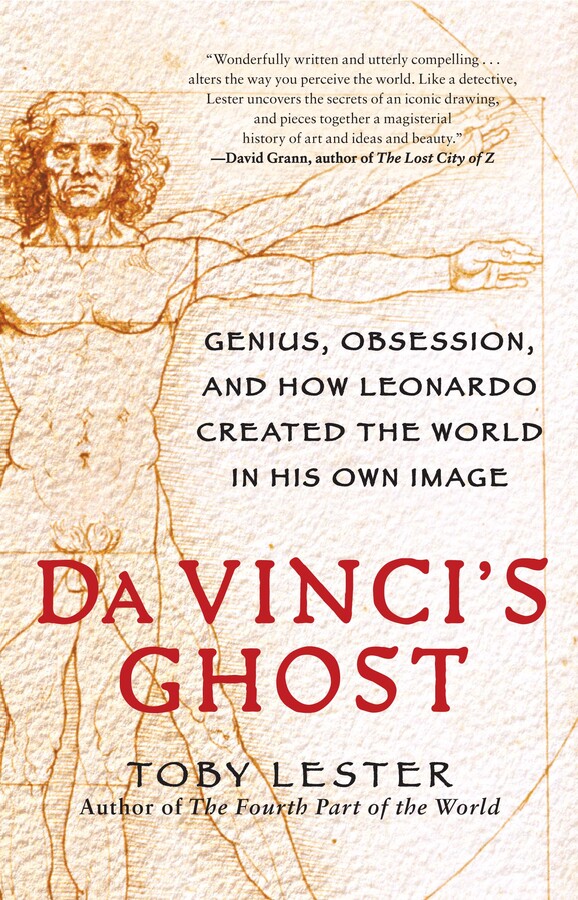
Da Vinci's Ghost
Genius, Obsession, and How Leonardo Created the World in His Own Image
By Toby Lester
Table of Contents
About The Book
In Da Vinci's Ghost, critically acclaimed historian Toby Lester tells the story of the world’s most iconic image, the Vitruvian Man, and sheds surprising new light on the artistry and scholarship of Leonardo da Vinci, one of history’s most fascinating figures.
Deftly weaving together art, architecture, history, theology, and much else, Da Vinci's Ghost is a first-rate intellectual enchantment.”—Charles Mann, author of 1493
Da Vinci didn’t summon Vitruvian Man out of thin air. He was inspired by the idea originally formulated by the Roman architect Vitruvius, who suggested that the human body could be made to fit inside a circle, long associated with the divine, and a square, related to the earthly and secular. To place a man inside those shapes was to imply that the human body could indeed be a blueprint for the workings of the universe. Da Vinci elevated Vitruvius’ idea to exhilarating heights when he set out to do something unprecedented, if the human body truly reflected the cosmos, he reasoned, then studying its anatomy more thoroughly than had ever been attempted before—peering deep into body and soul—might grant him an almost godlike perspective on the makeup of the world.
Written with the same narrative flair and intellectual sweep as Lester’s award-winning first book, the “almost unbearably thrilling” (Simon Winchester) Fourth Part of the World, and beautifully illustrated with Da Vinci's drawings, Da Vinci’s Ghost follows Da Vinci on his journey to understanding the secrets of the Vitruvian man. It captures a pivotal time in Western history when the Middle Ages were giving way to the Renaissance, when art, science, and philosophy were rapidly converging, and when it seemed possible that a single human being might embody—and even understand—the nature of the universe.
Deftly weaving together art, architecture, history, theology, and much else, Da Vinci's Ghost is a first-rate intellectual enchantment.”—Charles Mann, author of 1493
Da Vinci didn’t summon Vitruvian Man out of thin air. He was inspired by the idea originally formulated by the Roman architect Vitruvius, who suggested that the human body could be made to fit inside a circle, long associated with the divine, and a square, related to the earthly and secular. To place a man inside those shapes was to imply that the human body could indeed be a blueprint for the workings of the universe. Da Vinci elevated Vitruvius’ idea to exhilarating heights when he set out to do something unprecedented, if the human body truly reflected the cosmos, he reasoned, then studying its anatomy more thoroughly than had ever been attempted before—peering deep into body and soul—might grant him an almost godlike perspective on the makeup of the world.
Written with the same narrative flair and intellectual sweep as Lester’s award-winning first book, the “almost unbearably thrilling” (Simon Winchester) Fourth Part of the World, and beautifully illustrated with Da Vinci's drawings, Da Vinci’s Ghost follows Da Vinci on his journey to understanding the secrets of the Vitruvian man. It captures a pivotal time in Western history when the Middle Ages were giving way to the Renaissance, when art, science, and philosophy were rapidly converging, and when it seemed possible that a single human being might embody—and even understand—the nature of the universe.
Excerpt
Da Vinci’s Ghost
1
BODY OF EMPIRE
I have gathered what I observed to be useful, and brought it together as a single body.
—Vitruvius, Ten Books on Architecture (c. 25 B.C.)
MARCUS VITRUVIUS POLLIO was an army man, a cog in the great lumbering Roman war machine.
For years, assigned to the staff of Julius Caesar and other generals, he rumbled around Italy and the provinces, transporting equipment, fording rivers, pitching camps, digging ditches, sinking wells, constructing catapults, fighting battles, repairing siege engines, surveying captured land, laying out towns, founding colonies. Toiling away behind the scenes, he saw to it that everything worked. His efforts helped ensure victory and prosperity for Rome, and allowed his superiors to bask in fame and glory.
That seems to have struck him as not quite fair. In the mid-20s B.C., having retired from active duty, he looked back on his career and found he had almost nothing to show for the labors of a lifetime. “Little fame has resulted,” he lamented. “I am unknown to most people.”
But his working life wasn’t yet over. He still had time to make a name for himself and had even decided how he would do it. He would write a book—a how-to guide to the building of empire.
VITRUVIUS DIDN’T MAKE that decision in a vacuum. In the early 20s B.C., he and other Romans had watched with a mix of apprehension and pride as a canny new consul named Gaius Octavius Thurinus had asserted his grip on their capital city. In the previous decade Octavius, not yet forty, had avenged the murder of his uncle Julius Caesar and defeated his own archrival, Mark Antony, in Egypt, at last bringing to an end years of devastating civil war. Not long after returning home he had assumed a grand new name, Caesar Augustus, and had dedicated himself to the restoration of Rome. And then, as Vitruvius no doubt observed with delight, he had proceeded to launch the greatest building campaign the world had ever known, one that would fundamentally remake the city of Rome, transform the nature of Roman power and government, and redefine the very idea of empire. It was a campaign that in many ways gave lasting shape to what is today often described as the Western world.
Alive with resonances, the name Augustus inspired confidence. It meant “stately,” “dignified,” and “holy”: in a word, “august.” It implied an association with augurium (“augury”), the art of interpreting divine omens, which had long formed the bedrock on which Roman political, civic, and religious life was built. It also broadcast connections with augere (“to increase,” “to grow,” “to prosper”), the meanings of which were embedded in auctor (“originator,” “founder,” “author”) and auctoritas (“authority,” “power,” “the one in charge”). Augustus was Rome’s new augur, founder, and chief authority—and he would use his powers to bring a new age of prosperity to his people.
Augustus loved order. But what he found when he returned to Rome from Egypt in 29 B.C. was just the opposite: a decrepit megalopolis ravaged by years of war, political chaos, and administrative neglect. The city that Augustus came home to, wrote Suetonius, one of his first biographers, was “not adorned as the dignity of the empire demanded.”
That was putting it mildly. Most of Rome was a sprawling warren of precariously built multistory houses that pressed in along the sides of small, unpaved roads, creating suffocatingly close quarters where shopkeepers, street vendors, beggars, day laborers, prostitutes, unemployed soldiers, immigrants, foreign slaves, and beasts of burden all jostled together. Wheeled carts were banned during the day to reduce congestion, which meant a constant clatter at night. Public spaces were few and far between; temples and monuments revealed shocking signs of neglect; and the city’s once vaunted sewer system had fallen into disrepair. From the upper stories of their houses, home owners routinely dumped the contents of their chamber pots into the streets—and pedestrians routinely found themselves on the receiving end of this practice. To walk through much of Rome was to pick one’s way through a morass of garbage, animal refuse, human waste, and even the occasional corpse. Holding his fingers to his nose, one Roman chronicler of the period described the city as a giant “disease-ridden body.”
Rome was sick—but Augustus had the cure. He turned his attention first to the city’s physical infrastructure, launching a major effort to restore its public buildings, renovate its roads, repair and expand its aqueducts, and clean out its sewers. He also organized the citywide distribution of free goods and services: salt, olive oil, theater tickets, and even, at festival times, haircuts. The point of all this was clear: the hard times were over. Romans now could—and should—clean themselves up, rebuild their city, and enjoy a new era of peace and prosperity.
Augustus and his followers attributed the decline of Rome to one cause above all others: the neglect of the gods and their temples. Direct communication with the gods, the Romans believed, was what had allowed them to amass wealth, political power, and military might over the years, but now, with the temples falling into disrepair, and religious traditions with them, this hotline to the heavens, as one scholar has called it, had been severed. Right relations with the gods had to be reestablished if Rome was to thrive and rule the world. “Roman, you will remain sullied with the guilt of your fathers,” the poet Horace had written not long before, “until you have rebuilt the temples and restored all the ruined sanctuaries.”
So down they came, countless dilapidated structures of timber, mud, and brick. In their place, up rose magnificent new temples and monuments of gleaming, expensive marble, built in a style that deliberately harked back to the classic temple designs of the Etruscans and Greeks: a classical Renaissance that took place in Italy some fifteen hundred years before the one so often discussed today. Augustus devoted himself with astonishing energy to the task, setting into motion a flurry of construction the likes of which no city had ever experienced, and earning himself a reputation, according to the Roman historian Livy, as “the founder and restorer of all sanctuaries.” At the end of his life Augustus himself blandly but proudly catalogued the remarkable fruits of his labors.
I built the Senate House; and the Chalcidicum adjacent to it; the temple of Apollo on the Palatine with its porticoes; the temple of the divine Julius, the Lupercal, the portico at the Flaminian circus . . . a pulvinar at the Circus Maximus; the temples on the Capitol of Jupiter Feretrius and Jupiter the Thunderer; the temple of Quirinus; the temples of Minerva and Queen Juno and Jupiter Libertas on the Aventine; the temple of the Lares at the top of the Sacred Way; the temple of the Di Penates in the Velia; the temple of Youth; and the temple of the Great Mother on the Palatine. I restored the Capitol and the theatre of Pompey . . . . In my sixth consulship I restored eighty-two temples . . . . In my seventh consulship . . . I built the temple of Mars the Avenger and the Forum Augustum . . . . I built the theater adjacent to the temple of Apollo.
And that was just Rome. He also set his sights farther afield. Armies of Roman soldiers, engineers, and bureaucrats now began marching out in all directions into the provinces, making war, “pacifying” rebellious tribes, annexing territory, building roads, founding colonies, establishing new cities, and erecting monuments, all in Augustus’s name. “In cities old and new,” one observer wrote, “they build temples, monumental gateways, sacred precincts, and colonnades for him.” It was happening even in the distant eastern provinces, at the edges of the Roman world. “The whole of humanity, filled with reverence, turns to the Sebastos,” wrote one Syrian citizen of Rome, referring to Augustus by his Greek name. “Cities and provincial councils honor him with temples and sacrifices, for this is his due.”
Romans now encountered the name and image of Augustus everywhere in his growing sphere of influence: on coins and statues, on milestones and monuments and temples, in the names of roads and towns and colonies. In the middle of Rome—at the center of the world—he placed the milliarium aureum (“golden milestone”), the starting point for all roads leading out of the city. Naturally, it bore his name. Similarly, the place where a road reached its end at the outer limits of Roman territory sometimes bore his name: the terminus Augusti.
Something remarkable was taking place. At its center and circumference, and everywhere in between, Augustus was beginning to embody Rome—a metamorphosis that the Roman historian Florus, writing in the following century, claimed was his defining achievement. “By his wisdom and skill,” Florus wrote, “he set in order the body of empire, which was all overturned and thrown into confusion, and would certainly never have been able to attain coherence and harmony unless it were ruled by the nod of a single protector: its soul, as it were, and its mind.”
The body of empire. The very concept was an Augustan innovation. Before Augustus the Latin word imperium (“empire”) had signified an abstract power—a right of command held temporarily by an elected official or military commander. Many people had been able to possess this power at once, much as today many people can be said to possess media “empires.” The related term imperator (“emperor”) described nothing more than a commander’s fleeting status as a victor and could be used only between the time of a great victory and a return home in triumph. To claim it after that, he had to return to the battlefield and earn it again.
Augustus changed all that. By the time he took power Romans had already begun to imagine that their imperium, won year after year on the battlefield with the help of the gods, might allow them to become masters of the world. But they hadn’t thought of this imperium as something innately geographical or physical—as a world body, that is, made up of different member provinces, all set permanently in their rightful place and controlled by a single head of state. But that’s exactly what Augustus wanted Rome to become: a perfect body—his perfect body—of empire.
AS A PHYSICAL specimen, Augustus fell considerably short of anybody’s ideal.
Small and lame, with bad teeth, a crooked nose, and eyebrows that had grown together, he suffered from kidney stones and bladder trouble. Spots, birthmarks, and ringworm scars covered his body. Coins struck early in his career, when he still called himself Octavius, probably preserve the best surviving image of what he actually looked like—and they appear to depict a real person, imperfections and all (Figure 4). But coins struck after he renamed himself Augustus, in 27 B.C., present him with a bold new look (Figure 5).
Figure 4. Octavius, the individual, before 27 B.C.
Figure 5. Caesar Augustus, the ideal, after 27 B.C.
It was all part of his larger campaign of transformation. He had succeeded in bringing an end to civil war because, the story went, he was divi filius: the son of a god. The title derived from his uncle Julius Caesar, who, two years after having been murdered in 44 B.C., had been the only Roman other than Romulus ever to be officially deified by the Roman Senate. Not long before his death, Caesar had secretly adopted Octavius as his rightful heir, which in the eyes of the law did indeed make him the son of a god—and after consolidating power Augustus seems to have decided he should look the part.
Coins offered Augustus a way of introducing himself to Romans all over the world, literally by putting his new image into the hands of the people. A mint, it’s easy to forget, was an early version of the printing press, and it made possible for Augustus a feat that Johannes Gutenberg often is mistakenly given credit for: the cheap and easy distribution of the exactly repeatable image. Coins, Augustus and his supporters realized, were a powerful means of broadcasting his new look and all that it symbolized. As citizens carried his likeness all over the Roman world, they would spread the message that prosperity and increase derived from one source alone: Caesar Augustus. No longer would the forces of ugliness, imperfection, disease, and disorder tear Rome apart. Just as Octavius had remade his own body in an august new form, he would now remake his body of empire. And its coherence and harmony would derive from one source above all: the ideal human form.
Augustus turned to the art of ancient Greece to find models of that ideal. “He was interested in Greek studies,” his biographer Suetonius wrote, “and in these he excelled greatly. . . . There was nothing for which he looked so carefully as precepts and examples instructive to the public or to individuals.” The most celebrated model appeared in the work of the sculptor Polykleitos, revered by the Greeks and Romans alike as one of the greatest artists ever to have lived. Some four centuries earlier, Polykleitos had written a book titled the Canon, now lost, in which he laid out the mathematical—that is, “canonical”—proportions of the perfect human figure. Needless to say, it was male.
Polykleitos had done more than codify those proportions in writing. He had embodied them in a statue. Also called the Canon, the statue took the form of a nude athlete holding a spear and resting his weight on one foot, in a position of perfect equipoise: a pose designed to suggest a combination of tranquillity and strength, motion and rest (Figure 6).
The Spear Bearer of Polykleitos, copied again and again in antiquity, was a timeless classical ideal. Romans knew it well. Cicero described it as an exemplar of the beautiful, to be emulated and learned from. The first-century authority Quintilian described it as “full of dignity and holiness”—the very traits embedded in the name Augustus. The great Roman encyclopedist Pliny the Elder weighed in, too. “Polyclitus,” he wrote, “made a statue that artists call the Canon, and from which they derive the principles of their art, as if from a law of some kind. And he alone of men is deemed to have rendered art itself in a work of art.”
Figure 6. Roman copy of Polykleitos’s Spear Bearer, embodying the ideal proportions of the human form.
Figure 7. The Prima Porta statue of Augustus, based on the model of the Spear Bearer (c. 19 B.C.).
Few people outside elite circles in Rome ever had a chance to see Augustus in person. So somebody—perhaps Augustus himself, or perhaps a sculptor commissioned to make a statue of him—had a brilliant idea. The familiarity of the Spear Bearer as an icon made it a potentially powerful propaganda tool. Why not make the bodies of the Spear Bearer and Augustus one and the same? Why not, with the help of sculptors throughout the empire, erase Augustus’s imperfections and instead demonstrate to the Roman world that he incorporated a timeless ideal?
Statues of Augustus cast in this new mold began to proliferate all over the Roman world after 27 B.C. Along with the coins minted after that date, they defined him visually to a degree that’s hard to appreciate today, when political leaders are on constant public display in the media, warts and all. And nothing defined him more fully than the statue known as Augustus of Prima Porta, a work often copied in Roman times that is well worth pondering as an expression of the Augustan ideal (Figure 7).
In the statue Augustus poses as an emperor in triumph, clad in military regalia. With his right arm raised in the pose of an orator, he addresses the world, a pose that, in the language of classical sculpture, suggests an aura of divinity. Superficially, the statue looks quite different from the Spear Bearer—but in fact the resemblances are numerous and would have been obvious to educated Romans. The two statues correspond very closely in size and proportion; both have hair cropped symmetrically, in the classical Greek style; both have soft, idealized facial features; both possess a peaceful, remote look that conveys a sense of power calmly restrained; and both are cast in that characteristic one-footed stance. The message would have been hard to miss: Augustus embodies the Polykleitan ideal.
There’s more. Unlike the Spear Bearer, Augustus wears clothes, including a glorious breastplate depicting an event that justifies his pose as temporary emperor: his recent victory of the Romans over the Parthians, in modern-day Iran. The breastplate shows not only the Parthians in the east but also other peoples and provinces in the south, west, and north. It’s an allegorical world map, in other words, made an official part of the Roman body of empire.
The statue also has cosmic dimensions. A number of classical deities appear on the breastplate, among them, at the top, the twins Apollo and Diana, the gods of the sun and the moon. Romans looking at the statue would have understood the symbolism: Augustus and his body of empire mirror the divine perfection of the cosmic order.
Based on the ideal human form, reaching out in all directions to encompass the known world, and aligned with the cosmic order, Augustus in the Prima Porta statue sets in stone a powerful new Roman ideology of empire. His perfect form embodies Rome—and Rome’s perfect form, in turn, embodies the world. This was an idea that would animate Roman political thought for generations. Seneca would capture it best, in an address to the emperor Nero. “Your spirit will spread little by little through the whole great body of empire,” he declared, “joining all things in the shape of your likeness.”
AUGUSTUS, SOME SCHOLARS claim, had a special fondness for style guides and rule books, works that wove disparate strands of information into a corpus, or complete body of knowledge. This was precisely what Cicero had just done for the art of oratory, in On Rhetoric, and what Varro had just done for Latin grammar, in On the Latin Language. But when Augustus took power and began rebuilding Rome, no such guide existed for architecture. Even the idea of the field as a theoretical discipline, rather than as just a manual craft, had only begun to emerge. The term architectura itself—a Latin coinage probably derived from Greek roots—dates only to the 40s B.C. or so.
Observing from the sidelines as Augustus began to create his empire, Vitruvius must have sensed a once-in-a-lifetime opportunity. He could fill this void. If at the outset of the greatest building campaign the world had ever known no comprehensive guide to architecture existed—well, then, why shouldn’t he be the one to write it? How better to help set the empire in order, curry favor with the world’s most powerful ruler, and make a lasting name for himself? Why not, as he would soon put it, “bring the whole body of this great discipline to complete order”?
Even during his active career, Vitruvius seems to have stolen time from his official duties to study architectural theory. He found it a fascinating but frustrating pursuit. Over the years—especially late in his career, after Augustus, for reasons unknown, granted him a stipend that allowed him some leisure in his retirement—he managed to locate a number of specialized treatises, primarily by Greek authors: commentaries on individual buildings, discussions of specific technical problems, guides to systems of proportions. But they were “incomplete drafts,” he complained, “scattered like fragments.” He felt he could do better—and so he set to work. By the mid-20s B.C. he had produced De architectura libri decem, or Ten Books on Architecture—which, naturally, he dedicated to Augustus.
The Ten Books is a curious hybrid. At one level, it’s a rich repository of technical information for practitioners, divided, as its title suggests, into ten discrete books, each of which addresses a different subject. Vitruvius provides advice on just about everything he can think of: how to determine sites for new buildings and new cities; what kind of sand to use in mixing concrete; where to find different kinds of timber; how to construct arches, retaining walls, courtyards, villas, bathhouses, theaters, and temples; what to consider when installing floors and ceilings; ways to find water and build aqueducts; and how to make different kinds of machines—odometers, cranes, hoists, water pumps, catapults, siege engines, and more. The book is much studied in architecture programs today because it was also the first to codify the famous architectural orders used by the Greeks: Doric, Ionic, and Corinthian.
But all of this practical information had limited uses. A true architect can’t just be a master of his trade, Vitruvius insisted. He had to be the kind of well-rounded person who, centuries later, would come to be known as a Renaissance man. “He ought to be both naturally gifted and amenable to instruction,” he wrote, and then continued, “Let him be educated, skillful with the pencil, instructed in geometry, know much history, have followed the philosophers with attention, understand music, have some knowledge of medicine, know the opinions of the jurists, and be acquainted with astronomy and the theory of the heavens.”
Why such a broad definition of the architect—and, by extension, architecture? Because, according to Vitruvius, architecture is the defining human art. It creates civilization. It constructs homes and lays out cities, bringing people together. It designs temples, revealing the will of the gods and aligning the man-made with the divine. It produces machines, guaranteeing victory in times of war and prosperity in times of peace. In sum—as Vitruvius described it and as Augustus was practicing it—it builds empire.
MUCH OF WHAT Vitruvius has to say in the Ten Books involves some very basic principles. Again and again, whether the matter at hand is the assembly of a retaining wall or the layout of a city, everything comes down to the manipulation of squares and circles—or, as Vitruvius put it, “the use of the rule and compasses.” But in writing about circles and squares he was writing about more than just geometry, as his readers knew full well.
Philosophers, mathematicians, and mystics in the ancient world held the view that the circle possessed special symbolic powers. It represented unity and wholeness, the cosmic and the godly. Plato, for example, in one of his most influential and widely read works, the Timaeus, had likened the cosmos to a single world body animated by a world soul, the entirety of which was contained within a sphere, which he described as “a figure the most perfect and uniform of all.” This idea appealed to many Romans in the age of Julius Caesar and Augustus, especially as they developed their twin obsessions with order and empire. “I can see nothing more beautiful,” Cicero wrote not long before Vitruvius produced the Ten Books, “than that figure which contains all others, and which has nothing rough in it, nothing offensive, nothing cut into angles, nothing broken, nothing swelling, and nothing hollow.” Only circles and spheres “have the property of absolute uniformity in all their parts, of having every extremity equidistant from the center,” he continued; “there can be nothing more tightly bound together.”
Cicero had not just Plato but Aristotle in mind. Aristotle had described the cosmos as a concentric set of spheres, each of which spun at a different rate around a central axis. The word cosmos, meaning “order” in Greek, implied all of this—as does the word universe, with its suggestion of a giant single turning entity. The earth was the midpoint of the whole system. It didn’t move, but around it rotated the spheres of the moon, the sun, the planets, and finally the stars, together creating the apparent motions of the heavens.
Vitruvius devoted considerable time to describing this system in the Ten Books. “The cosmos,” he wrote, “is the all-encompassing system of everything in nature, and also the firmament, which is formed of the constellations and the courses of the stars. This revolves ceaselessly around the earth and sea.” The shape of the cosmos would seem to have little to do with the practice of architecture, but in fact, according to Vitruvius, it had everything to do with it—in the design of the cosmos, as he put it, “the power of nature has acted as architect.” And what the power of nature, or God, had done for the cosmos, he suggested, the human architect should for his creations—which is why some of the earliest surviving illustrations of the geocentric cosmos appear not in works of ancient astronomy or philosophy, as one might expect, but in the practical treatises of the very kinds of people Vitruvius worked closely with as an architect: Roman land surveyors (Figure 8).
God as the architect of the world: this was an idea that would echo down through the ages. Cicero himself had made a similar point not long before. The geometrical perfection of the cosmos suggested to many the presence of “not only an inhabitant of this celestial and divine abode,” he wrote, “but also a ruler and governor—the architect, as it were, of this mighty and monumental structure.”
The analogy made perfect sense to Vitruvius, who, after all, had dedicated his book to Rome’s divine ruler and governor, Augustus. The job of the architect, he proposed, was to survey the cosmic order of things, grasp its circular animating principles, and then bring them down to Earth. And the way to do that, he went on, was with the help of the set square.
Figure 8. One of the earliest surviving depictions of the spherical cosmos, set square against the horizon with the earth (terra) at its center. From a sixth-century copy of a Roman land-surveying treatise.
In human affairs as in architecture, Romans in the Augustan era fixated on the idea of the square as a complement to the idea of the circle. A good citizen had to be not only well-rounded in the liberal arts but also a model of physical and moral rectitude: “foursquare in hands and feet and mind, and fashioned without a flaw,” as one Greek writer had put it. Rome itself had supposedly been plowed in a circle at its founding, hence the relationship that Varro, for one, suggested between the words urbs (city) and orbis (circle)—but in founding the city, the story went, Romulus had divided the circular city into quarters for the purposes of augury, setting in order what future Romans would proudly call Roma quadrata (squared Rome).
So how would Romulus, in the mythical role of augur-surveyor, have squared his city? Imagine him on a hilltop late one evening, gazing out at the circular horizon. Looking up at the sky, he would have easily located the north celestial pole—“the pivot of the universe,” as one Roman surveyor would later describe it. This would have allowed him to divide the sky into quadrants based on the four cardinal directions. A sense of how he might have worked survives in a description by the Roman historian Livy, who wrote in the age of Augustus. “The augur, with his head veiled,” Livy recorded, “holding in his hand a crooked and knotless staff called lituus . . . prayed to the gods and fixed the regions from east to west, saying that the southern parts were to the right, and the northern to the left.” The Romans called each quadrant a templum: a sacred space carved out of the sky, subject to the act of contemplatio. These four parts they would often then divide into twelve smaller sections, each associated with a god who corresponded to the celestial bodies contained in that part of the sky, as in the templum of Mars—which, by extension, led to the idea of a temple as we now understand it, and the original sense of religious contemplation.
Finding the four cardinal points in the heavens was a critical task. “These points are charged with exceptional powers,” the Roman astronomer Marcus Manilius would explain during the reign of Augustus, “because the celestial circle is totally held in position by them, as by external supports. . . . If they did not clamp it with fetters at the two sides, and at the lowest and highest extremities of its compass, the heaven would fly apart.”
As it was above, so it had to be below. For a city to endure, as one Roman surveyor would write, it had to have “its origin in the heavens.” It had to be set square with the cardinal directions, just like the cosmos itself. So after dividing up the night sky an augur would have drawn a circle representing the horizon on the ground with his crooked staff and then traced two lines perpendicularly across it: one extending from north to south, the other from east to west. This plan he might later have confirmed with the help of a sundial, which would have allowed him, by revealing the specific path of the sun over the site, to draw with precision the two principal axes that would determine the layout of the rest of his city: the decumanus maximus, which ran from east to west, and the cardo maximus, which ran from north to south. The Romans also used the word cardo—meaning an axis or pole around which something turns—to describe what the earth and universe themselves revolved around, and it’s a term we still allude to today whenever we refer to the cardinal directions.
All of this highlights an important idea. Properly laid out, in the fashion illustrated by land surveyors in their treatises (Figures 9 and 10), Roman towns provided citizens with the comforting sense that their lives were in proper alignment with the divine order. Making their way along the cardo, they followed the axis around which all of the cosmic spheres turned; making their way along the decumanus, they followed the sun’s course.
Figure 9. How to lay out a city, from Roman land-surveying treatises. The horizon is divided into quadrants based on the cardinal directions. The cardo [kardo] maximus (KM) runs north-south, and the decumanus maximus (DM) runs east-west.
Figure 10. A generic Roman colony called Colonia Augusta.
Romulus and the early Romans had originally learned the arts of site selection and town planning from the Etruscans, and in the Ten Books Vitruvius argued for a return to these traditional methods. “I assert emphatically,” he wrote, “that the old principles for selecting a site should be called back into service.” Augustus’s surveyors and architects set to work in precisely that way, relying on the ancient art of augury, with its emphasis on the circle and the square, and the idea of a direct connection to the gods. Gradually, inexorably, they began to construct what they hoped would become a perfect body of empire—one in which Rome the city and Rome the empire could be considered one and the same thing, encompassing all four corners of the earth.
THE IDEA OF the Roman world as a body was no randomly chosen metaphor. It relied on an age-old philosophical conceit: that the human body was a scaled-down version of the world or the cosmos as a whole. Plato and other Greek philosophers had made the analogy repeatedly, as had the Bible (“Let us make man in our image”). Vitruvius himself had alluded to the idea, noting that blood, milk, sweat, urine, and tears were all related to the “countless varieties of juices” found in the ducts and veins of the earth. Writing not long after the death of Augustus, Philo of Alexandria had taken the analogy further, explicitly likening human bones to stones and wood, human hairs and nails to plants, human blood to rivers and streams. Astrologers and doctors, often one and the same in antiquity, developed their own version of the idea, expounding in detail on the direct correspondences between celestial objects and the human body. In this scheme of things, the spots and birthmarks covering the body of Augustus became manifest signs of his divinity, corresponding, according to his biographer Suetonius, “in form, order, and number with the stars of the Bear in the heavens.”
Nobody made the human analogy more consistently than the Stoic philosophers of Greece and Rome. The heavens, they argued, consisted of an invisible element called the aether, which had no material substance. The material world, on the other hand, was made up of four basic elements: earth, water, air, and fire. Holding all of the elements in a state of finely balanced tension and giving the cosmos its perfect form was the pneuma (Greek for “breath”): the all-pervasive divine spirit, or mind, of which the human mind was a small-scale model. “Who can doubt that a link exists between heaven and man,” Manilius would ask, adding, “Just as the world, composed of the elements of air and fire on high, and earth and water, houses an intelligence that, spread throughout it, directs the whole, so, too, with us the bodies of our earthly condition and our lifeblood house a mind that directs every part and animates the man.”
In making this kind of analogy, which biographers of Augustus would borrow and apply directly to their subject, Manilius and the Stoics were drawing on ancient Greek theories of medicine. The Greeks had written at great length on what constituted a healthy person. In their view, the human body wasn’t just subject to the laws of nature; it literally embodied them. The body was what the Romans called a minor mundus: a world in miniature, designed and held together according to the exact same principles as the cosmos itself. Like the world around it, the body consisted of the four material elements: flesh and bones (earth), blood (water), the invisible source of body heat (fire), and air. Keeping those elements in balance was the key to health; moisture had to be balanced against dryness, and heat against cold.
This led to some very strange but powerful ideas—which Vitruvius would lay out at length in the Ten Books. In southern climates, he explained, where Africans and Indians live, the excessive heat of the sun robs bodies of their moisture. This creates small people, darkens their skin, crinkles their hair, and raises the pitch of their voices. The heat quickens their minds, making them inventive and mentally agile, but it also dries out their blood, making them cowardly in battle. In northern climates, on the other hand, where the Germanic and Nordic tribes live, cold temperatures give rise to an abundance of moisture. This creates large people, lightens their skin, straightens their hair, and lowers the pitch of their voices. The cold renders their minds sluggish, making them slow-witted, but it keeps their supply of blood ample, making them brave warriors.
If the peoples of the world were to become members of a healthy and whole body of empire, Vitruvius argued, their natural excesses needed balancing out. And the gods had placed the Romans in Italy, halfway between the north pole and the equator, for just that reason.
The people of Italy are the most balanced with respect to both north and south, in terms of bodily form and the spiritual rigor required for decisive action. For exactly as the planet Jupiter is temperate, running in the middle between the sweltering planet Mars and the freezing planet Saturn, so, for the same reason, Italy has the unbeatable advantage of being balanced between the southern and northern regions, but with admixtures from both. And so she shatters the courage of [northern] barbarians by intelligent planning, and foils the plots of southerners by force of arms. Thus the divine mind allocated to the city of the Roman people a superb, temperate region in order that it could acquire governance of the whole world.
This is a remarkable passage. In effect, it provides the blueprint for a race-based ideology of empire that for two millennia would hold sway in Europe, and has yet to fully disappear. Geography and biology, Vitruvius was suggesting, are destiny. Placed at the center of the world by the gods, the Romans would rule the world forever as part of the natural order—if, that is, they could assemble a coherent world body of empire. Which is exactly what Vitruvius set out to explain how to do in his Ten Books.
AS AN ARCHITECT with plenty of hands-on experience, Vitruvius recognized that a singular challenge confronted the Romans if they wanted to build a body of empire based on the natural order. It would have to be assembled piece by piece, according to a set of standard measurements that could be understood and used by engineers and construction workers all over the world.
Earlier powers had encountered this challenge. Much head-scratching, for example, must have accompanied the construction of one fifth-century monument in Persia. “The stonecutters who wrought the stone,” an inscription on the monument reads, “those were Ionians and Sardians. The goldsmiths who wrought the gold, those were Medes and Egyptians. The men who wrought the wood, those were Sardians and Egyptians. The men who baked the brick, those were Babylonians. The men who adorned the wall, those were Medes and Egyptians.” The Greeks grappled with the problem in their own colonial building enterprises—and the only solution to it, they decided, was a system of measurement based on the human body.
This idea was nothing new. For as long as people have been measuring things, they’ve been using body parts to do it. Examples abound, among them the inch (the thumb), the foot, the cubit (the forearm), the Italian braccio (the full arm), and the fathom (both arms outstretched).
But all bodies are different. What the Greeks realized they needed was a system of measurements and proportional relationships that was based on a single body—an ideal body.
Fortunately, this was what Polykleitos and other Greek artists had tried to codify. As the Greek physician Galen would later record, Polykleitos in his books and statues had laid out “the proper proportion of the parts, such as, for example, that of finger to finger, and of all these to the palm and base of hand, of those to the forearm, of the forearm to the upper arm, and of everything to everything else.” This gave Greek builders what they needed. Using that model, they produced carvings in stone known as metrological reliefs, which provided them with a uniform standard of measurement embodied in the form of an idealized human figure.
Figure 11. The Oxford metrological relief (Greek, fifth-century B.C.), laying out a uniform system of measurement based on the ideal human form.
Two such reliefs survive, including one from about the fifth century B.C. that sets out in precise detail the exact size and relative proportions of the body parts most commonly used for measurement: the fingers, palm, hands, arms, head, chest, and feet (Figure 11). Vitruvius was well acquainted with this sort of relief, and with the canons of measurement proposed by ancient Greek artists. He had them in mind, in fact, when he wrote what would become the most famous passage of the Ten Books: a brief description of the figure we know today as Vitruvian Man.
THE PASSAGE APPEARS at the beginning of the third of his ten books, where he lays out principles for the design and construction of temples. The context is critical. Vitruvius knew that temples were the central element of Augustus’s building campaign. They, more than anything else, signified his desire to piece together a body of empire. They weren’t just august places, carved out of the sky and aligned with the gods. They were Augustus himself—august embodiments of earthly power and authority, full of dignity and holiness, designed according to the principles of the natural order. As one modern scholar has observed, the poet Ovid memorably summed up the idea in a pun. “Quis locus est templis augustior?” he asked. “What place is more august [more Augustus] than temples?”
This is the context into which Vitruvian Man was born. “No temple can be put together coherently without symmetry and proportion,” Vitruvius wrote, “unless it conforms exactly to the principle relating the members of a well-shaped man.”
At a literal level this is a very basic proposition: a temple must be designed according to the set of natural laws embodied in the human form. But that very linkage, between the universal and the particular as they come together in architecture and anatomy, implies something much grander. The proper building of a temple starts with the contemplation of the cosmos—but the only way to make sense of the cosmos, too vast an entity for the human mind to comprehend, is to study the scaled-down version on display in a well-shaped man.
Vitruvius then went on to lay out what the exact proportions of this figure should be. (In text only, it should be noted; no evidence survives that he ever illustrated his book.) The distance from his chin to the top of his forehead, he wrote, should be equal to the distance from his wrist to the tip of his middle finger—and both should be equal to one-tenth of his total body height. The distance from his chest to the crown of his head should be one-fourth of his total height, as should the width of his chest and his forearm. His foot should be one-sixth of his total height. His face itself should be divided into equal thirds: the first extending from the base of the chin to the bottom of the nostrils, the second from the nostrils to a point between the eyebrows, and the third from there to the top of the forehead. Similar relationships applied to other parts of the body, he continued, noting that readers could find details in the well-known works of “the famous painters and sculptors of antiquity”—a nod to Polykleitos and other Greeks.
But Vitruvius didn’t limit himself to enumerating the proportions of his well-shaped man. In the passage that comes next, he placed him inside a circle and a square—and gave shape to Vitruvian Man as we know him today. “Likewise,” he wrote,
in sacred dwellings the symmetry of the members ought to correspond completely, in every detail and with perfect fitness, to the entire magnitude of the whole. By the same token, the natural center of the body is the navel, for if a man were placed on his back with his hands and feet outspread, and the point of a compass put on his navel, both his fingers and his toes would be touched by the line of the circle going around him. You could also find a squared layout in the body in the same way that you made it produce the circular shape. For if you measured from the bottom of his feet to the top of his head and compared that measurement to his outspread hands, you would find the breadth the same as the height, just as in areas that have been squared with a set square.
The passage hums with resonances. Anatomy and architecture, art and aesthetics, the circle and the square, medicine and geography, religion and philosophy, politics and the ideology of empire—they’re all there, rolled into one. Part divine and part human, the source of harmony and order, Vitruvian Man, as described in the Ten Books, represents the measure of all things. At one level he’s a simple study in proportions, but at another he’s the expression of an ideal: a human figure whose body is the world, whose mind is its spirit, and whose being represents the power and order of the heavens brought down to Earth. His spread-eagled figure haunts the circular layout of Roman temples and cities, the full span of the globe, even the cosmos itself.
Vitruvius didn’t conjure up Vitruvian Man only as an abstraction. He also wanted his readers to associate the figure directly with a specific person: the august ruler who had just begun to build a body of empire in his own perfect image, and whose ideal form was embodied in all temples. Vitruvian Man, in other words, was none other than the figure to whom Vitruvius dedicated his Ten Books: Caesar Augustus himself.
That’s how Vitruvian Man came into the world, at least. But in the centuries that followed, he would take on a life of his own.
1
BODY OF EMPIRE
I have gathered what I observed to be useful, and brought it together as a single body.
—Vitruvius, Ten Books on Architecture (c. 25 B.C.)
MARCUS VITRUVIUS POLLIO was an army man, a cog in the great lumbering Roman war machine.
For years, assigned to the staff of Julius Caesar and other generals, he rumbled around Italy and the provinces, transporting equipment, fording rivers, pitching camps, digging ditches, sinking wells, constructing catapults, fighting battles, repairing siege engines, surveying captured land, laying out towns, founding colonies. Toiling away behind the scenes, he saw to it that everything worked. His efforts helped ensure victory and prosperity for Rome, and allowed his superiors to bask in fame and glory.
That seems to have struck him as not quite fair. In the mid-20s B.C., having retired from active duty, he looked back on his career and found he had almost nothing to show for the labors of a lifetime. “Little fame has resulted,” he lamented. “I am unknown to most people.”
But his working life wasn’t yet over. He still had time to make a name for himself and had even decided how he would do it. He would write a book—a how-to guide to the building of empire.
VITRUVIUS DIDN’T MAKE that decision in a vacuum. In the early 20s B.C., he and other Romans had watched with a mix of apprehension and pride as a canny new consul named Gaius Octavius Thurinus had asserted his grip on their capital city. In the previous decade Octavius, not yet forty, had avenged the murder of his uncle Julius Caesar and defeated his own archrival, Mark Antony, in Egypt, at last bringing to an end years of devastating civil war. Not long after returning home he had assumed a grand new name, Caesar Augustus, and had dedicated himself to the restoration of Rome. And then, as Vitruvius no doubt observed with delight, he had proceeded to launch the greatest building campaign the world had ever known, one that would fundamentally remake the city of Rome, transform the nature of Roman power and government, and redefine the very idea of empire. It was a campaign that in many ways gave lasting shape to what is today often described as the Western world.
Alive with resonances, the name Augustus inspired confidence. It meant “stately,” “dignified,” and “holy”: in a word, “august.” It implied an association with augurium (“augury”), the art of interpreting divine omens, which had long formed the bedrock on which Roman political, civic, and religious life was built. It also broadcast connections with augere (“to increase,” “to grow,” “to prosper”), the meanings of which were embedded in auctor (“originator,” “founder,” “author”) and auctoritas (“authority,” “power,” “the one in charge”). Augustus was Rome’s new augur, founder, and chief authority—and he would use his powers to bring a new age of prosperity to his people.
Augustus loved order. But what he found when he returned to Rome from Egypt in 29 B.C. was just the opposite: a decrepit megalopolis ravaged by years of war, political chaos, and administrative neglect. The city that Augustus came home to, wrote Suetonius, one of his first biographers, was “not adorned as the dignity of the empire demanded.”
That was putting it mildly. Most of Rome was a sprawling warren of precariously built multistory houses that pressed in along the sides of small, unpaved roads, creating suffocatingly close quarters where shopkeepers, street vendors, beggars, day laborers, prostitutes, unemployed soldiers, immigrants, foreign slaves, and beasts of burden all jostled together. Wheeled carts were banned during the day to reduce congestion, which meant a constant clatter at night. Public spaces were few and far between; temples and monuments revealed shocking signs of neglect; and the city’s once vaunted sewer system had fallen into disrepair. From the upper stories of their houses, home owners routinely dumped the contents of their chamber pots into the streets—and pedestrians routinely found themselves on the receiving end of this practice. To walk through much of Rome was to pick one’s way through a morass of garbage, animal refuse, human waste, and even the occasional corpse. Holding his fingers to his nose, one Roman chronicler of the period described the city as a giant “disease-ridden body.”
Rome was sick—but Augustus had the cure. He turned his attention first to the city’s physical infrastructure, launching a major effort to restore its public buildings, renovate its roads, repair and expand its aqueducts, and clean out its sewers. He also organized the citywide distribution of free goods and services: salt, olive oil, theater tickets, and even, at festival times, haircuts. The point of all this was clear: the hard times were over. Romans now could—and should—clean themselves up, rebuild their city, and enjoy a new era of peace and prosperity.
Augustus and his followers attributed the decline of Rome to one cause above all others: the neglect of the gods and their temples. Direct communication with the gods, the Romans believed, was what had allowed them to amass wealth, political power, and military might over the years, but now, with the temples falling into disrepair, and religious traditions with them, this hotline to the heavens, as one scholar has called it, had been severed. Right relations with the gods had to be reestablished if Rome was to thrive and rule the world. “Roman, you will remain sullied with the guilt of your fathers,” the poet Horace had written not long before, “until you have rebuilt the temples and restored all the ruined sanctuaries.”
So down they came, countless dilapidated structures of timber, mud, and brick. In their place, up rose magnificent new temples and monuments of gleaming, expensive marble, built in a style that deliberately harked back to the classic temple designs of the Etruscans and Greeks: a classical Renaissance that took place in Italy some fifteen hundred years before the one so often discussed today. Augustus devoted himself with astonishing energy to the task, setting into motion a flurry of construction the likes of which no city had ever experienced, and earning himself a reputation, according to the Roman historian Livy, as “the founder and restorer of all sanctuaries.” At the end of his life Augustus himself blandly but proudly catalogued the remarkable fruits of his labors.
I built the Senate House; and the Chalcidicum adjacent to it; the temple of Apollo on the Palatine with its porticoes; the temple of the divine Julius, the Lupercal, the portico at the Flaminian circus . . . a pulvinar at the Circus Maximus; the temples on the Capitol of Jupiter Feretrius and Jupiter the Thunderer; the temple of Quirinus; the temples of Minerva and Queen Juno and Jupiter Libertas on the Aventine; the temple of the Lares at the top of the Sacred Way; the temple of the Di Penates in the Velia; the temple of Youth; and the temple of the Great Mother on the Palatine. I restored the Capitol and the theatre of Pompey . . . . In my sixth consulship I restored eighty-two temples . . . . In my seventh consulship . . . I built the temple of Mars the Avenger and the Forum Augustum . . . . I built the theater adjacent to the temple of Apollo.
And that was just Rome. He also set his sights farther afield. Armies of Roman soldiers, engineers, and bureaucrats now began marching out in all directions into the provinces, making war, “pacifying” rebellious tribes, annexing territory, building roads, founding colonies, establishing new cities, and erecting monuments, all in Augustus’s name. “In cities old and new,” one observer wrote, “they build temples, monumental gateways, sacred precincts, and colonnades for him.” It was happening even in the distant eastern provinces, at the edges of the Roman world. “The whole of humanity, filled with reverence, turns to the Sebastos,” wrote one Syrian citizen of Rome, referring to Augustus by his Greek name. “Cities and provincial councils honor him with temples and sacrifices, for this is his due.”
Romans now encountered the name and image of Augustus everywhere in his growing sphere of influence: on coins and statues, on milestones and monuments and temples, in the names of roads and towns and colonies. In the middle of Rome—at the center of the world—he placed the milliarium aureum (“golden milestone”), the starting point for all roads leading out of the city. Naturally, it bore his name. Similarly, the place where a road reached its end at the outer limits of Roman territory sometimes bore his name: the terminus Augusti.
Something remarkable was taking place. At its center and circumference, and everywhere in between, Augustus was beginning to embody Rome—a metamorphosis that the Roman historian Florus, writing in the following century, claimed was his defining achievement. “By his wisdom and skill,” Florus wrote, “he set in order the body of empire, which was all overturned and thrown into confusion, and would certainly never have been able to attain coherence and harmony unless it were ruled by the nod of a single protector: its soul, as it were, and its mind.”
The body of empire. The very concept was an Augustan innovation. Before Augustus the Latin word imperium (“empire”) had signified an abstract power—a right of command held temporarily by an elected official or military commander. Many people had been able to possess this power at once, much as today many people can be said to possess media “empires.” The related term imperator (“emperor”) described nothing more than a commander’s fleeting status as a victor and could be used only between the time of a great victory and a return home in triumph. To claim it after that, he had to return to the battlefield and earn it again.
Augustus changed all that. By the time he took power Romans had already begun to imagine that their imperium, won year after year on the battlefield with the help of the gods, might allow them to become masters of the world. But they hadn’t thought of this imperium as something innately geographical or physical—as a world body, that is, made up of different member provinces, all set permanently in their rightful place and controlled by a single head of state. But that’s exactly what Augustus wanted Rome to become: a perfect body—his perfect body—of empire.
AS A PHYSICAL specimen, Augustus fell considerably short of anybody’s ideal.
Small and lame, with bad teeth, a crooked nose, and eyebrows that had grown together, he suffered from kidney stones and bladder trouble. Spots, birthmarks, and ringworm scars covered his body. Coins struck early in his career, when he still called himself Octavius, probably preserve the best surviving image of what he actually looked like—and they appear to depict a real person, imperfections and all (Figure 4). But coins struck after he renamed himself Augustus, in 27 B.C., present him with a bold new look (Figure 5).
Figure 4. Octavius, the individual, before 27 B.C.
Figure 5. Caesar Augustus, the ideal, after 27 B.C.
It was all part of his larger campaign of transformation. He had succeeded in bringing an end to civil war because, the story went, he was divi filius: the son of a god. The title derived from his uncle Julius Caesar, who, two years after having been murdered in 44 B.C., had been the only Roman other than Romulus ever to be officially deified by the Roman Senate. Not long before his death, Caesar had secretly adopted Octavius as his rightful heir, which in the eyes of the law did indeed make him the son of a god—and after consolidating power Augustus seems to have decided he should look the part.
Coins offered Augustus a way of introducing himself to Romans all over the world, literally by putting his new image into the hands of the people. A mint, it’s easy to forget, was an early version of the printing press, and it made possible for Augustus a feat that Johannes Gutenberg often is mistakenly given credit for: the cheap and easy distribution of the exactly repeatable image. Coins, Augustus and his supporters realized, were a powerful means of broadcasting his new look and all that it symbolized. As citizens carried his likeness all over the Roman world, they would spread the message that prosperity and increase derived from one source alone: Caesar Augustus. No longer would the forces of ugliness, imperfection, disease, and disorder tear Rome apart. Just as Octavius had remade his own body in an august new form, he would now remake his body of empire. And its coherence and harmony would derive from one source above all: the ideal human form.
Augustus turned to the art of ancient Greece to find models of that ideal. “He was interested in Greek studies,” his biographer Suetonius wrote, “and in these he excelled greatly. . . . There was nothing for which he looked so carefully as precepts and examples instructive to the public or to individuals.” The most celebrated model appeared in the work of the sculptor Polykleitos, revered by the Greeks and Romans alike as one of the greatest artists ever to have lived. Some four centuries earlier, Polykleitos had written a book titled the Canon, now lost, in which he laid out the mathematical—that is, “canonical”—proportions of the perfect human figure. Needless to say, it was male.
Polykleitos had done more than codify those proportions in writing. He had embodied them in a statue. Also called the Canon, the statue took the form of a nude athlete holding a spear and resting his weight on one foot, in a position of perfect equipoise: a pose designed to suggest a combination of tranquillity and strength, motion and rest (Figure 6).
The Spear Bearer of Polykleitos, copied again and again in antiquity, was a timeless classical ideal. Romans knew it well. Cicero described it as an exemplar of the beautiful, to be emulated and learned from. The first-century authority Quintilian described it as “full of dignity and holiness”—the very traits embedded in the name Augustus. The great Roman encyclopedist Pliny the Elder weighed in, too. “Polyclitus,” he wrote, “made a statue that artists call the Canon, and from which they derive the principles of their art, as if from a law of some kind. And he alone of men is deemed to have rendered art itself in a work of art.”
Figure 6. Roman copy of Polykleitos’s Spear Bearer, embodying the ideal proportions of the human form.
Figure 7. The Prima Porta statue of Augustus, based on the model of the Spear Bearer (c. 19 B.C.).
Few people outside elite circles in Rome ever had a chance to see Augustus in person. So somebody—perhaps Augustus himself, or perhaps a sculptor commissioned to make a statue of him—had a brilliant idea. The familiarity of the Spear Bearer as an icon made it a potentially powerful propaganda tool. Why not make the bodies of the Spear Bearer and Augustus one and the same? Why not, with the help of sculptors throughout the empire, erase Augustus’s imperfections and instead demonstrate to the Roman world that he incorporated a timeless ideal?
Statues of Augustus cast in this new mold began to proliferate all over the Roman world after 27 B.C. Along with the coins minted after that date, they defined him visually to a degree that’s hard to appreciate today, when political leaders are on constant public display in the media, warts and all. And nothing defined him more fully than the statue known as Augustus of Prima Porta, a work often copied in Roman times that is well worth pondering as an expression of the Augustan ideal (Figure 7).
In the statue Augustus poses as an emperor in triumph, clad in military regalia. With his right arm raised in the pose of an orator, he addresses the world, a pose that, in the language of classical sculpture, suggests an aura of divinity. Superficially, the statue looks quite different from the Spear Bearer—but in fact the resemblances are numerous and would have been obvious to educated Romans. The two statues correspond very closely in size and proportion; both have hair cropped symmetrically, in the classical Greek style; both have soft, idealized facial features; both possess a peaceful, remote look that conveys a sense of power calmly restrained; and both are cast in that characteristic one-footed stance. The message would have been hard to miss: Augustus embodies the Polykleitan ideal.
There’s more. Unlike the Spear Bearer, Augustus wears clothes, including a glorious breastplate depicting an event that justifies his pose as temporary emperor: his recent victory of the Romans over the Parthians, in modern-day Iran. The breastplate shows not only the Parthians in the east but also other peoples and provinces in the south, west, and north. It’s an allegorical world map, in other words, made an official part of the Roman body of empire.
The statue also has cosmic dimensions. A number of classical deities appear on the breastplate, among them, at the top, the twins Apollo and Diana, the gods of the sun and the moon. Romans looking at the statue would have understood the symbolism: Augustus and his body of empire mirror the divine perfection of the cosmic order.
Based on the ideal human form, reaching out in all directions to encompass the known world, and aligned with the cosmic order, Augustus in the Prima Porta statue sets in stone a powerful new Roman ideology of empire. His perfect form embodies Rome—and Rome’s perfect form, in turn, embodies the world. This was an idea that would animate Roman political thought for generations. Seneca would capture it best, in an address to the emperor Nero. “Your spirit will spread little by little through the whole great body of empire,” he declared, “joining all things in the shape of your likeness.”
AUGUSTUS, SOME SCHOLARS claim, had a special fondness for style guides and rule books, works that wove disparate strands of information into a corpus, or complete body of knowledge. This was precisely what Cicero had just done for the art of oratory, in On Rhetoric, and what Varro had just done for Latin grammar, in On the Latin Language. But when Augustus took power and began rebuilding Rome, no such guide existed for architecture. Even the idea of the field as a theoretical discipline, rather than as just a manual craft, had only begun to emerge. The term architectura itself—a Latin coinage probably derived from Greek roots—dates only to the 40s B.C. or so.
Observing from the sidelines as Augustus began to create his empire, Vitruvius must have sensed a once-in-a-lifetime opportunity. He could fill this void. If at the outset of the greatest building campaign the world had ever known no comprehensive guide to architecture existed—well, then, why shouldn’t he be the one to write it? How better to help set the empire in order, curry favor with the world’s most powerful ruler, and make a lasting name for himself? Why not, as he would soon put it, “bring the whole body of this great discipline to complete order”?
Even during his active career, Vitruvius seems to have stolen time from his official duties to study architectural theory. He found it a fascinating but frustrating pursuit. Over the years—especially late in his career, after Augustus, for reasons unknown, granted him a stipend that allowed him some leisure in his retirement—he managed to locate a number of specialized treatises, primarily by Greek authors: commentaries on individual buildings, discussions of specific technical problems, guides to systems of proportions. But they were “incomplete drafts,” he complained, “scattered like fragments.” He felt he could do better—and so he set to work. By the mid-20s B.C. he had produced De architectura libri decem, or Ten Books on Architecture—which, naturally, he dedicated to Augustus.
The Ten Books is a curious hybrid. At one level, it’s a rich repository of technical information for practitioners, divided, as its title suggests, into ten discrete books, each of which addresses a different subject. Vitruvius provides advice on just about everything he can think of: how to determine sites for new buildings and new cities; what kind of sand to use in mixing concrete; where to find different kinds of timber; how to construct arches, retaining walls, courtyards, villas, bathhouses, theaters, and temples; what to consider when installing floors and ceilings; ways to find water and build aqueducts; and how to make different kinds of machines—odometers, cranes, hoists, water pumps, catapults, siege engines, and more. The book is much studied in architecture programs today because it was also the first to codify the famous architectural orders used by the Greeks: Doric, Ionic, and Corinthian.
But all of this practical information had limited uses. A true architect can’t just be a master of his trade, Vitruvius insisted. He had to be the kind of well-rounded person who, centuries later, would come to be known as a Renaissance man. “He ought to be both naturally gifted and amenable to instruction,” he wrote, and then continued, “Let him be educated, skillful with the pencil, instructed in geometry, know much history, have followed the philosophers with attention, understand music, have some knowledge of medicine, know the opinions of the jurists, and be acquainted with astronomy and the theory of the heavens.”
Why such a broad definition of the architect—and, by extension, architecture? Because, according to Vitruvius, architecture is the defining human art. It creates civilization. It constructs homes and lays out cities, bringing people together. It designs temples, revealing the will of the gods and aligning the man-made with the divine. It produces machines, guaranteeing victory in times of war and prosperity in times of peace. In sum—as Vitruvius described it and as Augustus was practicing it—it builds empire.
MUCH OF WHAT Vitruvius has to say in the Ten Books involves some very basic principles. Again and again, whether the matter at hand is the assembly of a retaining wall or the layout of a city, everything comes down to the manipulation of squares and circles—or, as Vitruvius put it, “the use of the rule and compasses.” But in writing about circles and squares he was writing about more than just geometry, as his readers knew full well.
Philosophers, mathematicians, and mystics in the ancient world held the view that the circle possessed special symbolic powers. It represented unity and wholeness, the cosmic and the godly. Plato, for example, in one of his most influential and widely read works, the Timaeus, had likened the cosmos to a single world body animated by a world soul, the entirety of which was contained within a sphere, which he described as “a figure the most perfect and uniform of all.” This idea appealed to many Romans in the age of Julius Caesar and Augustus, especially as they developed their twin obsessions with order and empire. “I can see nothing more beautiful,” Cicero wrote not long before Vitruvius produced the Ten Books, “than that figure which contains all others, and which has nothing rough in it, nothing offensive, nothing cut into angles, nothing broken, nothing swelling, and nothing hollow.” Only circles and spheres “have the property of absolute uniformity in all their parts, of having every extremity equidistant from the center,” he continued; “there can be nothing more tightly bound together.”
Cicero had not just Plato but Aristotle in mind. Aristotle had described the cosmos as a concentric set of spheres, each of which spun at a different rate around a central axis. The word cosmos, meaning “order” in Greek, implied all of this—as does the word universe, with its suggestion of a giant single turning entity. The earth was the midpoint of the whole system. It didn’t move, but around it rotated the spheres of the moon, the sun, the planets, and finally the stars, together creating the apparent motions of the heavens.
Vitruvius devoted considerable time to describing this system in the Ten Books. “The cosmos,” he wrote, “is the all-encompassing system of everything in nature, and also the firmament, which is formed of the constellations and the courses of the stars. This revolves ceaselessly around the earth and sea.” The shape of the cosmos would seem to have little to do with the practice of architecture, but in fact, according to Vitruvius, it had everything to do with it—in the design of the cosmos, as he put it, “the power of nature has acted as architect.” And what the power of nature, or God, had done for the cosmos, he suggested, the human architect should for his creations—which is why some of the earliest surviving illustrations of the geocentric cosmos appear not in works of ancient astronomy or philosophy, as one might expect, but in the practical treatises of the very kinds of people Vitruvius worked closely with as an architect: Roman land surveyors (Figure 8).
God as the architect of the world: this was an idea that would echo down through the ages. Cicero himself had made a similar point not long before. The geometrical perfection of the cosmos suggested to many the presence of “not only an inhabitant of this celestial and divine abode,” he wrote, “but also a ruler and governor—the architect, as it were, of this mighty and monumental structure.”
The analogy made perfect sense to Vitruvius, who, after all, had dedicated his book to Rome’s divine ruler and governor, Augustus. The job of the architect, he proposed, was to survey the cosmic order of things, grasp its circular animating principles, and then bring them down to Earth. And the way to do that, he went on, was with the help of the set square.
Figure 8. One of the earliest surviving depictions of the spherical cosmos, set square against the horizon with the earth (terra) at its center. From a sixth-century copy of a Roman land-surveying treatise.
In human affairs as in architecture, Romans in the Augustan era fixated on the idea of the square as a complement to the idea of the circle. A good citizen had to be not only well-rounded in the liberal arts but also a model of physical and moral rectitude: “foursquare in hands and feet and mind, and fashioned without a flaw,” as one Greek writer had put it. Rome itself had supposedly been plowed in a circle at its founding, hence the relationship that Varro, for one, suggested between the words urbs (city) and orbis (circle)—but in founding the city, the story went, Romulus had divided the circular city into quarters for the purposes of augury, setting in order what future Romans would proudly call Roma quadrata (squared Rome).
So how would Romulus, in the mythical role of augur-surveyor, have squared his city? Imagine him on a hilltop late one evening, gazing out at the circular horizon. Looking up at the sky, he would have easily located the north celestial pole—“the pivot of the universe,” as one Roman surveyor would later describe it. This would have allowed him to divide the sky into quadrants based on the four cardinal directions. A sense of how he might have worked survives in a description by the Roman historian Livy, who wrote in the age of Augustus. “The augur, with his head veiled,” Livy recorded, “holding in his hand a crooked and knotless staff called lituus . . . prayed to the gods and fixed the regions from east to west, saying that the southern parts were to the right, and the northern to the left.” The Romans called each quadrant a templum: a sacred space carved out of the sky, subject to the act of contemplatio. These four parts they would often then divide into twelve smaller sections, each associated with a god who corresponded to the celestial bodies contained in that part of the sky, as in the templum of Mars—which, by extension, led to the idea of a temple as we now understand it, and the original sense of religious contemplation.
Finding the four cardinal points in the heavens was a critical task. “These points are charged with exceptional powers,” the Roman astronomer Marcus Manilius would explain during the reign of Augustus, “because the celestial circle is totally held in position by them, as by external supports. . . . If they did not clamp it with fetters at the two sides, and at the lowest and highest extremities of its compass, the heaven would fly apart.”
As it was above, so it had to be below. For a city to endure, as one Roman surveyor would write, it had to have “its origin in the heavens.” It had to be set square with the cardinal directions, just like the cosmos itself. So after dividing up the night sky an augur would have drawn a circle representing the horizon on the ground with his crooked staff and then traced two lines perpendicularly across it: one extending from north to south, the other from east to west. This plan he might later have confirmed with the help of a sundial, which would have allowed him, by revealing the specific path of the sun over the site, to draw with precision the two principal axes that would determine the layout of the rest of his city: the decumanus maximus, which ran from east to west, and the cardo maximus, which ran from north to south. The Romans also used the word cardo—meaning an axis or pole around which something turns—to describe what the earth and universe themselves revolved around, and it’s a term we still allude to today whenever we refer to the cardinal directions.
All of this highlights an important idea. Properly laid out, in the fashion illustrated by land surveyors in their treatises (Figures 9 and 10), Roman towns provided citizens with the comforting sense that their lives were in proper alignment with the divine order. Making their way along the cardo, they followed the axis around which all of the cosmic spheres turned; making their way along the decumanus, they followed the sun’s course.
Figure 9. How to lay out a city, from Roman land-surveying treatises. The horizon is divided into quadrants based on the cardinal directions. The cardo [kardo] maximus (KM) runs north-south, and the decumanus maximus (DM) runs east-west.
Figure 10. A generic Roman colony called Colonia Augusta.
Romulus and the early Romans had originally learned the arts of site selection and town planning from the Etruscans, and in the Ten Books Vitruvius argued for a return to these traditional methods. “I assert emphatically,” he wrote, “that the old principles for selecting a site should be called back into service.” Augustus’s surveyors and architects set to work in precisely that way, relying on the ancient art of augury, with its emphasis on the circle and the square, and the idea of a direct connection to the gods. Gradually, inexorably, they began to construct what they hoped would become a perfect body of empire—one in which Rome the city and Rome the empire could be considered one and the same thing, encompassing all four corners of the earth.
THE IDEA OF the Roman world as a body was no randomly chosen metaphor. It relied on an age-old philosophical conceit: that the human body was a scaled-down version of the world or the cosmos as a whole. Plato and other Greek philosophers had made the analogy repeatedly, as had the Bible (“Let us make man in our image”). Vitruvius himself had alluded to the idea, noting that blood, milk, sweat, urine, and tears were all related to the “countless varieties of juices” found in the ducts and veins of the earth. Writing not long after the death of Augustus, Philo of Alexandria had taken the analogy further, explicitly likening human bones to stones and wood, human hairs and nails to plants, human blood to rivers and streams. Astrologers and doctors, often one and the same in antiquity, developed their own version of the idea, expounding in detail on the direct correspondences between celestial objects and the human body. In this scheme of things, the spots and birthmarks covering the body of Augustus became manifest signs of his divinity, corresponding, according to his biographer Suetonius, “in form, order, and number with the stars of the Bear in the heavens.”
Nobody made the human analogy more consistently than the Stoic philosophers of Greece and Rome. The heavens, they argued, consisted of an invisible element called the aether, which had no material substance. The material world, on the other hand, was made up of four basic elements: earth, water, air, and fire. Holding all of the elements in a state of finely balanced tension and giving the cosmos its perfect form was the pneuma (Greek for “breath”): the all-pervasive divine spirit, or mind, of which the human mind was a small-scale model. “Who can doubt that a link exists between heaven and man,” Manilius would ask, adding, “Just as the world, composed of the elements of air and fire on high, and earth and water, houses an intelligence that, spread throughout it, directs the whole, so, too, with us the bodies of our earthly condition and our lifeblood house a mind that directs every part and animates the man.”
In making this kind of analogy, which biographers of Augustus would borrow and apply directly to their subject, Manilius and the Stoics were drawing on ancient Greek theories of medicine. The Greeks had written at great length on what constituted a healthy person. In their view, the human body wasn’t just subject to the laws of nature; it literally embodied them. The body was what the Romans called a minor mundus: a world in miniature, designed and held together according to the exact same principles as the cosmos itself. Like the world around it, the body consisted of the four material elements: flesh and bones (earth), blood (water), the invisible source of body heat (fire), and air. Keeping those elements in balance was the key to health; moisture had to be balanced against dryness, and heat against cold.
This led to some very strange but powerful ideas—which Vitruvius would lay out at length in the Ten Books. In southern climates, he explained, where Africans and Indians live, the excessive heat of the sun robs bodies of their moisture. This creates small people, darkens their skin, crinkles their hair, and raises the pitch of their voices. The heat quickens their minds, making them inventive and mentally agile, but it also dries out their blood, making them cowardly in battle. In northern climates, on the other hand, where the Germanic and Nordic tribes live, cold temperatures give rise to an abundance of moisture. This creates large people, lightens their skin, straightens their hair, and lowers the pitch of their voices. The cold renders their minds sluggish, making them slow-witted, but it keeps their supply of blood ample, making them brave warriors.
If the peoples of the world were to become members of a healthy and whole body of empire, Vitruvius argued, their natural excesses needed balancing out. And the gods had placed the Romans in Italy, halfway between the north pole and the equator, for just that reason.
The people of Italy are the most balanced with respect to both north and south, in terms of bodily form and the spiritual rigor required for decisive action. For exactly as the planet Jupiter is temperate, running in the middle between the sweltering planet Mars and the freezing planet Saturn, so, for the same reason, Italy has the unbeatable advantage of being balanced between the southern and northern regions, but with admixtures from both. And so she shatters the courage of [northern] barbarians by intelligent planning, and foils the plots of southerners by force of arms. Thus the divine mind allocated to the city of the Roman people a superb, temperate region in order that it could acquire governance of the whole world.
This is a remarkable passage. In effect, it provides the blueprint for a race-based ideology of empire that for two millennia would hold sway in Europe, and has yet to fully disappear. Geography and biology, Vitruvius was suggesting, are destiny. Placed at the center of the world by the gods, the Romans would rule the world forever as part of the natural order—if, that is, they could assemble a coherent world body of empire. Which is exactly what Vitruvius set out to explain how to do in his Ten Books.
AS AN ARCHITECT with plenty of hands-on experience, Vitruvius recognized that a singular challenge confronted the Romans if they wanted to build a body of empire based on the natural order. It would have to be assembled piece by piece, according to a set of standard measurements that could be understood and used by engineers and construction workers all over the world.
Earlier powers had encountered this challenge. Much head-scratching, for example, must have accompanied the construction of one fifth-century monument in Persia. “The stonecutters who wrought the stone,” an inscription on the monument reads, “those were Ionians and Sardians. The goldsmiths who wrought the gold, those were Medes and Egyptians. The men who wrought the wood, those were Sardians and Egyptians. The men who baked the brick, those were Babylonians. The men who adorned the wall, those were Medes and Egyptians.” The Greeks grappled with the problem in their own colonial building enterprises—and the only solution to it, they decided, was a system of measurement based on the human body.
This idea was nothing new. For as long as people have been measuring things, they’ve been using body parts to do it. Examples abound, among them the inch (the thumb), the foot, the cubit (the forearm), the Italian braccio (the full arm), and the fathom (both arms outstretched).
But all bodies are different. What the Greeks realized they needed was a system of measurements and proportional relationships that was based on a single body—an ideal body.
Fortunately, this was what Polykleitos and other Greek artists had tried to codify. As the Greek physician Galen would later record, Polykleitos in his books and statues had laid out “the proper proportion of the parts, such as, for example, that of finger to finger, and of all these to the palm and base of hand, of those to the forearm, of the forearm to the upper arm, and of everything to everything else.” This gave Greek builders what they needed. Using that model, they produced carvings in stone known as metrological reliefs, which provided them with a uniform standard of measurement embodied in the form of an idealized human figure.
Figure 11. The Oxford metrological relief (Greek, fifth-century B.C.), laying out a uniform system of measurement based on the ideal human form.
Two such reliefs survive, including one from about the fifth century B.C. that sets out in precise detail the exact size and relative proportions of the body parts most commonly used for measurement: the fingers, palm, hands, arms, head, chest, and feet (Figure 11). Vitruvius was well acquainted with this sort of relief, and with the canons of measurement proposed by ancient Greek artists. He had them in mind, in fact, when he wrote what would become the most famous passage of the Ten Books: a brief description of the figure we know today as Vitruvian Man.
THE PASSAGE APPEARS at the beginning of the third of his ten books, where he lays out principles for the design and construction of temples. The context is critical. Vitruvius knew that temples were the central element of Augustus’s building campaign. They, more than anything else, signified his desire to piece together a body of empire. They weren’t just august places, carved out of the sky and aligned with the gods. They were Augustus himself—august embodiments of earthly power and authority, full of dignity and holiness, designed according to the principles of the natural order. As one modern scholar has observed, the poet Ovid memorably summed up the idea in a pun. “Quis locus est templis augustior?” he asked. “What place is more august [more Augustus] than temples?”
This is the context into which Vitruvian Man was born. “No temple can be put together coherently without symmetry and proportion,” Vitruvius wrote, “unless it conforms exactly to the principle relating the members of a well-shaped man.”
At a literal level this is a very basic proposition: a temple must be designed according to the set of natural laws embodied in the human form. But that very linkage, between the universal and the particular as they come together in architecture and anatomy, implies something much grander. The proper building of a temple starts with the contemplation of the cosmos—but the only way to make sense of the cosmos, too vast an entity for the human mind to comprehend, is to study the scaled-down version on display in a well-shaped man.
Vitruvius then went on to lay out what the exact proportions of this figure should be. (In text only, it should be noted; no evidence survives that he ever illustrated his book.) The distance from his chin to the top of his forehead, he wrote, should be equal to the distance from his wrist to the tip of his middle finger—and both should be equal to one-tenth of his total body height. The distance from his chest to the crown of his head should be one-fourth of his total height, as should the width of his chest and his forearm. His foot should be one-sixth of his total height. His face itself should be divided into equal thirds: the first extending from the base of the chin to the bottom of the nostrils, the second from the nostrils to a point between the eyebrows, and the third from there to the top of the forehead. Similar relationships applied to other parts of the body, he continued, noting that readers could find details in the well-known works of “the famous painters and sculptors of antiquity”—a nod to Polykleitos and other Greeks.
But Vitruvius didn’t limit himself to enumerating the proportions of his well-shaped man. In the passage that comes next, he placed him inside a circle and a square—and gave shape to Vitruvian Man as we know him today. “Likewise,” he wrote,
in sacred dwellings the symmetry of the members ought to correspond completely, in every detail and with perfect fitness, to the entire magnitude of the whole. By the same token, the natural center of the body is the navel, for if a man were placed on his back with his hands and feet outspread, and the point of a compass put on his navel, both his fingers and his toes would be touched by the line of the circle going around him. You could also find a squared layout in the body in the same way that you made it produce the circular shape. For if you measured from the bottom of his feet to the top of his head and compared that measurement to his outspread hands, you would find the breadth the same as the height, just as in areas that have been squared with a set square.
The passage hums with resonances. Anatomy and architecture, art and aesthetics, the circle and the square, medicine and geography, religion and philosophy, politics and the ideology of empire—they’re all there, rolled into one. Part divine and part human, the source of harmony and order, Vitruvian Man, as described in the Ten Books, represents the measure of all things. At one level he’s a simple study in proportions, but at another he’s the expression of an ideal: a human figure whose body is the world, whose mind is its spirit, and whose being represents the power and order of the heavens brought down to Earth. His spread-eagled figure haunts the circular layout of Roman temples and cities, the full span of the globe, even the cosmos itself.
Vitruvius didn’t conjure up Vitruvian Man only as an abstraction. He also wanted his readers to associate the figure directly with a specific person: the august ruler who had just begun to build a body of empire in his own perfect image, and whose ideal form was embodied in all temples. Vitruvian Man, in other words, was none other than the figure to whom Vitruvius dedicated his Ten Books: Caesar Augustus himself.
That’s how Vitruvian Man came into the world, at least. But in the centuries that followed, he would take on a life of his own.
Reading Group Guide
Join our mailing list! Get our latest staff recommendations, award news and digital catalog links right to your inbox.
By clicking 'Sign me up' I acknowledge that I have read and agree to the privacy policy and terms of use.
This reading group guide for Da Vinci's Ghost includes an introduction, discussion questions, ideas for enhancing your book club, and a Q&A with author Toby Lester. The suggested questions are intended to help your reading group find new and interesting angles and topics for your discussion. We hope that these ideas will enrich your conversation and increase your enjoyment of the book.
Introduction
Leonardo da Vinci’s Vitruvian Man is one of the most recognizable and reproduced images in the world. In Da Vinci’s Ghost, Toby Lester examines why and how Leonardo came to draw the image. As Lester shows, Leonardo’s drawing gave unforgettable visual expression to an idea first set forth by a Roman architect named Vitruvius: namely, the idea that the proportions of the ideal human being are harmonious with those of nature and the cosmos. But Lester also reveals that the drawing provides a fascinating window through which to review and rethink all sorts of subjects, ranging from ancient theories of beauty to medieval church building to science and art in the Renaissance, while also helping to shed new light on the life and work of Leonardo himself. Surprisingly, Lester also notes that this apparently timeless image only achieved its iconic status a half century ago, when the art critic Kenneth Clark included it in a bestselling book titled The Nude. The book’s publication released the picture into the ecosystem of popular culture, where it has been reproducing rampantly ever since.
Topics & Questions for Discussion
1. If Vitruvian Man is the male ideal, who is the female ideal? Is there an image, painting, sculpture, or even a description in literature that is the female equivalent of Vitruvian Man?
2. According to Vitruvius, architecture is the defining human art. (p. 26) Do you agree?
3. Vitruvian Man is about perfect proportion, harmony, and order. Are these our definitions of beauty? Is there beauty to be found in asymmetry or imperfection, in disorder or chaos?
4. Would you have liked to live during Leonardo’s time in fifteenth-century Italy? If you could travel back in time, what age would you live in? And where? Why?
5. In his famous treatise On Painting, Leon Battista Alberti wrote, “Painting possesses a truly divine power.” (p. 82) Do you think there is an element of the divine in artistic talent? What do we mean when we call someone “gifted”?
6. Leonardo wanted to become “the universal master of representing every kind of form produced by nature.” (p. 93) Do you think his desire for ultimate mastery and comprehensive knowledge helped or hindered him as an artist?
7. Leonardo eventually gained the patronage of the rich and powerful Lorenzo de’ Medici. What do you think of the patronage system for supporting artists? Should we bring it back? Does it exist in some form today?
8. Where have you seen Vitruvian Man or imitations or parodies of the image?
9. Filippo Brunelleschi’s dome on the cathedral in Florence was a remarkable feat of architectural engineering as well as a triumphant moral accomplishment. (p. 110) Can you think of any current projects or construction that bears similar cultural weight today?
10. The Florentine artist and architect Filarete wrote that a building “is truly a living man.” (p. 155) Do you think that buildings have human or organic qualities?
11. Leonardo had to teach himself Latin in order to learn about all the subjects he wanted to master. (p. 170) What language do you wish you knew how to speak or write? Why?
12. Plato said the soul exists independent of the body. Leonardo, Aristotle, and St. Augustine all believed that the soul was a physical part of the body. (p. 180) Leonardo even mapped its location in the brain. (p. 185) What do you think: Are the soul and body unified or independent?
13. Leonardo da Vinci was a visual thinker. He had to draw things in order to make sense of the world. How do you best learn new information: visual, aural, verbal, tactile, kinesthetic, or any other way?
14. Vitruvian Man was released into popular culture in 1956 when the art historian Kenneth Clark included the image in his book The Nude: A Study in Ideal Form. (p. 220–21) What do you think it is about Vitruvian Man that has so captured our imagination? Why is it such a popular image?
15. Leonardo wrote of one of his anatomical studies, “With what words, O writer, will you describe with similar perfection the entire configuration that the drawing here does?” (p. 225) Do you think that images can communicate things that words cannot?
Enhance Your Book Club
1. Leonardo kept a number of now famous notebooks. Keep a notebook of your own for a week or a month. Write down your ideas, inventions, observations, and questions. Make sketches. Share with the group.
2. Read all or part of Alberti’s On Painting. It can be found online at: http://www.noteaccess.com/Texts/Alberti. Discuss the principles and ideas that Alberti lays out and whether the text has held up over time as an exposition of “the cultivation of a painter’s mind and character.” (p. 82)
3. Leonardo was extremely curious about how the world works and made an eclectic list of things he wanted to find out. (p. 168) Make your own list of ten things in the world that you want to know how they work.
4. Read Kenneth Clark’s The Nude: A Study in Ideal Form, which launched Vitruvian Man into the popular imagination. Does this enhance your understanding of Vitruvian Man? Can you see, in the context of this book, why the image immediately became so popular?
A Conversation with Toby Lester
1. What do you think it is about Leonardo’s image of Vitruvian Man that has so captivated people?
I’ve grappled with this question a lot and have ended up concluding that it defies easy explanation. At one level the answer’s pretty simple. To put it in modern terms, the picture just looks cool. There’s something about the marriage of geometrical figures and the beauty of the human form that we’re almost hardwired to appreciate. And Leonardo’s touch, of course, makes all the difference: the other figures of Vitruvian Man that I showcase in the book—forgotten Vitruvian Men that precede Leonardo’s—are executed much more clumsily. Ultimately, though, much of the power of the picture derives from its face, I think, which looks for all the world like the face of somebody intently studying himself in the mirror, trying to ascertain the secrets of his own nature. And that was precisely the task Leonardo assigned himself throughout his career. We’re all engaged in that same task, in one way or another, so maybe when we look at the picture we see ourselves, engaged in the universal-but-particular act of self-reflection.
2. This book must have required an enormous amount of research. Can you talk a bit about how you went about it and how long the research portion took? Did you travel a lot?
Sure. My books tend to be very research heavy. I start out by reading generally and burrowing into the footnotes, which send me to more and more obscure places. Luckily, I’ve had access to the library system at Harvard, where my wife works, so almost anything I find mentioned anywhere—a fifteenth-century manuscript, an unpublished dissertation, an obscure nineteenth-century journal article—I can track down. With this book, I did about three months of general research and then started writing, with the demands of the narrative then guiding me to what I need still to find out. I never feel quite ready to start writing, because there’s always more to learn about whatever it is I’m writing about, but the job of writing itself helps me narrow down my research, because anything that doesn’t serve the story I’m constructing has to fall away, no matter how interesting. As for travel, for this book I visited Florence, to do a little library research but mainly to soak up atmosphere; Venice, for a private viewing of Vitruvian Man itself; and Windsor Castle, just outside of London, which owns a stunning and large collection of Leonardo’s proportional and anatomical studies. And I have to say: There’s nothing quite like being left alone in a room for an afternoon with some thirty Leonardo drawings. It was quite a thrill.
3. You do a lot of writing for magazines, The Atlantic and others. How does the research and writing process for a book differ from the process for a magazine article?
In my case, not a whole lot, except that the scale of the enterprise is different. The problem with writing a book, which is also its great advantage, is that you have so much more room, and so much more time—this is why you hear stories so often of people who put in a decade or more working on a book. To avoid that fate, I try to treat each chapter like a long magazine article: it’s about the same length, and I try to give myself a deadline and then meet it. And once I’m done with a first draft, I don’t revisit it until I’ve finished the book.
4. Do you think it is significant that Vitruvian Man was launched into popular culture by Kenneth Clark’s The Nude: A Study in Ideal Form? Was there something about the zeitgeist or Clark’s book specifically that propelled this image in the way it did?
I honestly don’t know. I think the zeitgeist is a more likely answer than the book, because the book wouldn’t have done well had the zeitgeist not allowed it to. By the 1950s, popular interest in Leonardo was really on the rise, so my guess is that Vitruvian Man reappeared on the scene as a kind of compressed visual embodiment of everything that people wanted Leonardo to stand for, as both an artist and a scientist. And the more the image started to appear in new contexts, on spacecraft and shirts and logos and such, the more iconic and ironic meanings it accrued, until spoofs depicting Homer Simpson and Sponge Bob as Vitruvian Men themselves became part of the appeal.
5. There have been exhibitions of Leonardo da Vinci’s notebooks all over the world. Have you seen the notebooks? What do they reveal about to you the man?
I’ve seen a lot of drawings in the original, many of which originally were in some of Leonardo’s notebooks, and I’ve looked at most of the notebooks in full facsimile form. It’s an exhilarating thing to do. As you page through all of the detailed notes and experimental observations, the hastily jotted down lists of things to do, the elaborate plans for books never written, and, above all, the sketches and scribblings and diagrams and drawings, you get the sense that you’re inside Leonardo’s head. That’s really how I felt as I looked everything over: that in his notebooks Leonardo was thinking on the page. Everything is flux: curiosity drives it all, ideas spawn ideas, thoughts leap sideways and backwards, analogies present themselves as not just verbal but visual. And it’s this vast, Rube Goldbergian scaffolding that supports the construction of apparently serene paintings like the Mona Lisa and The Last Supper.
6. Poggio really did Vitruvius a service by sending his manuscript of the Ten Books to Florence. What do you think would have happened to it if he hadn’t?
Well, the chances are that some other dogged Renaissance book hunter would eventually have found the manuscript, with a copy eventually making its way back to Florence well before the end of the 1400s. But with even a decade or two of delay, Alberti might not have devoted himself to a study of Vitruvius and might not have written his own treatise on architecture in reaction to it—a work that was hugely influential not only in the Italian Renaissance’s revival of classical architecture but also for centuries after that. And I suppose it’s quite possible that without Alberti’s influence, interest in Vitruvius would have been less widespread, and Leonardo himself would never have drawn Vitruvian Man.
7. How did you arrive at the book’s title? Did you consider other titles?
I considered a few, but early on I came up with the ghost title and really felt it worked. It has to do with the idea that Vitruvian Man is a kind of self-portrait of Leonardo. In the book I marshall some evidence to suggest that it may have at least some elements of a true self-portrait, but that’s not a point I try to press. What interests me more is that it seems to me to be a metaphorical self-portrait in that it shows Leonardo doing what he always did: looking at himself, seeing the world, and trying to understand the nature of everything. Whenever I look at the picture now—and it really is everywhere—I see a vision of Leonardo gazing out from the page, dead for five hundred years but still a ghostly, ubiquitous presence in the modern world.
8. Do you have a favorite visual artist, Renaissance or otherwise?
Leonardo, without a doubt. But he’s a little like Mozart or Beethoven in music: his work is so well known that it’s hard to approach it without seeing the patina of centuries of adoring interpretation, and instead to understand just how remarkable it was in the context of its own times. To the extent that I could, that’s what I’ve tried to do in this book: scrape that patina off this one image and see what emerges.
9. Is there a female equivalent of the Vitruvian Man in terms of representing the ideal woman or an image of a woman that has equally captured the public imagination?
Nobody in ancient, medieval, or Renaissance times ever proposed a female analogue to Vitruvian Man. The male form simply was the ideal form for all of the men who were producing the art and doing the philosophy. I even quote a passage in the book from a medieval artists’ handbook that dismisses women in a single sentence, saying they aren’t worth discussing at length because they just don’t have proportions. That said, Leonardo incorporated a lot of his thinking about beauty and proportion in his painted portraits of women—most famously, of course, the Mona Lisa. And I think you might well be able to make the case that just like Vitruvian Man, the Mona Lisa itself is a study of the both the microcosm (Mona Lisa herself, and the baby she’s often assumed to be carrying) and the macrocosm (the backdrop against which she’s painted, in which all of the various forces of the natural world are at play).
10. Both this book and The Fourth Part of the World are concerned with images—pieces of paper with drawings on them—that have influenced our understanding of man, the world, and history. Is this something that appeals to you especially—the art object itself?
I might put it a little differently: what appeals to me is the expressive power of the visual. Maps are wonderful in that respect: at one level, they’re very two-dimensional and neutral, but in fact they represent whole worlds of thought and history and cultural assumptions. That was the premise of The Fourth Part of the World: that by peering carefully at a single map, you can start to see the unfolding of an entire historical and cultural epic of discovery. The same holds true for Vitruvian Man. Leonardo believed deeply that images could capture, condense, and convey information much more effectively than words, and Vitruvian Man is a testament to that: it’s a vision of the cosmos, it’s a map of the world, it’s a summary of architectural theory, it’s a church plan, it’s a commentary on medieval and Renaissance art, and, just perhaps, it’s a self-portrait.
Introduction
Leonardo da Vinci’s Vitruvian Man is one of the most recognizable and reproduced images in the world. In Da Vinci’s Ghost, Toby Lester examines why and how Leonardo came to draw the image. As Lester shows, Leonardo’s drawing gave unforgettable visual expression to an idea first set forth by a Roman architect named Vitruvius: namely, the idea that the proportions of the ideal human being are harmonious with those of nature and the cosmos. But Lester also reveals that the drawing provides a fascinating window through which to review and rethink all sorts of subjects, ranging from ancient theories of beauty to medieval church building to science and art in the Renaissance, while also helping to shed new light on the life and work of Leonardo himself. Surprisingly, Lester also notes that this apparently timeless image only achieved its iconic status a half century ago, when the art critic Kenneth Clark included it in a bestselling book titled The Nude. The book’s publication released the picture into the ecosystem of popular culture, where it has been reproducing rampantly ever since.
Topics & Questions for Discussion
1. If Vitruvian Man is the male ideal, who is the female ideal? Is there an image, painting, sculpture, or even a description in literature that is the female equivalent of Vitruvian Man?
2. According to Vitruvius, architecture is the defining human art. (p. 26) Do you agree?
3. Vitruvian Man is about perfect proportion, harmony, and order. Are these our definitions of beauty? Is there beauty to be found in asymmetry or imperfection, in disorder or chaos?
4. Would you have liked to live during Leonardo’s time in fifteenth-century Italy? If you could travel back in time, what age would you live in? And where? Why?
5. In his famous treatise On Painting, Leon Battista Alberti wrote, “Painting possesses a truly divine power.” (p. 82) Do you think there is an element of the divine in artistic talent? What do we mean when we call someone “gifted”?
6. Leonardo wanted to become “the universal master of representing every kind of form produced by nature.” (p. 93) Do you think his desire for ultimate mastery and comprehensive knowledge helped or hindered him as an artist?
7. Leonardo eventually gained the patronage of the rich and powerful Lorenzo de’ Medici. What do you think of the patronage system for supporting artists? Should we bring it back? Does it exist in some form today?
8. Where have you seen Vitruvian Man or imitations or parodies of the image?
9. Filippo Brunelleschi’s dome on the cathedral in Florence was a remarkable feat of architectural engineering as well as a triumphant moral accomplishment. (p. 110) Can you think of any current projects or construction that bears similar cultural weight today?
10. The Florentine artist and architect Filarete wrote that a building “is truly a living man.” (p. 155) Do you think that buildings have human or organic qualities?
11. Leonardo had to teach himself Latin in order to learn about all the subjects he wanted to master. (p. 170) What language do you wish you knew how to speak or write? Why?
12. Plato said the soul exists independent of the body. Leonardo, Aristotle, and St. Augustine all believed that the soul was a physical part of the body. (p. 180) Leonardo even mapped its location in the brain. (p. 185) What do you think: Are the soul and body unified or independent?
13. Leonardo da Vinci was a visual thinker. He had to draw things in order to make sense of the world. How do you best learn new information: visual, aural, verbal, tactile, kinesthetic, or any other way?
14. Vitruvian Man was released into popular culture in 1956 when the art historian Kenneth Clark included the image in his book The Nude: A Study in Ideal Form. (p. 220–21) What do you think it is about Vitruvian Man that has so captured our imagination? Why is it such a popular image?
15. Leonardo wrote of one of his anatomical studies, “With what words, O writer, will you describe with similar perfection the entire configuration that the drawing here does?” (p. 225) Do you think that images can communicate things that words cannot?
Enhance Your Book Club
1. Leonardo kept a number of now famous notebooks. Keep a notebook of your own for a week or a month. Write down your ideas, inventions, observations, and questions. Make sketches. Share with the group.
2. Read all or part of Alberti’s On Painting. It can be found online at: http://www.noteaccess.com/Texts/Alberti. Discuss the principles and ideas that Alberti lays out and whether the text has held up over time as an exposition of “the cultivation of a painter’s mind and character.” (p. 82)
3. Leonardo was extremely curious about how the world works and made an eclectic list of things he wanted to find out. (p. 168) Make your own list of ten things in the world that you want to know how they work.
4. Read Kenneth Clark’s The Nude: A Study in Ideal Form, which launched Vitruvian Man into the popular imagination. Does this enhance your understanding of Vitruvian Man? Can you see, in the context of this book, why the image immediately became so popular?
A Conversation with Toby Lester
1. What do you think it is about Leonardo’s image of Vitruvian Man that has so captivated people?
I’ve grappled with this question a lot and have ended up concluding that it defies easy explanation. At one level the answer’s pretty simple. To put it in modern terms, the picture just looks cool. There’s something about the marriage of geometrical figures and the beauty of the human form that we’re almost hardwired to appreciate. And Leonardo’s touch, of course, makes all the difference: the other figures of Vitruvian Man that I showcase in the book—forgotten Vitruvian Men that precede Leonardo’s—are executed much more clumsily. Ultimately, though, much of the power of the picture derives from its face, I think, which looks for all the world like the face of somebody intently studying himself in the mirror, trying to ascertain the secrets of his own nature. And that was precisely the task Leonardo assigned himself throughout his career. We’re all engaged in that same task, in one way or another, so maybe when we look at the picture we see ourselves, engaged in the universal-but-particular act of self-reflection.
2. This book must have required an enormous amount of research. Can you talk a bit about how you went about it and how long the research portion took? Did you travel a lot?
Sure. My books tend to be very research heavy. I start out by reading generally and burrowing into the footnotes, which send me to more and more obscure places. Luckily, I’ve had access to the library system at Harvard, where my wife works, so almost anything I find mentioned anywhere—a fifteenth-century manuscript, an unpublished dissertation, an obscure nineteenth-century journal article—I can track down. With this book, I did about three months of general research and then started writing, with the demands of the narrative then guiding me to what I need still to find out. I never feel quite ready to start writing, because there’s always more to learn about whatever it is I’m writing about, but the job of writing itself helps me narrow down my research, because anything that doesn’t serve the story I’m constructing has to fall away, no matter how interesting. As for travel, for this book I visited Florence, to do a little library research but mainly to soak up atmosphere; Venice, for a private viewing of Vitruvian Man itself; and Windsor Castle, just outside of London, which owns a stunning and large collection of Leonardo’s proportional and anatomical studies. And I have to say: There’s nothing quite like being left alone in a room for an afternoon with some thirty Leonardo drawings. It was quite a thrill.
3. You do a lot of writing for magazines, The Atlantic and others. How does the research and writing process for a book differ from the process for a magazine article?
In my case, not a whole lot, except that the scale of the enterprise is different. The problem with writing a book, which is also its great advantage, is that you have so much more room, and so much more time—this is why you hear stories so often of people who put in a decade or more working on a book. To avoid that fate, I try to treat each chapter like a long magazine article: it’s about the same length, and I try to give myself a deadline and then meet it. And once I’m done with a first draft, I don’t revisit it until I’ve finished the book.
4. Do you think it is significant that Vitruvian Man was launched into popular culture by Kenneth Clark’s The Nude: A Study in Ideal Form? Was there something about the zeitgeist or Clark’s book specifically that propelled this image in the way it did?
I honestly don’t know. I think the zeitgeist is a more likely answer than the book, because the book wouldn’t have done well had the zeitgeist not allowed it to. By the 1950s, popular interest in Leonardo was really on the rise, so my guess is that Vitruvian Man reappeared on the scene as a kind of compressed visual embodiment of everything that people wanted Leonardo to stand for, as both an artist and a scientist. And the more the image started to appear in new contexts, on spacecraft and shirts and logos and such, the more iconic and ironic meanings it accrued, until spoofs depicting Homer Simpson and Sponge Bob as Vitruvian Men themselves became part of the appeal.
5. There have been exhibitions of Leonardo da Vinci’s notebooks all over the world. Have you seen the notebooks? What do they reveal about to you the man?
I’ve seen a lot of drawings in the original, many of which originally were in some of Leonardo’s notebooks, and I’ve looked at most of the notebooks in full facsimile form. It’s an exhilarating thing to do. As you page through all of the detailed notes and experimental observations, the hastily jotted down lists of things to do, the elaborate plans for books never written, and, above all, the sketches and scribblings and diagrams and drawings, you get the sense that you’re inside Leonardo’s head. That’s really how I felt as I looked everything over: that in his notebooks Leonardo was thinking on the page. Everything is flux: curiosity drives it all, ideas spawn ideas, thoughts leap sideways and backwards, analogies present themselves as not just verbal but visual. And it’s this vast, Rube Goldbergian scaffolding that supports the construction of apparently serene paintings like the Mona Lisa and The Last Supper.
6. Poggio really did Vitruvius a service by sending his manuscript of the Ten Books to Florence. What do you think would have happened to it if he hadn’t?
Well, the chances are that some other dogged Renaissance book hunter would eventually have found the manuscript, with a copy eventually making its way back to Florence well before the end of the 1400s. But with even a decade or two of delay, Alberti might not have devoted himself to a study of Vitruvius and might not have written his own treatise on architecture in reaction to it—a work that was hugely influential not only in the Italian Renaissance’s revival of classical architecture but also for centuries after that. And I suppose it’s quite possible that without Alberti’s influence, interest in Vitruvius would have been less widespread, and Leonardo himself would never have drawn Vitruvian Man.
7. How did you arrive at the book’s title? Did you consider other titles?
I considered a few, but early on I came up with the ghost title and really felt it worked. It has to do with the idea that Vitruvian Man is a kind of self-portrait of Leonardo. In the book I marshall some evidence to suggest that it may have at least some elements of a true self-portrait, but that’s not a point I try to press. What interests me more is that it seems to me to be a metaphorical self-portrait in that it shows Leonardo doing what he always did: looking at himself, seeing the world, and trying to understand the nature of everything. Whenever I look at the picture now—and it really is everywhere—I see a vision of Leonardo gazing out from the page, dead for five hundred years but still a ghostly, ubiquitous presence in the modern world.
8. Do you have a favorite visual artist, Renaissance or otherwise?
Leonardo, without a doubt. But he’s a little like Mozart or Beethoven in music: his work is so well known that it’s hard to approach it without seeing the patina of centuries of adoring interpretation, and instead to understand just how remarkable it was in the context of its own times. To the extent that I could, that’s what I’ve tried to do in this book: scrape that patina off this one image and see what emerges.
9. Is there a female equivalent of the Vitruvian Man in terms of representing the ideal woman or an image of a woman that has equally captured the public imagination?
Nobody in ancient, medieval, or Renaissance times ever proposed a female analogue to Vitruvian Man. The male form simply was the ideal form for all of the men who were producing the art and doing the philosophy. I even quote a passage in the book from a medieval artists’ handbook that dismisses women in a single sentence, saying they aren’t worth discussing at length because they just don’t have proportions. That said, Leonardo incorporated a lot of his thinking about beauty and proportion in his painted portraits of women—most famously, of course, the Mona Lisa. And I think you might well be able to make the case that just like Vitruvian Man, the Mona Lisa itself is a study of the both the microcosm (Mona Lisa herself, and the baby she’s often assumed to be carrying) and the macrocosm (the backdrop against which she’s painted, in which all of the various forces of the natural world are at play).
10. Both this book and The Fourth Part of the World are concerned with images—pieces of paper with drawings on them—that have influenced our understanding of man, the world, and history. Is this something that appeals to you especially—the art object itself?
I might put it a little differently: what appeals to me is the expressive power of the visual. Maps are wonderful in that respect: at one level, they’re very two-dimensional and neutral, but in fact they represent whole worlds of thought and history and cultural assumptions. That was the premise of The Fourth Part of the World: that by peering carefully at a single map, you can start to see the unfolding of an entire historical and cultural epic of discovery. The same holds true for Vitruvian Man. Leonardo believed deeply that images could capture, condense, and convey information much more effectively than words, and Vitruvian Man is a testament to that: it’s a vision of the cosmos, it’s a map of the world, it’s a summary of architectural theory, it’s a church plan, it’s a commentary on medieval and Renaissance art, and, just perhaps, it’s a self-portrait.
About The Author
Photo Credit: Catherine Claypoole
Toby Lester is the author of The Fourth Part of the World (2009) and a contributing editor to The Atlantic. A former Peace Corps volunteer and United Nations observer, he lives in the Boston area with his wife and three daughters. His work has also appeared on the radio program This American Life.
Product Details
- Publisher: Free Press (October 30, 2012)
- Length: 320 pages
- ISBN13: 9781439189245
Browse Related Books
Resources and Downloads
High Resolution Images
-
Book Cover Image (jpg): Da Vinci's Ghost
Trade Paperback 9781439189245
-
Author Photo (jpg): Toby Lester Photo Credit: Catherine Claypoole(4.8 MB)
Any use of an author photo must include its respective photo credit
Da Vinci's Ghost
Genius, Obsession, and How Leonardo Created the World in His Own Image
By Toby Lester
Join our mailing list!
By clicking 'Sign me up' I acknowledge that I have read and agree to the privacy policy and terms of use.