Get our latest staff recommendations, award news and digital catalog links right to your inbox.
Table of Contents
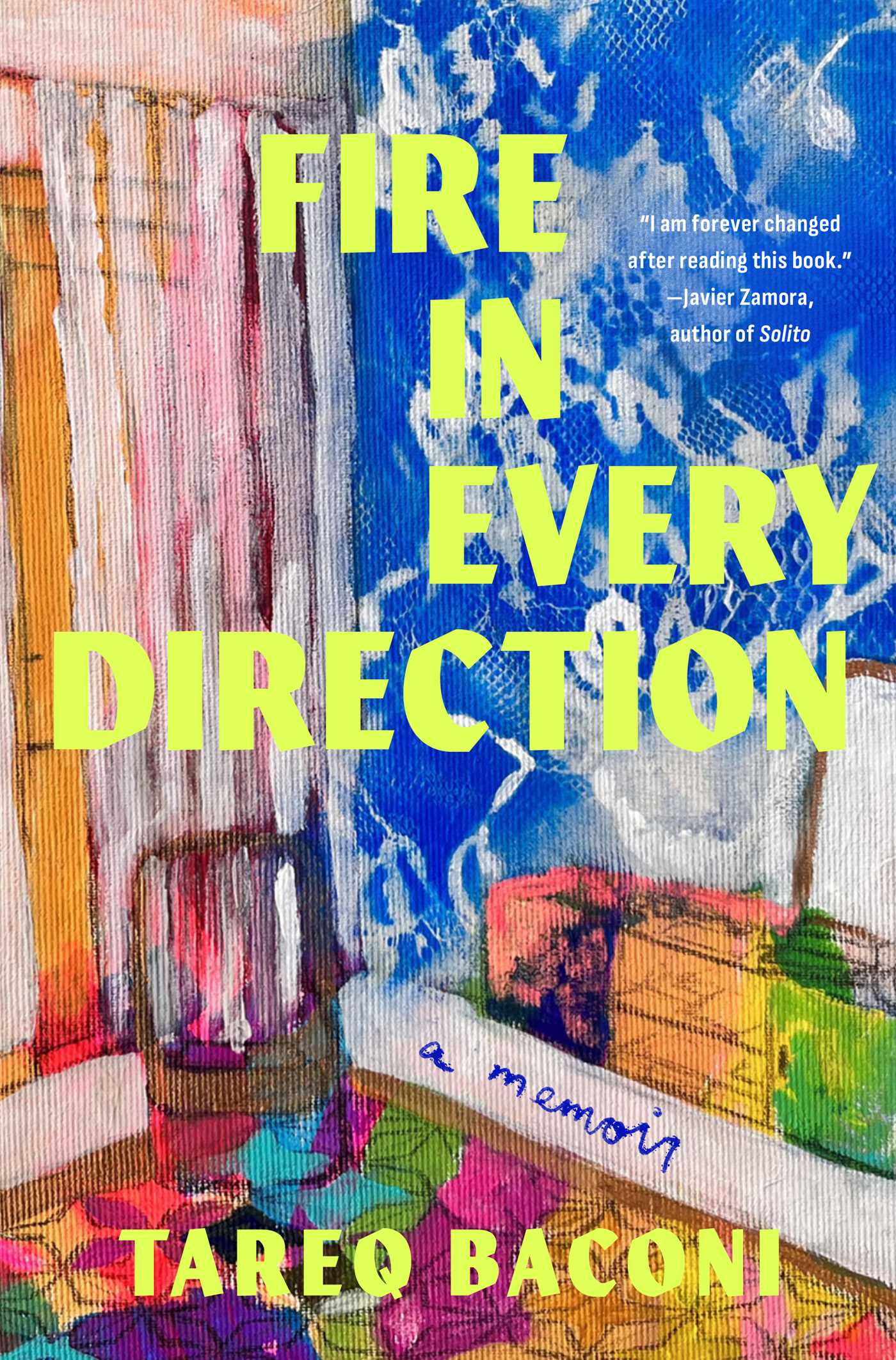
About The Book
LitHub’s Most Anticipated Books of 2025
“I am forever changed after reading this book.” —Javier Zamora, author of Solito
From the renowned Palestinian scholar, a memoir of political and queer awakening, of impossible love amidst generations of displacement, and what it means to return home.
Both a love story and a coming-of-age tale that spans countries and continents, Fire in Every Direction balances humor and loss, nostalgia and hope, as it takes us from the Middle East to London, and from 1948 to the present. Tareq Baconi crafts a deeply intimate, unforgettable portrait of how a political consciousness—desire and resistance—is passed down through generations.
In 1948, Tareq’s grandmother, Eva, would flee Haifa as Zionist militias seized the city. In the late 1970s, she would flee Beirut with her daughter, Rima, as the country was in the throes of a civil war. In Amman, the family would eventually obtain the comfort of middle class life—still, a young Tareq would feel trapped: by cultures of silence, by a sense of not belonging, by his own growing awareness that he is in love with his childhood best friend, Ramzi.
After relocating to London for college, Tareq hopes to put aside his past, and begins to work through an understanding of self as a queer man. Yet as the Iraq War radicalizes young people around the world towards anti-war protest, history comes back to him: hushed whispers overheard, stories of his mother’s years as an activist in Beirut and her return to Palestine during a moment of calm.
Living between the region and London, Tareq fits in neither and feels alienated from both. Queerness is policed back in Amman, just as his Palestinian-ness is abroad. These gradual estrangements escalate, forcing him to grapple with what it means to live in liminal spaces, and rethink the meaning of home. Eventually, tracing the journey of his family before him, Tareq returns to Palestine.
This is an account of finding oneself through histories of dispossession and reclaiming what has been silenced.
“I am forever changed after reading this book.” —Javier Zamora, author of Solito
From the renowned Palestinian scholar, a memoir of political and queer awakening, of impossible love amidst generations of displacement, and what it means to return home.
Both a love story and a coming-of-age tale that spans countries and continents, Fire in Every Direction balances humor and loss, nostalgia and hope, as it takes us from the Middle East to London, and from 1948 to the present. Tareq Baconi crafts a deeply intimate, unforgettable portrait of how a political consciousness—desire and resistance—is passed down through generations.
In 1948, Tareq’s grandmother, Eva, would flee Haifa as Zionist militias seized the city. In the late 1970s, she would flee Beirut with her daughter, Rima, as the country was in the throes of a civil war. In Amman, the family would eventually obtain the comfort of middle class life—still, a young Tareq would feel trapped: by cultures of silence, by a sense of not belonging, by his own growing awareness that he is in love with his childhood best friend, Ramzi.
After relocating to London for college, Tareq hopes to put aside his past, and begins to work through an understanding of self as a queer man. Yet as the Iraq War radicalizes young people around the world towards anti-war protest, history comes back to him: hushed whispers overheard, stories of his mother’s years as an activist in Beirut and her return to Palestine during a moment of calm.
Living between the region and London, Tareq fits in neither and feels alienated from both. Queerness is policed back in Amman, just as his Palestinian-ness is abroad. These gradual estrangements escalate, forcing him to grapple with what it means to live in liminal spaces, and rethink the meaning of home. Eventually, tracing the journey of his family before him, Tareq returns to Palestine.
This is an account of finding oneself through histories of dispossession and reclaiming what has been silenced.
Excerpt
Chapter 1
WE lived in a stone house in al-Abdali, on the seam between East and West Amman, where my parents landed after fleeing the civil war in Lebanon, privileged enough to bypass the east’s refugee camps but not yet sufficiently affluent to settle in the west. One Friday in May, after our customary chicken tikka lunch takeout, Baba turned in for his siesta and Laith and I helped Mama clear the table. Tata took Nadim, five years younger than me and then still a baby, and put him down for his nap.
“Every week the same routine,” Mama grumbled. “We never do anything exciting. There’s a whole world out there, and all he wants to do is sleep.”
Her discontent gnawed at her, whether we were out in the world or not. Laith looked at me and shrugged, then cruelly sniggered as he pointed to the raised step at the top of the tight corridor leading from the sitting room into the kitchen, where I had one day tripped and broken my arm. I shoved him as we followed Mama, placing the dishes in the sink next to where she was furiously scrubbing. “Go get dressed, boys,” she declared, as if announcing a long-planned excursion. “We’re going to Jerash to see the ruins.”
Laith had been begging for weeks to visit the film set where part of Indiana Jones was being shot. After Mama had made sure Tata would not mind staying in and watching Nadim, we left. We drove for almost an hour, north out of the city, through the hills surrounding Amman, and down to Jerash, the town nestled between the ruins of a long-lost Roman world and the ruins of ours, in the form of the largest Palestinian refugee camp in Jordan, which had sprouted right next to it. Majida al-Roumi was blasting from the radio and Mama was lost in thought. Laith and I were in the back seat, bursting with excitement over this unexpected adventure, putting our faces by the open windows as warm air gushed in. My tongue, stuck out, was dry as cardboard. We were driving on the overpass built above the entrance to the camp when Mama turned the volume down. “Look how they leave them to rot in this place,” she said, pointing to the camp. “Just look.”
Laith scooted over to my side as we both stared out the window. The buildings were haggard, brown and stained, unlike Amman’s polished limestone, and the streets denser and more cramped than other parts of the city. But I was not sure why Mama appeared so aggrieved. The scene did not look much different from al-Abdali or Amman’s downtown—generally chaotic and overcrowded. Laith must have thought the same. “What am I looking at?” he asked. “And who’s ‘they’?” I added, thinking that those people congregating in the markets that had sprung up around the mosque after Friday noon prayers looked like they were free to go anywhere they wanted. Mama glanced back at us in the rearview mirror and said nothing for a few minutes. “The big shits,” she said, as she turned the volume back up. “Men with fat asses who think they know what they’re doing.” I giggled as Laith—five years older than me and thinking himself an adult—leaned over to the front seat and tapped Mama on the shoulder. “Mama,” he whispered in her ear, “you can’t say ‘shit’ in front of Tareq!”
That was the spring of my fifth or sixth birthday, days before Jerash’s annual summer festival was set to begin. We arrived in that part of the afternoon reserved for slumber—when the midday sun had not yet cooled enough to entice anyone out of their homes, and those who had ventured out carried themselves lethargically. We entered the ancient city through the Arch of Hadrian and walked into the esplanade that led to the grand Oval Forum, an expanse which gave a sense of the vast scale of the once-thriving metropolis. Merchants were setting up their stalls around the perimeter of the central courtyard in preparation for the throngs who would descend come dusk and stay late into the night.
We crossed the forum and strolled along the corridor lined with Corinthian columns, all the way to the Temple of Artemis. The vanilla-colored boulders carpeting the floor were like an obstacle course, uneven and scattered. Apart from two or three sweaty tourists, with cameras dangling around their necks and sizable backpacks on their shoulders, we were the only people walking in the heat. The film set that Laith was after had been constructed on that main corridor, and here, more people, mostly foreigners, were milling about. Laith got swallowed up by the crowd. Mama and I stood close by to watch. Even though the energy was frenzied, not much appeared to be happening, and I lost what little interest I had, becoming distracted, restless, my mind fixating on the market stalls we would walk through on the way back, heaving, I anticipated, with mounds of toys.
The sun was low by the time we returned to the Oval Forum and reentered a space that had, in the short span of time we were on set, somehow morphed from an imposing, majestic Roman arena into a bustling market resembling the one we had driven by on the way to Jerash. The smell of chestnuts and roasted peanuts wafted through the air and mingled with the steam from tubs of boiling water cooking sweet corn. “Lemons, grapes, oranges, grapefruits!” Merchants were shouting, riffing off one another and adding to the din of the gathering crowds. “Kitchen supplies, cooking utensils, bargains to be had!” Stalls piled high with fresh fruit and vegetables from the surrounding valleys had been set up next to others with stacks of socks and underwear, spices, and kitchenware. Shoppers had begun congregating in the market, haggling as they walked through. Arabic pop songs blasted from speakers that DJs had hung on the intricately carved crowns of the columns, which had been lit in purple, blue, and yellow. The space had a carnival-like atmosphere and I knew, before she said anything, that Mama would be itching to leave within seconds.
“We should head back,” she said, on cue. “Baba will be waking up soon.” My eyes scanned the stalls. It was the sparkle that caught my attention. I pulled Mama aside and into an alley. Tucked between rows of merchandise, dolls had been hung from the iron metal bars holding up one shop front. They were much larger than normal, more figurines than dolls—almost half my size and dressed in the most grotesque outfits. Mounds and mounds of chiffon and sponge-like material had been stitched around their waists to create bell-curve gowns that fell as almost perfect circles around their legs. The dolls had round, painted faces and their eyes were large and maniacal. Glittering beads had been sewn onto the gowns and the dolls had tiaras attached, glue visible, to their heads. The fabrics were washed-out pastel colors: light green, pink, and blue.
I latched on to an orange-brown one, transfixed, barely registering Mama’s halfhearted attempts to nudge me to move on. “Come, let’s go. We need to head home. Baba will be asking for us.” Her efforts were futile; within seconds, the doll and I had become inseparable, destined to be together. Mama shook her head and turned to the vendor, an elderly man who offered an amused smile and a shrug of his shoulders. Defeated, she made the payment and walked away from the stall, with me and Laith in tow. I held on to my precious companion, her small, plastic hand in mine, fretting that her outfit might be crushed by the crowd. We made our way out of the market toward the North Amphitheater, where the stage was being set for an opera. Before walking to our car, we sat on one of the bottom steps for a brief rest. I made sure my doll had a comfortable position on the hard stone next to me and glanced up with satisfaction. The look Mama and Laith gave me was one I would become intimately familiar with. It was a look not unsettling enough to upset me, yet not so innocuous as to be forgotten either.
1
WE lived in a stone house in al-Abdali, on the seam between East and West Amman, where my parents landed after fleeing the civil war in Lebanon, privileged enough to bypass the east’s refugee camps but not yet sufficiently affluent to settle in the west. One Friday in May, after our customary chicken tikka lunch takeout, Baba turned in for his siesta and Laith and I helped Mama clear the table. Tata took Nadim, five years younger than me and then still a baby, and put him down for his nap.
“Every week the same routine,” Mama grumbled. “We never do anything exciting. There’s a whole world out there, and all he wants to do is sleep.”
Her discontent gnawed at her, whether we were out in the world or not. Laith looked at me and shrugged, then cruelly sniggered as he pointed to the raised step at the top of the tight corridor leading from the sitting room into the kitchen, where I had one day tripped and broken my arm. I shoved him as we followed Mama, placing the dishes in the sink next to where she was furiously scrubbing. “Go get dressed, boys,” she declared, as if announcing a long-planned excursion. “We’re going to Jerash to see the ruins.”
Laith had been begging for weeks to visit the film set where part of Indiana Jones was being shot. After Mama had made sure Tata would not mind staying in and watching Nadim, we left. We drove for almost an hour, north out of the city, through the hills surrounding Amman, and down to Jerash, the town nestled between the ruins of a long-lost Roman world and the ruins of ours, in the form of the largest Palestinian refugee camp in Jordan, which had sprouted right next to it. Majida al-Roumi was blasting from the radio and Mama was lost in thought. Laith and I were in the back seat, bursting with excitement over this unexpected adventure, putting our faces by the open windows as warm air gushed in. My tongue, stuck out, was dry as cardboard. We were driving on the overpass built above the entrance to the camp when Mama turned the volume down. “Look how they leave them to rot in this place,” she said, pointing to the camp. “Just look.”
Laith scooted over to my side as we both stared out the window. The buildings were haggard, brown and stained, unlike Amman’s polished limestone, and the streets denser and more cramped than other parts of the city. But I was not sure why Mama appeared so aggrieved. The scene did not look much different from al-Abdali or Amman’s downtown—generally chaotic and overcrowded. Laith must have thought the same. “What am I looking at?” he asked. “And who’s ‘they’?” I added, thinking that those people congregating in the markets that had sprung up around the mosque after Friday noon prayers looked like they were free to go anywhere they wanted. Mama glanced back at us in the rearview mirror and said nothing for a few minutes. “The big shits,” she said, as she turned the volume back up. “Men with fat asses who think they know what they’re doing.” I giggled as Laith—five years older than me and thinking himself an adult—leaned over to the front seat and tapped Mama on the shoulder. “Mama,” he whispered in her ear, “you can’t say ‘shit’ in front of Tareq!”
That was the spring of my fifth or sixth birthday, days before Jerash’s annual summer festival was set to begin. We arrived in that part of the afternoon reserved for slumber—when the midday sun had not yet cooled enough to entice anyone out of their homes, and those who had ventured out carried themselves lethargically. We entered the ancient city through the Arch of Hadrian and walked into the esplanade that led to the grand Oval Forum, an expanse which gave a sense of the vast scale of the once-thriving metropolis. Merchants were setting up their stalls around the perimeter of the central courtyard in preparation for the throngs who would descend come dusk and stay late into the night.
We crossed the forum and strolled along the corridor lined with Corinthian columns, all the way to the Temple of Artemis. The vanilla-colored boulders carpeting the floor were like an obstacle course, uneven and scattered. Apart from two or three sweaty tourists, with cameras dangling around their necks and sizable backpacks on their shoulders, we were the only people walking in the heat. The film set that Laith was after had been constructed on that main corridor, and here, more people, mostly foreigners, were milling about. Laith got swallowed up by the crowd. Mama and I stood close by to watch. Even though the energy was frenzied, not much appeared to be happening, and I lost what little interest I had, becoming distracted, restless, my mind fixating on the market stalls we would walk through on the way back, heaving, I anticipated, with mounds of toys.
The sun was low by the time we returned to the Oval Forum and reentered a space that had, in the short span of time we were on set, somehow morphed from an imposing, majestic Roman arena into a bustling market resembling the one we had driven by on the way to Jerash. The smell of chestnuts and roasted peanuts wafted through the air and mingled with the steam from tubs of boiling water cooking sweet corn. “Lemons, grapes, oranges, grapefruits!” Merchants were shouting, riffing off one another and adding to the din of the gathering crowds. “Kitchen supplies, cooking utensils, bargains to be had!” Stalls piled high with fresh fruit and vegetables from the surrounding valleys had been set up next to others with stacks of socks and underwear, spices, and kitchenware. Shoppers had begun congregating in the market, haggling as they walked through. Arabic pop songs blasted from speakers that DJs had hung on the intricately carved crowns of the columns, which had been lit in purple, blue, and yellow. The space had a carnival-like atmosphere and I knew, before she said anything, that Mama would be itching to leave within seconds.
“We should head back,” she said, on cue. “Baba will be waking up soon.” My eyes scanned the stalls. It was the sparkle that caught my attention. I pulled Mama aside and into an alley. Tucked between rows of merchandise, dolls had been hung from the iron metal bars holding up one shop front. They were much larger than normal, more figurines than dolls—almost half my size and dressed in the most grotesque outfits. Mounds and mounds of chiffon and sponge-like material had been stitched around their waists to create bell-curve gowns that fell as almost perfect circles around their legs. The dolls had round, painted faces and their eyes were large and maniacal. Glittering beads had been sewn onto the gowns and the dolls had tiaras attached, glue visible, to their heads. The fabrics were washed-out pastel colors: light green, pink, and blue.
I latched on to an orange-brown one, transfixed, barely registering Mama’s halfhearted attempts to nudge me to move on. “Come, let’s go. We need to head home. Baba will be asking for us.” Her efforts were futile; within seconds, the doll and I had become inseparable, destined to be together. Mama shook her head and turned to the vendor, an elderly man who offered an amused smile and a shrug of his shoulders. Defeated, she made the payment and walked away from the stall, with me and Laith in tow. I held on to my precious companion, her small, plastic hand in mine, fretting that her outfit might be crushed by the crowd. We made our way out of the market toward the North Amphitheater, where the stage was being set for an opera. Before walking to our car, we sat on one of the bottom steps for a brief rest. I made sure my doll had a comfortable position on the hard stone next to me and glanced up with satisfaction. The look Mama and Laith gave me was one I would become intimately familiar with. It was a look not unsettling enough to upset me, yet not so innocuous as to be forgotten either.
About The Author
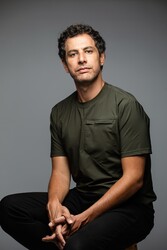
Photograph by Anastasia Casey
Tareq Baconi is a Palestinian writer, scholar, and activist. He is the grandson of refugees from Jerusalem and Haifa and grew up between Amman and Beirut. His work has appeared in, among others, The New York Times and The Baffler, and he contributes essays to The New York Review of Books and the London Review of Books. He has also written for film; his award-winning BFI short One Like Him, a queer love story set in Jordan, screened in over thirty festivals. He is the author of What Now, Hamas Contained: A History of Palestinian Resistance, which was shortlisted for the Palestine Book Award, and Fire in Every Direction.
Product Details
- Publisher: Washington Square Press (November 4, 2025)
- Length: 256 pages
- ISBN13: 9781668068564
Browse Related Books
Raves and Reviews
"Acclaimed scholar and analyst Baconi chronicles his coming of age as a young gay man and defiant Palestinian. A brilliant and wrenching tale of personal and political awakening."
—Booklist (starred review)
"Lyrical and moving, Baconi's excellent memoir describes a people in real danger of being forgotten as well as a land where hope sstreaddles walls."
—Library Journal
"In this poignant autobiography, queer Palestinian writer and activist Baconi tenderly explores identity, nationality, and family history [....] With lyrical prose and shrewd narrative instincts, Baconi transmutes hardship into comfort. Readers will find it difficult not to be moved."
—Publishers Weekly
"Intimate and vulnerable, creating an unsparing portrait...for all the tragedies, however, it is ultimately a book filled with love, from and for his own family, for the region, Palestine and queer culture."
—The Guardian
"It is difficult to read Tareq Baconi’s intimate, mesmerizing meditation on dispossession and not think about how much safer it would have been to not write a book like this, to leave a dangerous past undisturbed. In stunning detail—both physical and emotional—Baconi traces a story of personal and communal alienation, longing, and liberation. Drawn here in beautiful, crushing clarity is an account of what systems of degradation, fear and theft can do to a person, a society, a world. That Baconi has managed to do all this in a memoir that still feels so firmly rooted in love is a marvel. Fire in Every Direction is a marvel."
—Omar El Akkad, New York Times bestselling author of One Day, Everyone Will Have Always Been Against This
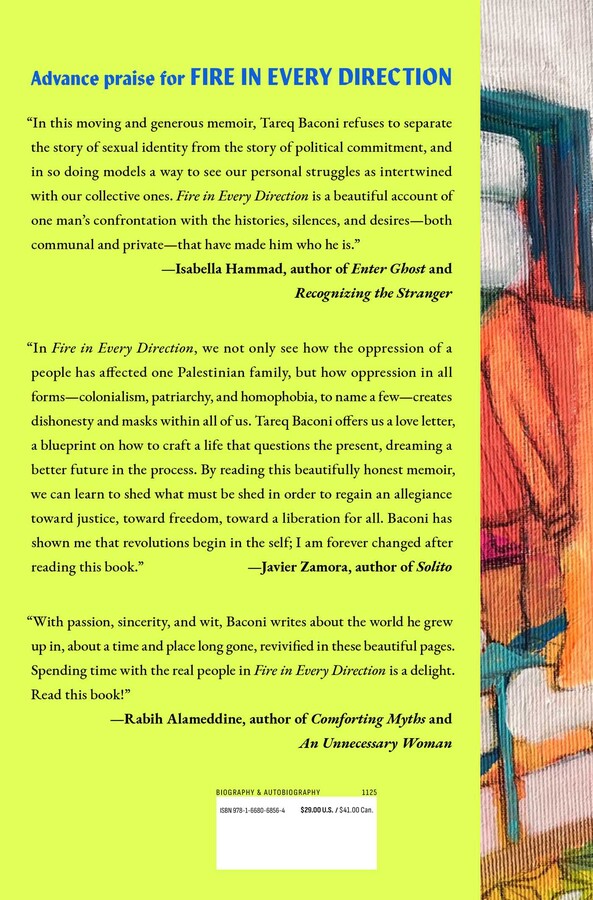
“In this moving and generous memoir, Tareq Baconi refuses to separate the story of sexual identity from the story of political commitment, and in so doing models a way to see our personal struggles as intertwined with our collective ones. Fire in Every Direction is a beautiful account of one man's confrontation with the histories, silences, and desires—both communal and private—that have made him who he is.”
—Isabella Hammad, author of Enter Ghost and Recognizing the Stranger
"In this poignant autobiography, queer Palestinian writer and activist Baconi tenderly explores identity, nationality, and family history."
—The Millions
"I love this book. It is beautifully woven and registers acutely at the intimate and global levels of life."
—Judith Butler, bestselling author of Who's Afraid of Gender
"In Fire in Every Direction, we not only see how the oppression of a people has affected one Palestinian family, but how oppression in all forms—colonialism, patriarchy, homophobia, to name a few—creates dishonesty and masks within all of us. Tareq Baconi offers us a love letter, a blueprint on how to craft a life that questions the present, dreaming a better future in the process. By reading this beautifully honest memoir, we can learn to shed what must be shed in order to regain an allegiance toward justice, toward freedom, toward a liberation for all. Baconi has shown me that revolutions begin in the self; I am forever changed after reading this book."—Javier Zamora, author of Solito
"In a time when it can feel like language has been stripped of meaning and words have lost all power, Fire in Every Direction arrives as an affirmation and a refusal of silence. Luminous, moving, and achingly beautiful, every page of this book is guided by Tareq Baconi's fierce intelligence and a tenderness that this world does not deserve. You do not read this book to repair your heart, you read this book to understand the fissures."
—Maaza Mengiste, author of The Shadow King
"Outstanding...I found the blend between the personal and political to be very cleverly achieved. A brilliant book."
—Raja Shehadeh, author of We Could Have Been Friends, My Father and I
“A powerful memoir of queer and Palestinian reckoning. Tareq Baconi creates 'a gaze of our own' by bringing his open heart to a tough confrontation with histories both intimate and diasporic. An important contribution to our many literatures.”
—Sarah Schulman, author of The Fantasy and Necessity of Solidarity
"With passion, sincerity, and wit, Baconi writes about the world he grew up in, about a time and place long gone, revivified in these beautiful pages. Spending time with the real people in Fire in Every Direction is a delight. Read this book!"
—Rabih Alameddine, author of Comforting Myths and An Unnecessary Woman
"With eloquence, passion, and insight, Tareq Baconi weaves his personal story as a queer kid growing up in the refugee community in Jordan, into the larger narrative of his family’s dislocation, and the Palestinian struggle. In so doing, he gives new meaning to the concept of liberation, personal and political. Fire in Every Direction is a primarily a love story: about how one learns to overcome loss—of a homeland, of a beloved—due to the interventions of authorities, be they parents or conquerors. It is a deeply inspiring and absorbing read, especially in these times."
—Mark Gevisser, author of The Pink Line
Resources and Downloads
High Resolution Images
-
Book Cover Image (jpg): Fire in Every Direction
Hardcover 9781668068564
-
Author Photo (jpg): Tareq Baconi Photograph by Anastasia Casey(0.1 MB)
Any use of an author photo must include its respective photo credit
Join our mailing list!
By clicking 'Sign me up' I acknowledge that I have read and agree to the privacy policy and terms of use.