
Get our latest staff recommendations, award news and digital catalog links right to your inbox.
Table of Contents
About The Book
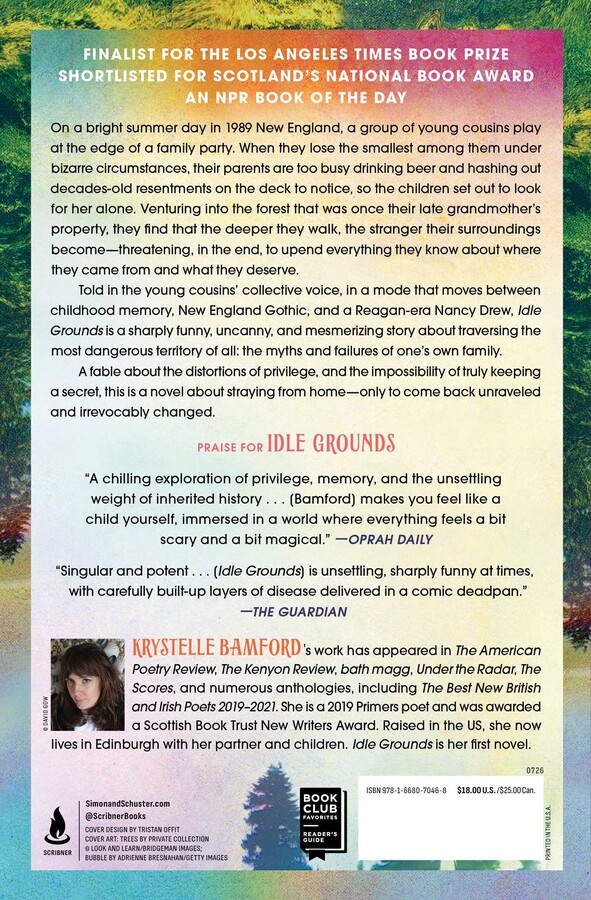
Finalist for the Los Angeles Times Book Award for First Fiction
Finalist for Scotland’s National Book Award for Debut Fiction
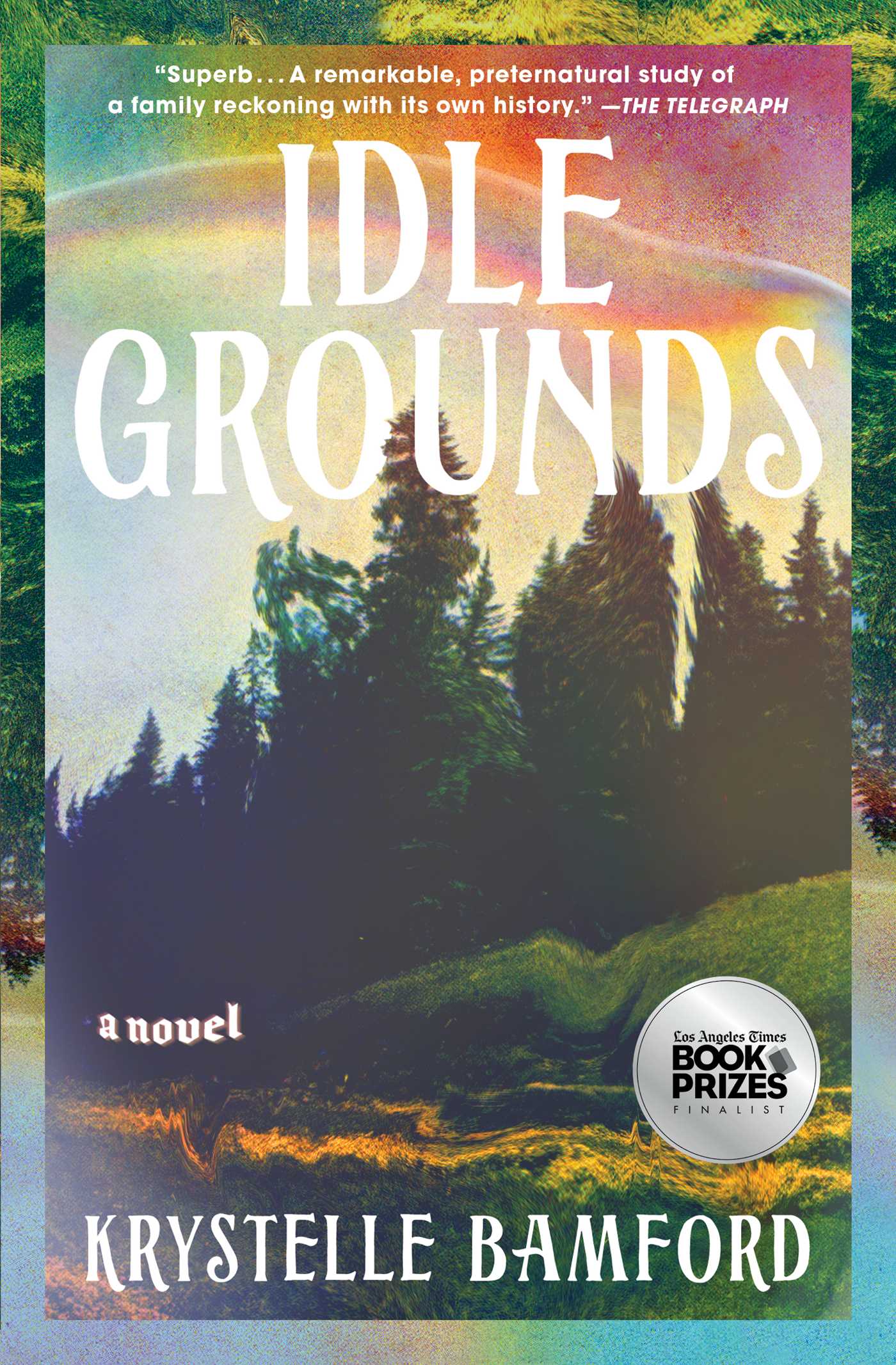
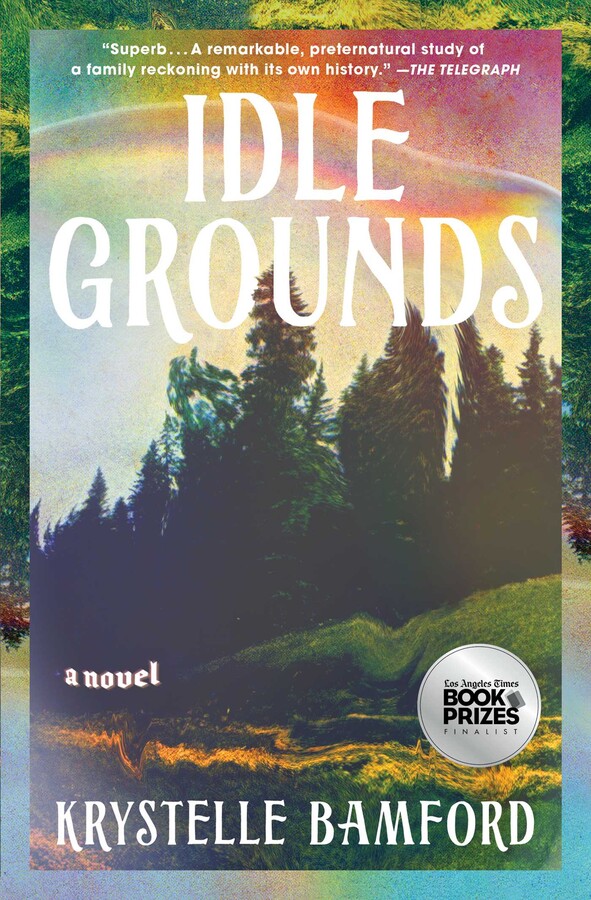
“This debut novel is superb. Idle Grounds is a remarkable, preternatural study of a family reckoning with its own history … Bamford’s arresting novel briefly unveils the strangeness [of childhood] once again.” —The Telegraph
In this mesmerizing, sharply funny story about a family in decline, set in 1989 New England, a group of young cousins wander deep into the woods their grandparents once owned—finding that the farther they go, the stranger their surroundings become.
As always with these things it started with a birthday party.
Lingering at the edge of a family party, a troop of cousins loses track of the youngest child among them. With their parents preoccupied with bickering about decades-old crises, the children decide to investigate themselves—to the rickety chicken coop, the barn and its two troublesome horses, and into the woods that once comprised their late grandmother’s property. The more the children search, and the deeper they walk, the more unsettling the woods become and the more lost they are, caught between their aunt’s home in the present day, their parents’ childhood home just through the trees, and the memory of the house their grandmother grew up in. Soon, what began as a quest for answers gives way to a journey that undermines everything they’ve been told about who they are, where they came from, and what they deserve.
Told in the young cousins’ collective voice, in a mode that moves between childhood memory, New England Gothic, and a Reagan-era Nancy Drew, Idle Grounds is an “unsettling and sharply funny” (The Guardian) exploration of the interior lives of children and a gripping meditation on birthright, decline, and the weight of family history. A fable of the distortions of privilege and the impossibility of keeping secrets hidden, this is a novel about straying from home—only to come back unraveled, unsettled, and irrevocably changed.
Finalist for Scotland’s National Book Award for Debut Fiction
“This debut novel is superb. Idle Grounds is a remarkable, preternatural study of a family reckoning with its own history … Bamford’s arresting novel briefly unveils the strangeness [of childhood] once again.” —The Telegraph
In this mesmerizing, sharply funny story about a family in decline, set in 1989 New England, a group of young cousins wander deep into the woods their grandparents once owned—finding that the farther they go, the stranger their surroundings become.
As always with these things it started with a birthday party.
Lingering at the edge of a family party, a troop of cousins loses track of the youngest child among them. With their parents preoccupied with bickering about decades-old crises, the children decide to investigate themselves—to the rickety chicken coop, the barn and its two troublesome horses, and into the woods that once comprised their late grandmother’s property. The more the children search, and the deeper they walk, the more unsettling the woods become and the more lost they are, caught between their aunt’s home in the present day, their parents’ childhood home just through the trees, and the memory of the house their grandmother grew up in. Soon, what began as a quest for answers gives way to a journey that undermines everything they’ve been told about who they are, where they came from, and what they deserve.
Told in the young cousins’ collective voice, in a mode that moves between childhood memory, New England Gothic, and a Reagan-era Nancy Drew, Idle Grounds is an “unsettling and sharply funny” (The Guardian) exploration of the interior lives of children and a gripping meditation on birthright, decline, and the weight of family history. A fable of the distortions of privilege and the impossibility of keeping secrets hidden, this is a novel about straying from home—only to come back unraveled, unsettled, and irrevocably changed.
Excerpt
Chapter One: Initial Sighting CHAPTER ONE INITIAL SIGHTING
As always with these things it started with a birthday party. What you should probably know is that the day was bright and clean even though it was summertime, which was malarial at best most years but this year it wasn’t.
As I said, it was bright and clean.
An aunt with yellow, highly styled hair had baked a cake, also yellow, with sugar confetti. It was a boxed cake rather than a homemade one as those are a variable lot and not to be trusted. Her name was Frankie. It was Frankie’s house but not Frankie’s birthday because she wouldn’t have baked her own cake even if it was just from a box, nor would she have hosted her own party as it takes a special kind of person to do that and Frankie was just ordinary in a hysterical, wet-eyed kind of way. She was unmarried and also the only Republican in the family as far as we knew.
It was one of the grown-ups’ birthdays; it doesn’t matter. What matters is that we were all together, which everyone seemed to dread and anticipate in equal measure. Cars and cars and cars rolled up Frankie’s blue gravel drive and every last one of them nosed forward the last few feet and you just knew they were saying something like “Well, here we are!”
Cousins stuck their legs out from the car doors, always the children first, parents girding their loins behind the steering wheels.
“It’s eleven now, we’re out of here by three,” our parents said, a fount of shaky determination, “three at the latest.”
Cousins eyed up cousins, standing a full cousin-length away, giving a shy wave while the adults eased themselves out with a dish covered in tinfoil or a six-pack of Beck’s tinkling like a piggy bank.
“Stay up here, okay? Up where we can hear you.”
Chickens hopped around on hostile yellow legs. Bug spray was passed along, hot dogs were sliced from their packaging. Hummingbirds appeared at the feeder, fed, vanished.
Frankie had built the house herself. She’d built it so far back from the road that you forgot leaving was an option. Though technically within the borders of the town where most of us lived, Frankie’s house was really in horse country, and although it was only ten minutes in the car from the elementary school, horse country had hardly any people in it. Instead it was full of split-rail fences and birch and pine woods and a few old houses landed like dice rolling way off the playing board into their own shaded grottoes forever.
It was very pretty.
The house’s back deck dropped away into a sloping pasture in which Frankie kept two horses whose names, it seemed, were always changing. Beyond the pasture with the horses was the bulk of the woods, which tumbled downward to a river which was mentioned sometimes but never as a destination. The river was, as far as we knew, the boundary of the family property.
On the wall of Frankie’s dining room she had copies of oil paintings of hunting parties or that’s what we guessed anyway because of their red coats and trumpets. The horses looked absolutely panicked, the people on their backs panicked too but in a more focused way. No one ever ate in there, Frankie’s dining room. We just passed through it on our way out to the deck, or from the deck into the dark of the house to use the bathroom or get ourselves a glass of water or fetch something from our parents’ coat pockets. Once the adults had drinks in their hands everyone relaxed. Back then the bottles were green for the most part and in the sun they looked unbelievably expensive, like they were carved from something you had to excavate and polish.
Anyway what I’ve established, I hope you’ll agree, is that it was a beautiful day and there was no reason for what happened to happen. Nothing propulsive in the atmosphere or setting. The adults were talking about many things, they had known each other for so long the conversation just rowed across the surface of the water like this:
“Reagan is worse. Mom would have loved him though.”
“Mom would have left Dad for Reagan if Dad hadn’t left first, no question.”
“Reagan would have loved Mom.”
“She would have died before voting for him though.”
“Yes. Do you remember when—”
It was interesting in that we were excluded entirely but after a while we got restless and went inside, where there were some more of us sitting on the steps that went up to the bathroom and bedrooms and this lot was talking among themselves like birds before they fly off in one jaggy but coordinated movement. There were ten of us cousins give or take and the tallest and also the oldest one was Travis. He was twelve. He looked at us with his long, swinging jaw, trying to weigh us up. Time had passed since the last time we’d all been together, his face said, but blood was blood.
“Do you guys want to see something?”
Yes, we said. We always want to see something.
We all went up the stairs together. The wallpaper had both stripes and flowers so either the flowers seemed caged or the stripes looked like they had some kind of bacterial infection.
“Okay”—Travis pressed his finger against the screen of the bathroom window—“look.”
What we were looking at was Frankie’s front yard and drive with our parents’ cars and then beyond that, at the far-left periphery of our vision, a shed with Frankie’s tools and behind it the band of woods that separated Frankie’s house from her neighbor’s house, which used to be the house they all grew up in, our parents that is, their childhood home.
“Just watch.”
It was funny because even though we’d been to Frankie’s many times, our parents had never really mentioned the childhood home. It was there under a weight of trees like a bug under a rock and so we’d never given it a second thought. Until Frankie told us, we hadn’t even known they’d lived there, but here’s what we did know: sometimes our grandmother Beezy had whumped them with a switch cut from a blackberry bush.
We watched. If Travis weren’t so tall and old we would have given up watching but he pressed his finger against the screen so hard it turned violet-white and then we saw it. One of the flock from the stairs gave a little moan.
“What is it?”
“Shh.” It was certain Travis’s finger would be grated right down to the knuckle. The blond prow of his hair nosed against the screen.
At first it was just a movement, like when you close your eyes in the sun and things jump about. From the wall of trees hiding the childhood home to Frankie’s shed. A ten-yard dash.
“What is it?”
“Shhhh—”
Oh, it was fast, you had to give it that. So fast you just knew that whatever it was it didn’t want to be seen, but the thing is, we had seen it.
“There!” Travis was in a special school.
One of the little ones was standing on the toilet seat and nearly toppled onto the rest of us below but Travis hardly noticed. His whole body was like when you rub a balloon on your hair. At Travis’s school there weren’t any desks, just beanbags, and a robotics lab and a theater where you could sit all around the stage so no one ever needed to feel left out. The Macalasters’ kitchen was filled with mugs with the school’s motto on them, which was the words nostra sponte underneath a shield with animals and plants. It was costing his parents the earth.
Frankie’s yard was still in the sun, pinned down by the heat. Directly below us in spitting range there was a statue of a pop-eyed jockey with his face painted bright paintbox pink that our parents hated, just get rid of that thing oh my god in this day and age. He stood at the source of the blue gravel drive holding a lantern, which must have been intended for someone else—he had no use for it himself—out toward Frankie’s shed and the thicket of pines with the childhood home lost somewhere behind it and this thing moving so fast, the size of a big cat, 15 percent bigger than a big cat.
Last Thanksgiving Travis’s mother, Aunt Maureen, had slapped Frankie across the face. We were all there at Aunt Maureen’s but we hadn’t really been paying much attention until the moments just before the slap, which was so hard we felt slapped ourselves. Frankie had cried and smiled at the same time and Aunt Maureen had said, “Sorry, I’m sorry,” over and over again until someone took her into the other room and no one saw her until board games later that night, where she didn’t play but just sat there, Travis’s dad rubbing her back in circles.
Zip zip zip. From the tree line to the shed but not back again, that was the part we couldn’t figure out, it was just ever in one direction. You could be excused for thinking that meant it was many different things running to the shed but we just knew it was the same thing over and over, which was worse, somehow, even though it should have been better that there was only just one.
The door rattled splenetically at our backs but it was just an aunt-by-marriage, needing to pee.
“What are you all doing in here?” she said and we shrugged.
“Come on,” Travis said in his quietest voice and crooked his finger toward Frankie’s bedroom.
Frankie’s bedroom had a thick aquamarine-ish carpet and potted ferns and a statue of a woman made of white marble, no bigger than the smallest of us. Her face was like “O!” and she was so soft-looking you might want to run your hands all over the stone except for the snake that wove itself around the folds of her body. Its head reared back at a vicious angle which let you know that it was a biting snake as opposed to, say, a talking one. Otherwise it was a quiet room, full of pet hair.
We crowded to the window.
We didn’t know what to hope for, thing or nothing. Thing meant that our day, only somewhat extraordinary, would become truly remarkable, but it would also mean that whatever else we feared—a woman sewing us into our beds while we were asleep, for example—was possible even if it wasn’t probable. It opened things up in ways both surprising and permanent. Nothing, on the other hand, meant that we would need to go downstairs eventually and get ourselves a 7UP, start thinking about the 9 times tables or something along those lines. That or listen to our parents, who always ended up talking about one thing, which was what had happened with our grandmother Beezy and who was responsible and what the roots of it were and who was responsible for the roots. Everyone with invisible pickaxes and miner’s lights and dirt all over the place. Shining lights into each other’s faces, getting careless with their pickaxes the more they drank, not being mindful of the dirt or who got dirty.
We heard our aunt flush next door and just as we all looked at the sound there it was, like it sensed we were distracted, zip!
It was clever. It already thought it knew us well.
And it was just then, sparked by the flush, that the littlest one, whose name was Abi, made a break for it. Abi was Travis’s sister and she was nice, you could tell even though she was only three, the type who kissed your elbow when you weren’t looking. She’d always been that way. The other thing about Abi is that she had a purple cast on her wrist, on which someone had done a tic-tac-toe, and her pigtails stood straight up from her head, which made her look like a satellite floating in space and gave her an aura of alert melancholy. She still took naps in the afternoon but when she was awake she was everywhere. In many ways she was the best of us.
Abi was out the door and, we had to presume, down the stairs, but honestly here is what it looked like: when she rounded the corner and out of sight it looked like the house moved toward her rather than, you know, the other way around. It looked like the house just jumped and snuffed her out.
Travis reached toward where she’d been and called “Abi!” and what was funny is that he was scared for no reason. You could tell that he was really terrified. We all were. The house spasmed, then sat back.
“Hey, Abi!”
But Abi was gone as if she’d never been there at all and there was nothing we could do so eventually we resumed watching the stretch between the shed and the tree line which shielded our parents’ childhood home and it was our stretch now, whether we wanted it or not, and even from Frankie’s bedroom we could feel the warmth of the springy soil coming up through our soles. We felt the sky was preternaturally blue but otherwise, otherwise the day was bright and clean.
As always with these things it started with a birthday party. What you should probably know is that the day was bright and clean even though it was summertime, which was malarial at best most years but this year it wasn’t.
As I said, it was bright and clean.
An aunt with yellow, highly styled hair had baked a cake, also yellow, with sugar confetti. It was a boxed cake rather than a homemade one as those are a variable lot and not to be trusted. Her name was Frankie. It was Frankie’s house but not Frankie’s birthday because she wouldn’t have baked her own cake even if it was just from a box, nor would she have hosted her own party as it takes a special kind of person to do that and Frankie was just ordinary in a hysterical, wet-eyed kind of way. She was unmarried and also the only Republican in the family as far as we knew.
It was one of the grown-ups’ birthdays; it doesn’t matter. What matters is that we were all together, which everyone seemed to dread and anticipate in equal measure. Cars and cars and cars rolled up Frankie’s blue gravel drive and every last one of them nosed forward the last few feet and you just knew they were saying something like “Well, here we are!”
Cousins stuck their legs out from the car doors, always the children first, parents girding their loins behind the steering wheels.
“It’s eleven now, we’re out of here by three,” our parents said, a fount of shaky determination, “three at the latest.”
Cousins eyed up cousins, standing a full cousin-length away, giving a shy wave while the adults eased themselves out with a dish covered in tinfoil or a six-pack of Beck’s tinkling like a piggy bank.
“Stay up here, okay? Up where we can hear you.”
Chickens hopped around on hostile yellow legs. Bug spray was passed along, hot dogs were sliced from their packaging. Hummingbirds appeared at the feeder, fed, vanished.
Frankie had built the house herself. She’d built it so far back from the road that you forgot leaving was an option. Though technically within the borders of the town where most of us lived, Frankie’s house was really in horse country, and although it was only ten minutes in the car from the elementary school, horse country had hardly any people in it. Instead it was full of split-rail fences and birch and pine woods and a few old houses landed like dice rolling way off the playing board into their own shaded grottoes forever.
It was very pretty.
The house’s back deck dropped away into a sloping pasture in which Frankie kept two horses whose names, it seemed, were always changing. Beyond the pasture with the horses was the bulk of the woods, which tumbled downward to a river which was mentioned sometimes but never as a destination. The river was, as far as we knew, the boundary of the family property.
On the wall of Frankie’s dining room she had copies of oil paintings of hunting parties or that’s what we guessed anyway because of their red coats and trumpets. The horses looked absolutely panicked, the people on their backs panicked too but in a more focused way. No one ever ate in there, Frankie’s dining room. We just passed through it on our way out to the deck, or from the deck into the dark of the house to use the bathroom or get ourselves a glass of water or fetch something from our parents’ coat pockets. Once the adults had drinks in their hands everyone relaxed. Back then the bottles were green for the most part and in the sun they looked unbelievably expensive, like they were carved from something you had to excavate and polish.
Anyway what I’ve established, I hope you’ll agree, is that it was a beautiful day and there was no reason for what happened to happen. Nothing propulsive in the atmosphere or setting. The adults were talking about many things, they had known each other for so long the conversation just rowed across the surface of the water like this:
“Reagan is worse. Mom would have loved him though.”
“Mom would have left Dad for Reagan if Dad hadn’t left first, no question.”
“Reagan would have loved Mom.”
“She would have died before voting for him though.”
“Yes. Do you remember when—”
It was interesting in that we were excluded entirely but after a while we got restless and went inside, where there were some more of us sitting on the steps that went up to the bathroom and bedrooms and this lot was talking among themselves like birds before they fly off in one jaggy but coordinated movement. There were ten of us cousins give or take and the tallest and also the oldest one was Travis. He was twelve. He looked at us with his long, swinging jaw, trying to weigh us up. Time had passed since the last time we’d all been together, his face said, but blood was blood.
“Do you guys want to see something?”
Yes, we said. We always want to see something.
We all went up the stairs together. The wallpaper had both stripes and flowers so either the flowers seemed caged or the stripes looked like they had some kind of bacterial infection.
“Okay”—Travis pressed his finger against the screen of the bathroom window—“look.”
What we were looking at was Frankie’s front yard and drive with our parents’ cars and then beyond that, at the far-left periphery of our vision, a shed with Frankie’s tools and behind it the band of woods that separated Frankie’s house from her neighbor’s house, which used to be the house they all grew up in, our parents that is, their childhood home.
“Just watch.”
It was funny because even though we’d been to Frankie’s many times, our parents had never really mentioned the childhood home. It was there under a weight of trees like a bug under a rock and so we’d never given it a second thought. Until Frankie told us, we hadn’t even known they’d lived there, but here’s what we did know: sometimes our grandmother Beezy had whumped them with a switch cut from a blackberry bush.
We watched. If Travis weren’t so tall and old we would have given up watching but he pressed his finger against the screen so hard it turned violet-white and then we saw it. One of the flock from the stairs gave a little moan.
“What is it?”
“Shh.” It was certain Travis’s finger would be grated right down to the knuckle. The blond prow of his hair nosed against the screen.
At first it was just a movement, like when you close your eyes in the sun and things jump about. From the wall of trees hiding the childhood home to Frankie’s shed. A ten-yard dash.
“What is it?”
“Shhhh—”
Oh, it was fast, you had to give it that. So fast you just knew that whatever it was it didn’t want to be seen, but the thing is, we had seen it.
“There!” Travis was in a special school.
One of the little ones was standing on the toilet seat and nearly toppled onto the rest of us below but Travis hardly noticed. His whole body was like when you rub a balloon on your hair. At Travis’s school there weren’t any desks, just beanbags, and a robotics lab and a theater where you could sit all around the stage so no one ever needed to feel left out. The Macalasters’ kitchen was filled with mugs with the school’s motto on them, which was the words nostra sponte underneath a shield with animals and plants. It was costing his parents the earth.
Frankie’s yard was still in the sun, pinned down by the heat. Directly below us in spitting range there was a statue of a pop-eyed jockey with his face painted bright paintbox pink that our parents hated, just get rid of that thing oh my god in this day and age. He stood at the source of the blue gravel drive holding a lantern, which must have been intended for someone else—he had no use for it himself—out toward Frankie’s shed and the thicket of pines with the childhood home lost somewhere behind it and this thing moving so fast, the size of a big cat, 15 percent bigger than a big cat.
Last Thanksgiving Travis’s mother, Aunt Maureen, had slapped Frankie across the face. We were all there at Aunt Maureen’s but we hadn’t really been paying much attention until the moments just before the slap, which was so hard we felt slapped ourselves. Frankie had cried and smiled at the same time and Aunt Maureen had said, “Sorry, I’m sorry,” over and over again until someone took her into the other room and no one saw her until board games later that night, where she didn’t play but just sat there, Travis’s dad rubbing her back in circles.
Zip zip zip. From the tree line to the shed but not back again, that was the part we couldn’t figure out, it was just ever in one direction. You could be excused for thinking that meant it was many different things running to the shed but we just knew it was the same thing over and over, which was worse, somehow, even though it should have been better that there was only just one.
The door rattled splenetically at our backs but it was just an aunt-by-marriage, needing to pee.
“What are you all doing in here?” she said and we shrugged.
“Come on,” Travis said in his quietest voice and crooked his finger toward Frankie’s bedroom.
Frankie’s bedroom had a thick aquamarine-ish carpet and potted ferns and a statue of a woman made of white marble, no bigger than the smallest of us. Her face was like “O!” and she was so soft-looking you might want to run your hands all over the stone except for the snake that wove itself around the folds of her body. Its head reared back at a vicious angle which let you know that it was a biting snake as opposed to, say, a talking one. Otherwise it was a quiet room, full of pet hair.
We crowded to the window.
We didn’t know what to hope for, thing or nothing. Thing meant that our day, only somewhat extraordinary, would become truly remarkable, but it would also mean that whatever else we feared—a woman sewing us into our beds while we were asleep, for example—was possible even if it wasn’t probable. It opened things up in ways both surprising and permanent. Nothing, on the other hand, meant that we would need to go downstairs eventually and get ourselves a 7UP, start thinking about the 9 times tables or something along those lines. That or listen to our parents, who always ended up talking about one thing, which was what had happened with our grandmother Beezy and who was responsible and what the roots of it were and who was responsible for the roots. Everyone with invisible pickaxes and miner’s lights and dirt all over the place. Shining lights into each other’s faces, getting careless with their pickaxes the more they drank, not being mindful of the dirt or who got dirty.
We heard our aunt flush next door and just as we all looked at the sound there it was, like it sensed we were distracted, zip!
It was clever. It already thought it knew us well.
And it was just then, sparked by the flush, that the littlest one, whose name was Abi, made a break for it. Abi was Travis’s sister and she was nice, you could tell even though she was only three, the type who kissed your elbow when you weren’t looking. She’d always been that way. The other thing about Abi is that she had a purple cast on her wrist, on which someone had done a tic-tac-toe, and her pigtails stood straight up from her head, which made her look like a satellite floating in space and gave her an aura of alert melancholy. She still took naps in the afternoon but when she was awake she was everywhere. In many ways she was the best of us.
Abi was out the door and, we had to presume, down the stairs, but honestly here is what it looked like: when she rounded the corner and out of sight it looked like the house moved toward her rather than, you know, the other way around. It looked like the house just jumped and snuffed her out.
Travis reached toward where she’d been and called “Abi!” and what was funny is that he was scared for no reason. You could tell that he was really terrified. We all were. The house spasmed, then sat back.
“Hey, Abi!”
But Abi was gone as if she’d never been there at all and there was nothing we could do so eventually we resumed watching the stretch between the shed and the tree line which shielded our parents’ childhood home and it was our stretch now, whether we wanted it or not, and even from Frankie’s bedroom we could feel the warmth of the springy soil coming up through our soles. We felt the sky was preternaturally blue but otherwise, otherwise the day was bright and clean.
Reading Group Guide
Join our mailing list! Get our latest staff recommendations, award news and digital catalog links right to your inbox.
By clicking 'Sign me up' I acknowledge that I have read and agree to the privacy policy and terms of use.
Idle Grounds
Krystelle Bamford
This reading group guide for Idle Grounds includes an introduction, discussion questions, and ideas for enhancing your book club. The suggested questions are intended to help your reading group find new and interesting angles and topics for your discussion. We hope that these ideas will enrich your conversation and increase your enjoyment of the book.
Introduction
From the window of their aunt’s house above a family party, a group of children watch something mysterious moving at the edge of the forest. It’s a bright, clear summer day and their parents are embroiled in a drama of their own on the deck, negotiating and renegotiating decades-old disagreements over cheese balls and beer. When the cousins somehow lose the youngest among them, they must set out alone, searching through the house, across the grounds, and, eventually, the forest that was once part of their domineering late grandmother’s property. But as their search deepens and the afternoon unravels, their quest and the woods around them become stranger than they could ever have imagined, undermining everything they thought they knew about themselves, and who and where they came from.
A twist on the classic kid-detective novel, Idle Grounds is both a delightful mystery and a hair-raising examination of family secrets, wealth, and the vagaries of privilege.
Topics & Questions for Discussion
1. The novel is written almost entirely in the collective first-person. What effect did this have on your reading experience? How do you imagine the novel would read differently if it were told from a first-person or third-person perspective?
2. Revisit the foreword, which considers the feeling of unfairness that surrounds sudden tragedy: “It’s the shock of the thing, is what I’m saying, and my new and somewhat untested theory is that when something is shocking it also seems unfair even when it isn’t.” How does this inform your understanding of the tragedy at the end of the novel? Are there other parallels between the family of the novel and the Romanov family?
3. How is the author able to establish what kind of family this is—who they are politically, how much wealth they have or have had as a family, what their social lives are like—despite being circumscribed by a child’s limited, warped perspective? What do these things look like to a child? Choose a few moments from the first few chapters to discuss with the group.
4. What do you make of this first passage that addresses Beezy (pages 11–12), how she remains the center of gravity of the parents’ conversations? Now that you’ve finished the novel, what kind of upbringing does it seem like the cousins’ parents had? How would you characterize the central dilemmas and tensions of the parents’ upbringing? In contrast, how would you characterize the central problems of the cousins’ upbringings?
5. The description of the day being “bright and clean” is a repeated refrain throughout the novel, particularly in the first chapter. Similarly, the sun and clear sky become significant symbols throughout the novel. What do you make of this? What do these things seem to signify? Are there other symbols or motifs that you picked up on? Discuss with the group.
6. The jockey, a racist caricature, holds much significance for the family and is a fraught symbol for the cousins, though they’re not quite sure why, or of what. Initially, the cousins say, “No one knew where the jockey with the lantern came from . . . one day the jockey was coming to live with one of us. It was traveling toward us at an undetermined speed, though which one of us would be chosen it was impossible to predict; only the fact of its arrival was certain” (15). Later, the narrative voice says, “though we probably didn’t put it this way to ourselves in that moment, I think we could feel the ripple this rotten thing made and that it would carry us along if we let it, which we probably would, not wanting to hurt anyone’s feelings” (164). What is being broached here? What feelings are you sensing from the cousins about this? How does this relate to the mysteries and stakes of the larger novel—the explicit and implicit dynamics that the cousins are picking up on and articulating?
7. “Kids, despite obliviousness to many things like etiquette and social cues, are hugely in tune with sadness, especially their parents’” (35). Pick a passage in the novel that shows the kids' attunement to the emotional truth of something, whether it be a moment, an object, or a conversation—despite their lack of understanding of etiquette, social cues, or social/cultural context—and discuss with the group.
8. Consider the idea on page 36 that “sadness” recasts all the events that came before it, “infecting” the past. How do you see this happening throughout the novel, which recounts a day that ends in a defining tragedy for the cousins? In what ways does the narrative voice recapitulate this sort of inescapable, infectious sadness; in what ways does it break free of it, if at all?
9. Throughout the novel, the narrative voice breaks away from the events of the novel and offers some perspective, primarily hints about the cousins’ futures as adults. For example: “We were thinking too much like ourselves and not enough like Abi, who was perhaps, it was dawning on us, a subtler kind of person. . . . This was our first hint that we would not be artists, not one of us. . . . Do you remember when you first knew?” (47–48). In the same vein, sometimes the narrative voice goes from the collective voice (“we”) to the singular (“I”). What effect do these variations in the narrative mode have on you? How do they alter your reading experience?
10. We first come across the mantle on page 55: “It was only a thing you could feel, which was thickness like a layer of translucent fat over an otherwise ordinary scene. Or a snail’s glutinous mantle.” What do you think the mantle is? What do you make of the fact that the cousins are sure that their parents wouldn’t notice it?
11. Revisit Chapter 10, “Childhood Home.” What seems to be at play in the cousins’ reaction to the current occupant of what they’re convinced is their parents’ childhood home? Does it matter, ultimately, whether this was their parents’ childhood home? What nascent or implicit feelings seem to be being stoked here?
12. Consider the end of Chapter 12, “Cemetery.” What is the big revelation of this chapter? In the wake of it, the narrative voice says: “What were we doing again? We were looking at things. . . . We were thinking about the nature of loyalty and disloyalty. . . . Was that it? Was that all? Surely not. Surely, we were looking for something. We had lost something and were here to retrieve it. We were here to bring it back home” (115). What started as an expedition into the woods to find Abi has turned into something much larger. What are the kids now realizing that they’ve stumbled on? What has been lost? By whom? What, in the end, do the kids bring home with them?
13. The final Intermezzo returns to the Romanovs, commenting on the Fabergé egg that belonged to the mother: “I’ve seen photos of the egg . . . and while you’d think you’d open the house to find the kids inside it’s actually the other way around—the house is inside the kids, which must be, I suspect, how the mother had wanted it all along” (176). What are the layers to this observation? What are the many ways that the figurative house is inside the kids, as opposed to the other way around? What does this say about long-buried secrets, inheritance, and childhood decline? Is it always a bad thing, to be indelibly marked by where you came from?
14. In the final chapter, the novel turns to the unresolvable inconsistences and mysteries of the bright, clean day on which it takes place. Ultimately the cousins decide to leave much unknown: “the mystery was over and we were tired. To put it frankly, we weren’t up to it” (185). As the day and its unanswered questions—the mantle, the zip-zip-zip, the forest’s voices, their parents’ childhood home, etc.—draw inevitably to a close, the kids face down the rest of their lives outside the narrative unit of the story, the mystery of this one day. Even as the novel closes, we can feel the questions that the central “mystery” has unlocked continuing to unravel past the bounds of the mystery itself: the conventions of the kid-detective story cannot contain them. What do you make of this chapter, and the kids’ self-consciousness of all that lies outside of the mystery?
Enhance Your Book Club
1. Choose a Nancy Drew or Hardy Boys book to read as a group. How does Idle Grounds play with the tropes and formulas of the kid-detective novel?
2. Read Frankie’s favorite poem, “The Charge of the Light Brigade” as a group. How does the poem speak to the novel? To Frankie, the poem is about “being brave in the face of adversity” (18). Do you agree? Why or why not? How does this poem expand your understanding of the novel?
Krystelle Bamford
This reading group guide for Idle Grounds includes an introduction, discussion questions, and ideas for enhancing your book club. The suggested questions are intended to help your reading group find new and interesting angles and topics for your discussion. We hope that these ideas will enrich your conversation and increase your enjoyment of the book.
Introduction
From the window of their aunt’s house above a family party, a group of children watch something mysterious moving at the edge of the forest. It’s a bright, clear summer day and their parents are embroiled in a drama of their own on the deck, negotiating and renegotiating decades-old disagreements over cheese balls and beer. When the cousins somehow lose the youngest among them, they must set out alone, searching through the house, across the grounds, and, eventually, the forest that was once part of their domineering late grandmother’s property. But as their search deepens and the afternoon unravels, their quest and the woods around them become stranger than they could ever have imagined, undermining everything they thought they knew about themselves, and who and where they came from.
A twist on the classic kid-detective novel, Idle Grounds is both a delightful mystery and a hair-raising examination of family secrets, wealth, and the vagaries of privilege.
Topics & Questions for Discussion
1. The novel is written almost entirely in the collective first-person. What effect did this have on your reading experience? How do you imagine the novel would read differently if it were told from a first-person or third-person perspective?
2. Revisit the foreword, which considers the feeling of unfairness that surrounds sudden tragedy: “It’s the shock of the thing, is what I’m saying, and my new and somewhat untested theory is that when something is shocking it also seems unfair even when it isn’t.” How does this inform your understanding of the tragedy at the end of the novel? Are there other parallels between the family of the novel and the Romanov family?
3. How is the author able to establish what kind of family this is—who they are politically, how much wealth they have or have had as a family, what their social lives are like—despite being circumscribed by a child’s limited, warped perspective? What do these things look like to a child? Choose a few moments from the first few chapters to discuss with the group.
4. What do you make of this first passage that addresses Beezy (pages 11–12), how she remains the center of gravity of the parents’ conversations? Now that you’ve finished the novel, what kind of upbringing does it seem like the cousins’ parents had? How would you characterize the central dilemmas and tensions of the parents’ upbringing? In contrast, how would you characterize the central problems of the cousins’ upbringings?
5. The description of the day being “bright and clean” is a repeated refrain throughout the novel, particularly in the first chapter. Similarly, the sun and clear sky become significant symbols throughout the novel. What do you make of this? What do these things seem to signify? Are there other symbols or motifs that you picked up on? Discuss with the group.
6. The jockey, a racist caricature, holds much significance for the family and is a fraught symbol for the cousins, though they’re not quite sure why, or of what. Initially, the cousins say, “No one knew where the jockey with the lantern came from . . . one day the jockey was coming to live with one of us. It was traveling toward us at an undetermined speed, though which one of us would be chosen it was impossible to predict; only the fact of its arrival was certain” (15). Later, the narrative voice says, “though we probably didn’t put it this way to ourselves in that moment, I think we could feel the ripple this rotten thing made and that it would carry us along if we let it, which we probably would, not wanting to hurt anyone’s feelings” (164). What is being broached here? What feelings are you sensing from the cousins about this? How does this relate to the mysteries and stakes of the larger novel—the explicit and implicit dynamics that the cousins are picking up on and articulating?
7. “Kids, despite obliviousness to many things like etiquette and social cues, are hugely in tune with sadness, especially their parents’” (35). Pick a passage in the novel that shows the kids' attunement to the emotional truth of something, whether it be a moment, an object, or a conversation—despite their lack of understanding of etiquette, social cues, or social/cultural context—and discuss with the group.
8. Consider the idea on page 36 that “sadness” recasts all the events that came before it, “infecting” the past. How do you see this happening throughout the novel, which recounts a day that ends in a defining tragedy for the cousins? In what ways does the narrative voice recapitulate this sort of inescapable, infectious sadness; in what ways does it break free of it, if at all?
9. Throughout the novel, the narrative voice breaks away from the events of the novel and offers some perspective, primarily hints about the cousins’ futures as adults. For example: “We were thinking too much like ourselves and not enough like Abi, who was perhaps, it was dawning on us, a subtler kind of person. . . . This was our first hint that we would not be artists, not one of us. . . . Do you remember when you first knew?” (47–48). In the same vein, sometimes the narrative voice goes from the collective voice (“we”) to the singular (“I”). What effect do these variations in the narrative mode have on you? How do they alter your reading experience?
10. We first come across the mantle on page 55: “It was only a thing you could feel, which was thickness like a layer of translucent fat over an otherwise ordinary scene. Or a snail’s glutinous mantle.” What do you think the mantle is? What do you make of the fact that the cousins are sure that their parents wouldn’t notice it?
11. Revisit Chapter 10, “Childhood Home.” What seems to be at play in the cousins’ reaction to the current occupant of what they’re convinced is their parents’ childhood home? Does it matter, ultimately, whether this was their parents’ childhood home? What nascent or implicit feelings seem to be being stoked here?
12. Consider the end of Chapter 12, “Cemetery.” What is the big revelation of this chapter? In the wake of it, the narrative voice says: “What were we doing again? We were looking at things. . . . We were thinking about the nature of loyalty and disloyalty. . . . Was that it? Was that all? Surely not. Surely, we were looking for something. We had lost something and were here to retrieve it. We were here to bring it back home” (115). What started as an expedition into the woods to find Abi has turned into something much larger. What are the kids now realizing that they’ve stumbled on? What has been lost? By whom? What, in the end, do the kids bring home with them?
13. The final Intermezzo returns to the Romanovs, commenting on the Fabergé egg that belonged to the mother: “I’ve seen photos of the egg . . . and while you’d think you’d open the house to find the kids inside it’s actually the other way around—the house is inside the kids, which must be, I suspect, how the mother had wanted it all along” (176). What are the layers to this observation? What are the many ways that the figurative house is inside the kids, as opposed to the other way around? What does this say about long-buried secrets, inheritance, and childhood decline? Is it always a bad thing, to be indelibly marked by where you came from?
14. In the final chapter, the novel turns to the unresolvable inconsistences and mysteries of the bright, clean day on which it takes place. Ultimately the cousins decide to leave much unknown: “the mystery was over and we were tired. To put it frankly, we weren’t up to it” (185). As the day and its unanswered questions—the mantle, the zip-zip-zip, the forest’s voices, their parents’ childhood home, etc.—draw inevitably to a close, the kids face down the rest of their lives outside the narrative unit of the story, the mystery of this one day. Even as the novel closes, we can feel the questions that the central “mystery” has unlocked continuing to unravel past the bounds of the mystery itself: the conventions of the kid-detective story cannot contain them. What do you make of this chapter, and the kids’ self-consciousness of all that lies outside of the mystery?
Enhance Your Book Club
1. Choose a Nancy Drew or Hardy Boys book to read as a group. How does Idle Grounds play with the tropes and formulas of the kid-detective novel?
2. Read Frankie’s favorite poem, “The Charge of the Light Brigade” as a group. How does the poem speak to the novel? To Frankie, the poem is about “being brave in the face of adversity” (18). Do you agree? Why or why not? How does this poem expand your understanding of the novel?
About The Author
Photograph by David Gow
Krystelle Bamford’s work has appeared in The American Poetry Review, The Kenyon Review, bath magg, Under the Radar, The Scores, and numerous anthologies including the Best New British and Irish Poets 2019–2021. She is a 2019 Primers poet and was awarded a Scottish Book Trust New Writers Award. Raised in the US, she now lives in Edinburgh with her partner and children. Idle Grounds is her first novel.
Product Details
- Publisher: Scribner (July 7, 2026)
- Length: 224 pages
- ISBN13: 9781668070468
Browse Related Books
Raves and Reviews
An NPR Book of the Day
One of Town & Country’s Best Books of February
A Lit Hub, TAG24, Dazed Digital, and Cosmopolitan UK Most Anticipated Book
“A chilling exploration of privilege, memory, and the unsettling weight of inherited history. It’s a spiraling tale that you’ll feel compelled to finish in one sitting, quick-moving and innovative. Bamford shines light into the inner lives of children – their strange fixations and values – and makes you feel like a child yourself, immersed in a world where everything feels a bit scary and a bit magical.”
—Oprah Daily
“Arch and haunting...in barbed, poetic prose, Bamford captures the cousins' uneasy communal existence. It's a fresh spin on the well-worn trope of a family with secrets.”
—Publishers Weekly
“An eerie and powerful exploration of family and identity, Idle Grounds is truly a read like no other.”
—TAG24
“Darkly comedic…an unsettling and atmospheric journey.”
—Town & Country
“Pensive and lush, yet sharp and funny, Idle Grounds is such a unique novel. Bamford’s style is bright and clever, and the book is easy to read and challenging in the way of great literature. It is weird, wonderful and highly recommended.”
—Bookreporter
“A literary journey rich with magical realism, beautiful and eerie all at once…Idle Grounds is a gorgeous first offering by an author with prodigious skill.”
—Booklist
“Glimmering with foreboding, Bamford’s debut is an eerie consideration of family secrets in a sun-dappled setting…The novel casts an atmospheric spell with its surreal episodes and hints of unhappiness…Curious and original.”
—Kirkus
Resources and Downloads
High Resolution Images
-
Book Cover Image (jpg): Idle Grounds
Trade Paperback 9781668070468
-
Author Photo (jpg): Krystelle Bamford Photograph by David Gow(0.1 MB)
Any use of an author photo must include its respective photo credit
Join our mailing list!
By clicking 'Sign me up' I acknowledge that I have read and agree to the privacy policy and terms of use.