Get our latest staff recommendations, award news and digital catalog links right to your inbox.
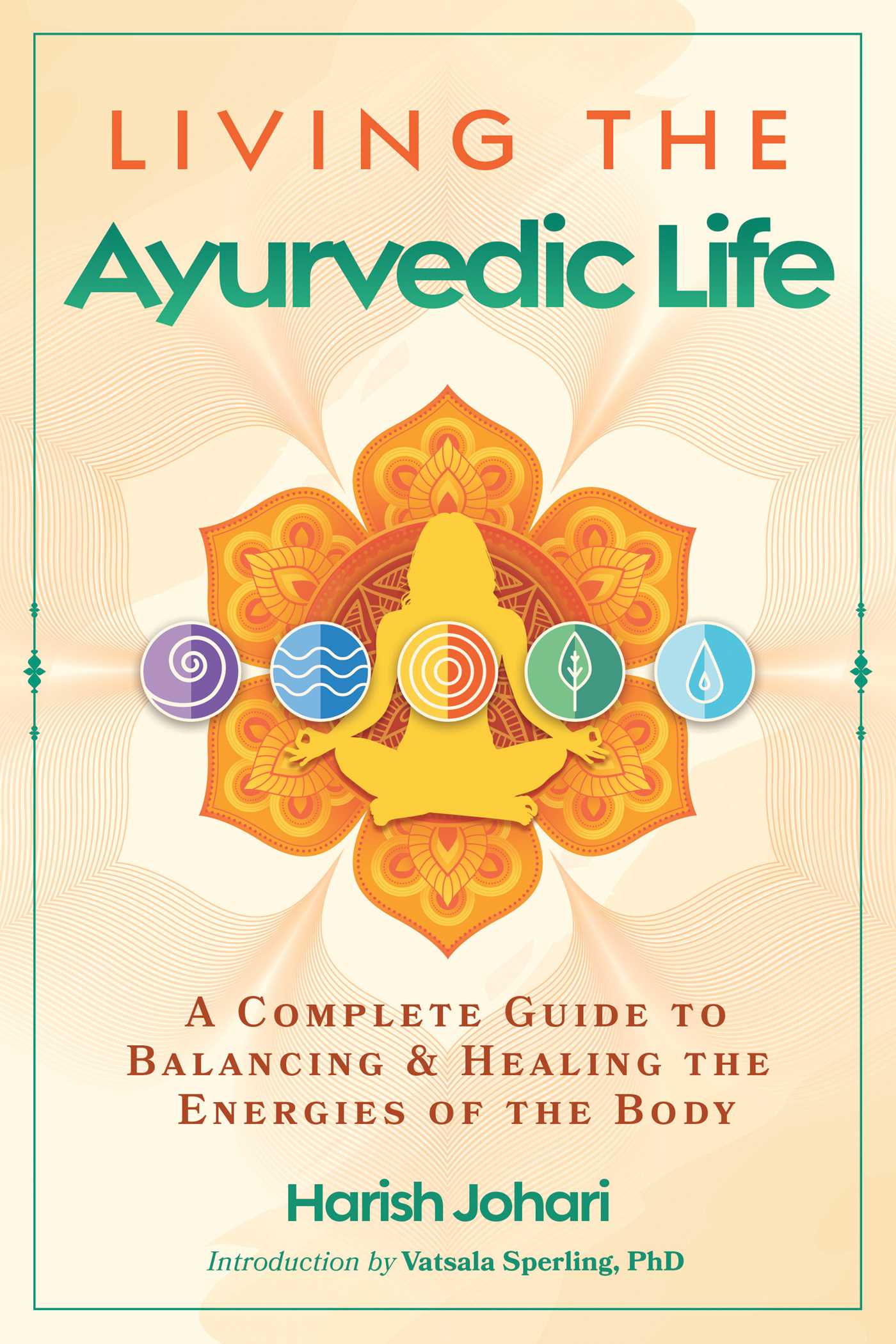
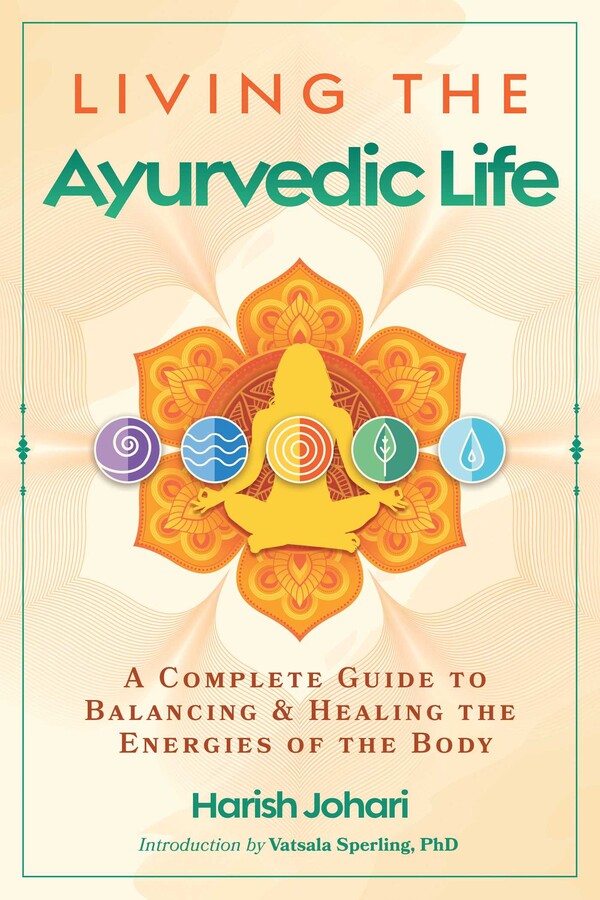
Living the Ayurvedic Life
A Complete Guide to Balancing and Healing the Energies of the Body
Introduction by Vatsala Sperling
Published by Healing Arts Press
Distributed by Simon & Schuster
Table of Contents
About The Book
Improve your health and longevity with ancient yogic principles
• Reveals how making small, strategic changes to habits and behaviors in daily life can lead to better physical, mental, and spiritual well-being
• Explores breathing practices, sleep habits, the energetic effects of specific foods, and different types of fasting
• Explains how exercise and yoga, massage, bathing, and sexual energy retention can increase vitality
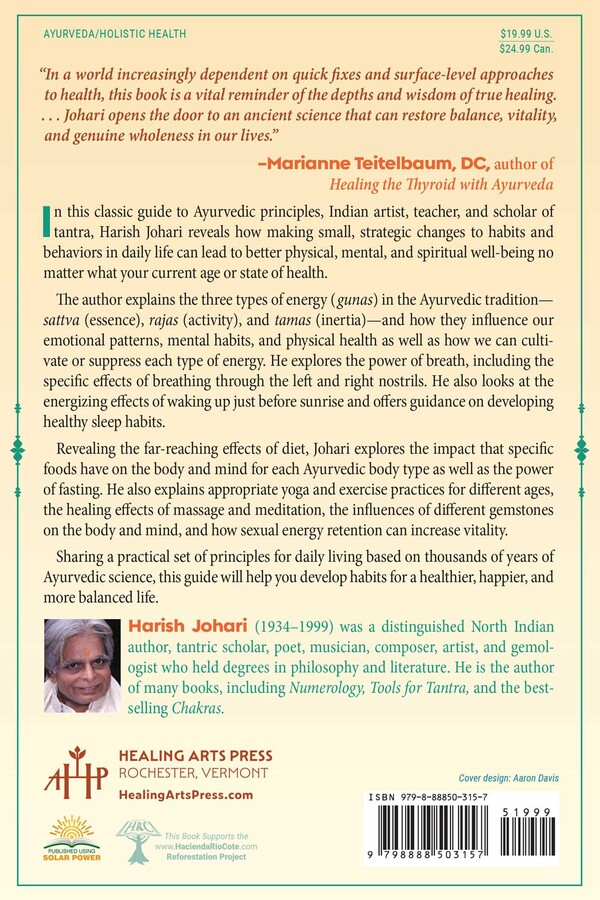
In this classic guide to Ayurvedic principles, Indian artist, teacher, and scholar of tantra, Harish Johari reveals how making small, strategic changes to habits and behaviors in daily life can lead to better physical, mental, and spiritual well-being no matter what your current age or state of health.
The author explains the three types of energy (gunas) in the Ayurvedic tradition—sattva (essence), rajas (activity), and tamas (inertia)—and how they influence our emotional patterns, mental habits, and physical health as well as how we can cultivate or suppress each type of energy. He explores the power of breath, including the specific effects of breathing through the left and right nostrils. He also looks at the energizing effects of waking up just before sunrise and offers guidance on developing healthy sleep habits.
Revealing the far-reaching effects of diet, Johari explores the impact that specific foods have on the body and mind for each Ayurvedic body type as well as the power of fasting. He also explains appropriate yoga and exercise practices for different ages, the healing effects of massage and meditation, the influences of different gemstones on the body and mind, and how sexual energy retention can increase vitality.
Sharing a practical set of principles for daily living based on thousands of years of Ayurvedic science, this guide will help you develop habits for a healthier, happier, and more balanced life.
• Reveals how making small, strategic changes to habits and behaviors in daily life can lead to better physical, mental, and spiritual well-being
• Explores breathing practices, sleep habits, the energetic effects of specific foods, and different types of fasting
• Explains how exercise and yoga, massage, bathing, and sexual energy retention can increase vitality
In this classic guide to Ayurvedic principles, Indian artist, teacher, and scholar of tantra, Harish Johari reveals how making small, strategic changes to habits and behaviors in daily life can lead to better physical, mental, and spiritual well-being no matter what your current age or state of health.
The author explains the three types of energy (gunas) in the Ayurvedic tradition—sattva (essence), rajas (activity), and tamas (inertia)—and how they influence our emotional patterns, mental habits, and physical health as well as how we can cultivate or suppress each type of energy. He explores the power of breath, including the specific effects of breathing through the left and right nostrils. He also looks at the energizing effects of waking up just before sunrise and offers guidance on developing healthy sleep habits.
Revealing the far-reaching effects of diet, Johari explores the impact that specific foods have on the body and mind for each Ayurvedic body type as well as the power of fasting. He also explains appropriate yoga and exercise practices for different ages, the healing effects of massage and meditation, the influences of different gemstones on the body and mind, and how sexual energy retention can increase vitality.
Sharing a practical set of principles for daily living based on thousands of years of Ayurvedic science, this guide will help you develop habits for a healthier, happier, and more balanced life.
Excerpt
CHAPTER ONE
The Three Gunas
Everything that exists forms one part of a vast and universal play of cosmic energy. There is nothing that has an independent existence, for any single “thing” can be shown to have direct links to other “things.” Independence and individuality are myths of human origin. Man cannot live without air. Air exists because the planetary mass of the earth and its rotational speed (and a host of other factors) enable it to cloak itself with a mantle of gases. And the earth itself exists by the grace of the sun, which in turn exists as part of the galaxy. The galaxy exists as part of the macrocosm.
At this point Western science enters into a realm of theoretical astrophysics and cosmogenesis. The myth of human individuality is belied by the scientific evidence, but the nature of this universe of which humanity is part remains an elusive and fascinating mystery.
In India, however, people have for thousands of years seen their individual roles as interdependent agents in a macrocosmic drama. The role of humanity is understood as a manifestation of the same primal force that gave birth to suns and galaxies. Humanity is seen in the light of a complex and meaningful cosmology and ontology (science of being-as-it-is). It seems far more than coincidence that this most ancient of cosmologies is increasingly confirmed with each refinement in contemporary knowledge from the material sciences.
It is this cosmology that underlies all classical Indian science, including the science of daily life.
Most of the Indian views of reality can be understood in Western terms. But no parallel terms exist for the forces at work at the heart of creation, the triad that exists at the core of every phenomenon. These all-pervasive forces are the three gunas, called tamas (inertia), rajas (activity), and sattva (essence).
All manifestation springs from the common source of prakriti. This primordial wellspring of being can be likened to an inverted tree, one whose roots are up, and trunk and branches downward. The part of the tree that is hidden from human sensory perception is the root part, the mool-prakriti (mool = root). It is this root from which all creation arises. Mool-prakriti, the primary existence, is the state of complete balance, or equilibrium. This prakriti is without gender, without identification, without form—without any qualifications to its nature. Nature here is undifferentiated, beyond all human sensory perceptions.
In this stage of undifferentiated unity, existence assumes only the purest and lightest frequencies. All at this stage is sattva, essence.
For this state of wholeness, sattva continually generates space from itself. And this generation of space is the first step in the creation cycle. For a time, space pours out freely, as water flows freely in the ocean. But once manifestation begins, the pull is inexorably downward. As the currents of space are generated, a blockage in their flow evolves as the current eddies back on itself. This blockage, this obstruction in the flow of space, is tamas.
It is tamas that is the prime cause of creation, for without obstruction sattvic frequencies would never begin the descent from subtle to gross.
The presence of tamas breaks the uniformity of the flow of space, forming an independent circuit. This new circuit, a closed system formed out of the frequencies of the root prakriti, is called the golden egg (hiranya Garbha in Sanskrit).
So long as the prakriti is inert, motionless, nothing exists but pure sattva. But the generation of space creates motion, activity. It is the nature of creation that once the play of action begins that the energy flows inevitably from high to low, from subtle to gross. Once the action starts, currents of energy are formed. And with the passage of time, it is inevitable that one current obstructs the passage of another—forming an eddy, a ripple in the stream of evolution.
By themselves, the gunas are imperceptible—rather, beyond perception. Only the effects of their action can be seen.
This is just as with a person. Try to see a person. Anything that the eye can perceive is not the person. The body that is seen goes through continual changes as it evolves, matures, and decays. The cells are continually dying and being replaced by new growth. The tissues with which life began all die before age twelve. In effect, one has a new body every twelve years. Yet there is an abiding sense of “I” that never changes, which stands beyond the changing nature of the form. It is this “I” that is the essence of a person—and this “I” is never seen.
Similarly, try to hear a person. What is heard is not the person, but a code of electrical signals within the listener’s own brain caused by the vibration of air molecules striking the eardrum. Yet the inner sound of the person, his or her own rhythm cycle, exists beyond the changes of the outer sounds the person makes. This sound cannot be heard by another.
So too one cannot smell another person, only the chemicals that are being given off by the body—chemicals that have their source in foods, drinks, and compounds. And similarly, one cannot know the taste of another person, nor can one know his or her touch.
What one does experience of another is the effect, the gross manifestation of the person’s being. But the real nature cannot be perceived through the senses.
Whatever is experienced of another person is just the external effect of an internal causal process happening within the other. And so too the real form of the gunas cannot be experienced through the senses. All that can be known is the effect of their interactions, their maya.
Ice, liquid, and steam constitute three manifestations of the same essential substance, water. In the liquid state, the essence of water is able to flow freely within the confines dictated by the shape of its container. In ice form, this same essence has lost all mobility and has become confined to one form and one placement. In steam form, the essence is closest to its true nature, for now it fills whatever room it occupies and makes its way into all spaces, all niches and corners.
Water is the rajasic form of the essence, and the transitional stage between ice and steam, and between steam and ice. To become steam, ice first has to become water; and to become ice, steam first has to become water. Ice, then, is the tamasic form of the essence, the form most bound by time and space, and the form in which the movement of individual particles has virtually ceased. Lastly, steam is the sattvic form of the essence, for steam has escaped the limits of gravity and form and dispersed into space.
If, on its journey, the subtle encounters knowledge, that knowledge immediately burns off the ignorance arising from attachment and being immediately merges with its true nature, which is pure light.
Ignorance is the path of evolution. Evoluton flows in the darkness of ignorance, and in that ignorance the unlimited becomes limited, thinking itself to be a limited body.
This is the structure of the tree of prakriti. From the invisible roots arises a sense of individuality, the ego. The ego, in turn, creates five sense elements with which to create the world of names and forms. Next, mind arises, and with mind five sense organs and five work organs. Lastly, the physical body itself. The fruit of the tree of prakriti is birth, age, and enjoyment, and the taste of the fruit is pleasure and pain. From pure sattva, consciousness became active (rajas) and found itself pulled downward into the limitation (tamas) of individual form.
Consciousness has become bound by form, and while so enmeshed in its own game must obey the laws and principles governing the domain of names and forms. The three gunas and five elements (space, air, fire, water, and earth) constitute the ashtadha prakriti, the eightfold nature of manifest reality. All that exists in the world of the senses is but a play of the elements, directed by the ever changing interaction of the gunas and experienced by the One Consciousness (the self).
The gunas can be seen as three colored strands braided together. Sometimes one color appears most dominant on the surface, sometimes another, sometimes another. Yet by observing the whole cord, one sees that dominance is an illusion: All three are always present, only one sometimes hides another from view. They are not three distinct entities, but three forms of one existence. The gunas do not disturb each other, nor do they contradict each other. Neither do they present obstacles in each other’s way. One helps the other to evolve. They act together in coherence with each other, and are present in everything in varying proportions.
The Three Gunas
Everything that exists forms one part of a vast and universal play of cosmic energy. There is nothing that has an independent existence, for any single “thing” can be shown to have direct links to other “things.” Independence and individuality are myths of human origin. Man cannot live without air. Air exists because the planetary mass of the earth and its rotational speed (and a host of other factors) enable it to cloak itself with a mantle of gases. And the earth itself exists by the grace of the sun, which in turn exists as part of the galaxy. The galaxy exists as part of the macrocosm.
At this point Western science enters into a realm of theoretical astrophysics and cosmogenesis. The myth of human individuality is belied by the scientific evidence, but the nature of this universe of which humanity is part remains an elusive and fascinating mystery.
In India, however, people have for thousands of years seen their individual roles as interdependent agents in a macrocosmic drama. The role of humanity is understood as a manifestation of the same primal force that gave birth to suns and galaxies. Humanity is seen in the light of a complex and meaningful cosmology and ontology (science of being-as-it-is). It seems far more than coincidence that this most ancient of cosmologies is increasingly confirmed with each refinement in contemporary knowledge from the material sciences.
It is this cosmology that underlies all classical Indian science, including the science of daily life.
Most of the Indian views of reality can be understood in Western terms. But no parallel terms exist for the forces at work at the heart of creation, the triad that exists at the core of every phenomenon. These all-pervasive forces are the three gunas, called tamas (inertia), rajas (activity), and sattva (essence).
All manifestation springs from the common source of prakriti. This primordial wellspring of being can be likened to an inverted tree, one whose roots are up, and trunk and branches downward. The part of the tree that is hidden from human sensory perception is the root part, the mool-prakriti (mool = root). It is this root from which all creation arises. Mool-prakriti, the primary existence, is the state of complete balance, or equilibrium. This prakriti is without gender, without identification, without form—without any qualifications to its nature. Nature here is undifferentiated, beyond all human sensory perceptions.
In this stage of undifferentiated unity, existence assumes only the purest and lightest frequencies. All at this stage is sattva, essence.
For this state of wholeness, sattva continually generates space from itself. And this generation of space is the first step in the creation cycle. For a time, space pours out freely, as water flows freely in the ocean. But once manifestation begins, the pull is inexorably downward. As the currents of space are generated, a blockage in their flow evolves as the current eddies back on itself. This blockage, this obstruction in the flow of space, is tamas.
It is tamas that is the prime cause of creation, for without obstruction sattvic frequencies would never begin the descent from subtle to gross.
The presence of tamas breaks the uniformity of the flow of space, forming an independent circuit. This new circuit, a closed system formed out of the frequencies of the root prakriti, is called the golden egg (hiranya Garbha in Sanskrit).
So long as the prakriti is inert, motionless, nothing exists but pure sattva. But the generation of space creates motion, activity. It is the nature of creation that once the play of action begins that the energy flows inevitably from high to low, from subtle to gross. Once the action starts, currents of energy are formed. And with the passage of time, it is inevitable that one current obstructs the passage of another—forming an eddy, a ripple in the stream of evolution.
By themselves, the gunas are imperceptible—rather, beyond perception. Only the effects of their action can be seen.
This is just as with a person. Try to see a person. Anything that the eye can perceive is not the person. The body that is seen goes through continual changes as it evolves, matures, and decays. The cells are continually dying and being replaced by new growth. The tissues with which life began all die before age twelve. In effect, one has a new body every twelve years. Yet there is an abiding sense of “I” that never changes, which stands beyond the changing nature of the form. It is this “I” that is the essence of a person—and this “I” is never seen.
Similarly, try to hear a person. What is heard is not the person, but a code of electrical signals within the listener’s own brain caused by the vibration of air molecules striking the eardrum. Yet the inner sound of the person, his or her own rhythm cycle, exists beyond the changes of the outer sounds the person makes. This sound cannot be heard by another.
So too one cannot smell another person, only the chemicals that are being given off by the body—chemicals that have their source in foods, drinks, and compounds. And similarly, one cannot know the taste of another person, nor can one know his or her touch.
What one does experience of another is the effect, the gross manifestation of the person’s being. But the real nature cannot be perceived through the senses.
Whatever is experienced of another person is just the external effect of an internal causal process happening within the other. And so too the real form of the gunas cannot be experienced through the senses. All that can be known is the effect of their interactions, their maya.
Ice, liquid, and steam constitute three manifestations of the same essential substance, water. In the liquid state, the essence of water is able to flow freely within the confines dictated by the shape of its container. In ice form, this same essence has lost all mobility and has become confined to one form and one placement. In steam form, the essence is closest to its true nature, for now it fills whatever room it occupies and makes its way into all spaces, all niches and corners.
Water is the rajasic form of the essence, and the transitional stage between ice and steam, and between steam and ice. To become steam, ice first has to become water; and to become ice, steam first has to become water. Ice, then, is the tamasic form of the essence, the form most bound by time and space, and the form in which the movement of individual particles has virtually ceased. Lastly, steam is the sattvic form of the essence, for steam has escaped the limits of gravity and form and dispersed into space.
If, on its journey, the subtle encounters knowledge, that knowledge immediately burns off the ignorance arising from attachment and being immediately merges with its true nature, which is pure light.
Ignorance is the path of evolution. Evoluton flows in the darkness of ignorance, and in that ignorance the unlimited becomes limited, thinking itself to be a limited body.
This is the structure of the tree of prakriti. From the invisible roots arises a sense of individuality, the ego. The ego, in turn, creates five sense elements with which to create the world of names and forms. Next, mind arises, and with mind five sense organs and five work organs. Lastly, the physical body itself. The fruit of the tree of prakriti is birth, age, and enjoyment, and the taste of the fruit is pleasure and pain. From pure sattva, consciousness became active (rajas) and found itself pulled downward into the limitation (tamas) of individual form.
Consciousness has become bound by form, and while so enmeshed in its own game must obey the laws and principles governing the domain of names and forms. The three gunas and five elements (space, air, fire, water, and earth) constitute the ashtadha prakriti, the eightfold nature of manifest reality. All that exists in the world of the senses is but a play of the elements, directed by the ever changing interaction of the gunas and experienced by the One Consciousness (the self).
The gunas can be seen as three colored strands braided together. Sometimes one color appears most dominant on the surface, sometimes another, sometimes another. Yet by observing the whole cord, one sees that dominance is an illusion: All three are always present, only one sometimes hides another from view. They are not three distinct entities, but three forms of one existence. The gunas do not disturb each other, nor do they contradict each other. Neither do they present obstacles in each other’s way. One helps the other to evolve. They act together in coherence with each other, and are present in everything in varying proportions.
Product Details
- Publisher: Healing Arts Press (April 7, 2026)
- Length: 256 pages
- ISBN13: 9798888503157
Browse Related Books
Raves and Reviews
“In a world increasingly dependent on quick fixes and surface-level approaches to health, this book is a vital reminder of the depths and wisdom of true healing. Ayurveda offers a complete system of well-being—one that embraces the whole person through diet, daily routines, seasonal balance, and cleansing practices that work in harmony with nature. For those of us in the modern Western world, where our health care often treats symptoms rather than root causes, this knowledge is profoundly needed. Johari opens the door to an ancient science that can restore balance, vitality, and genuine wholeness in our lives.”
– Marianne Teitelbaum, DC, author of Healing the Thyroid with Ayurveda
Resources and Downloads
High Resolution Images
-
Book Cover Image (jpg): Living the Ayurvedic Life
2nd Edition, New Edition of Dhanwantari Trade Paperback 9798888503157
Living the Ayurvedic Life
A Complete Guide to Balancing and Healing the Energies of the Body
Introduction by Vatsala Sperling
Published by Healing Arts Press
Distributed by Simon & Schuster
Join our mailing list!
By clicking 'Sign me up' I acknowledge that I have read and agree to the privacy policy and terms of use.