Get our latest staff recommendations, award news and digital catalog links right to your inbox.
Published by Wisdom Publications
Distributed by Simon & Schuster
Table of Contents
About The Book
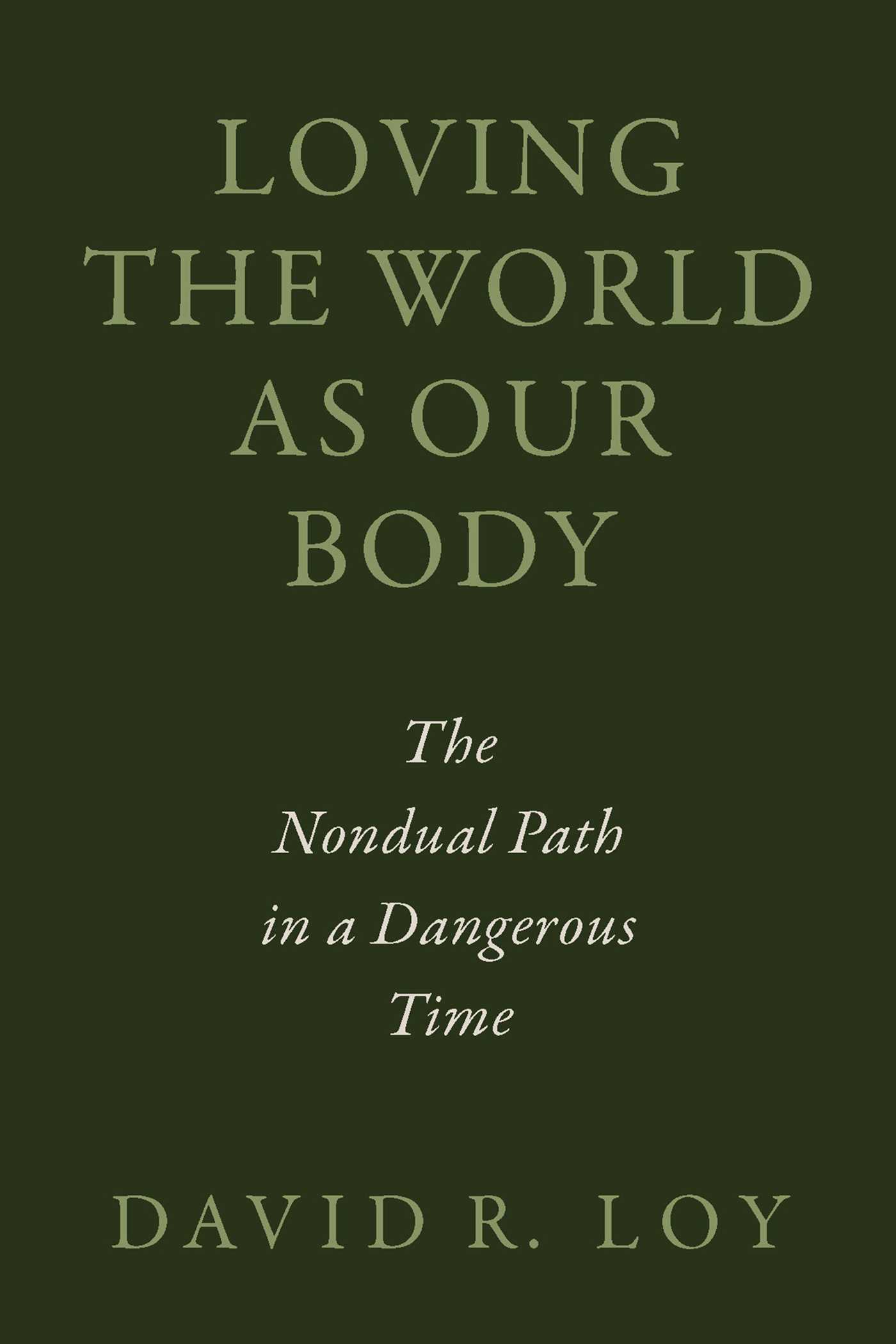
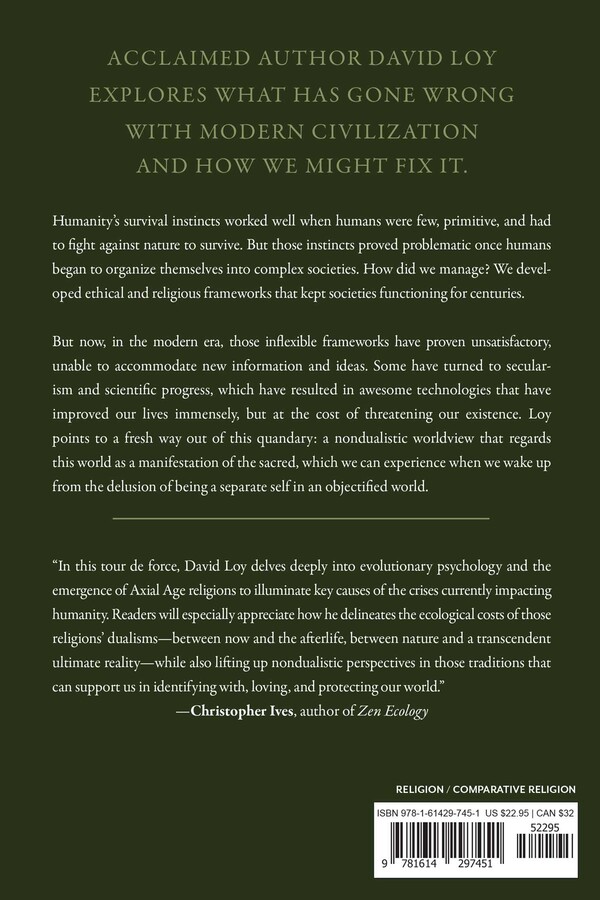
Acclaimed author David Loy explores what has gone wrong with humanity and how we can fix it.
Humanity’s survival instincts worked great back when humans were few, primitive, and had to fight against the entirety of nature to survive. But those same instincts proved disastrous once humans began to organize themselves into complex societies. How did we manage? We developed moral and ethical frameworks that kept societies functioning for centuries.
But now, in the modern era, those frameworks again have proven unsatisfactory—rigid, inflexible, and often unable to accommodate new information and ideas. So some of us have turned to secularism and scientific progress, which have resulted in awesome technologies—many of which improve our lives immensely, but some of which threaten our existence.
E. O. Wilson sums up our quandary: “The real problem of humanity is that we have Paleolithic emotions, medieval institutions, and god-like technology.” Where do we go from here?
David Loy describes how today we are left with three primary worldviews competing for our allegiance.
The first has the most adherents and includes traditional religious versions of cosmological dualism, including the promise (or threat) of individual post mortem salvation (or damnation).
The second is secularism, supported by the physical sciences and offering a naturalistic understanding of the world that does not support any spiritual or afterlife transcendence.
The third worldview regards the earth and its creatures as sacred, without the need for a “higher reality” to have created them. Humanity is one of the manifestations of a self-organizing cosmos that, according to some versions, is evolving to become more self-aware. According to this nondualist paradigm, everything is a manifestation of the sacred, which we can experience when we wake up from the delusion of being a separate self in an objectified world.
This third view is our way out of the quandary, and Loy shows readers how this nondualist view has actually been with us longer than we think: within the more esoteric views woven through and among a wide variety of otherwise traditional religious traditions.
Table of Contents
Introduction
What We Can Learn from Our Evolution
An Inevitable Certainty
Sexuality
Beyond Freedom and Determinism
How to Be an Ape
Altruism and Tribalism
Self-Domestication
Civilization
Religion
Why Our Evolutionary Psychology Matters Today
What We Could Have Learned from Our Religions
The Axial Age
Script/ure
Transcendence
The Birth of the Axial Age
The Good, the Bad, and the Ugly
Why This Matters
What We Need Today
Shamanism
Judaism
Christianity
Islam
Vedanta
Buddhism
China
Waking Up to the Dream
Conclusion
Touching the Earth
Notes
Index
About the Author
Humanity’s survival instincts worked great back when humans were few, primitive, and had to fight against the entirety of nature to survive. But those same instincts proved disastrous once humans began to organize themselves into complex societies. How did we manage? We developed moral and ethical frameworks that kept societies functioning for centuries.
But now, in the modern era, those frameworks again have proven unsatisfactory—rigid, inflexible, and often unable to accommodate new information and ideas. So some of us have turned to secularism and scientific progress, which have resulted in awesome technologies—many of which improve our lives immensely, but some of which threaten our existence.
E. O. Wilson sums up our quandary: “The real problem of humanity is that we have Paleolithic emotions, medieval institutions, and god-like technology.” Where do we go from here?
David Loy describes how today we are left with three primary worldviews competing for our allegiance.
The first has the most adherents and includes traditional religious versions of cosmological dualism, including the promise (or threat) of individual post mortem salvation (or damnation).
The second is secularism, supported by the physical sciences and offering a naturalistic understanding of the world that does not support any spiritual or afterlife transcendence.
The third worldview regards the earth and its creatures as sacred, without the need for a “higher reality” to have created them. Humanity is one of the manifestations of a self-organizing cosmos that, according to some versions, is evolving to become more self-aware. According to this nondualist paradigm, everything is a manifestation of the sacred, which we can experience when we wake up from the delusion of being a separate self in an objectified world.
This third view is our way out of the quandary, and Loy shows readers how this nondualist view has actually been with us longer than we think: within the more esoteric views woven through and among a wide variety of otherwise traditional religious traditions.
Table of Contents
Introduction
What We Can Learn from Our Evolution
An Inevitable Certainty
Sexuality
Beyond Freedom and Determinism
How to Be an Ape
Altruism and Tribalism
Self-Domestication
Civilization
Religion
Why Our Evolutionary Psychology Matters Today
What We Could Have Learned from Our Religions
The Axial Age
Script/ure
Transcendence
The Birth of the Axial Age
The Good, the Bad, and the Ugly
Why This Matters
What We Need Today
Shamanism
Judaism
Christianity
Islam
Vedanta
Buddhism
China
Waking Up to the Dream
Conclusion
Touching the Earth
Notes
Index
About the Author
Excerpt
Introduction
A Path on the Precipice
Is this the most dangerous time in human history? That’s the opinion of Noam Chomsky in a September 2020 interview. It’s such an extraordinary claim that I tried to think of a counterexample. World War II? Chomsky is old enough to remember the 1930s, when there was a real possibility that Nazism could take over much of Eurasia, “but even that, horrible enough, was not like the end of organized human life on earth, which is what we’re facing.”
When he gave the interview, the COVID-19 pandemic was near its peak, but Chomsky didn’t mention it. Instead, he focused on three issues: the climate crisis, the growing threat of nuclear war, and the decline of democracy—that is, rising authoritarianism—around the world. Unfortunately, each of these problems has become markedly worse since his interview.
Urgent though it is, accelerating global heating is only part of a much larger ecological catastrophe, which includes many other threats, most obviously loss of biodiversity. Back in 1900 (when world population was only 1.6 billion) humans plus our domesticated livestock, such as cattle and pigs, constituted about 83 percent of the total biomass of all mammals that live on land. By 2000 it had increased to 96 percent: 36 percent human, 60 percent other mammals. The biomass of our poultry is about three times that of all the wild birds on earth. We have also reduced the world’s biomass of plant matter by half.[ii] For every five wild mammals living in 1970, there were two in 2017, and less than that now. Species are disappearing at rates variously estimated to be one thousand or even ten thousand times as quickly as they would without human impact.
In addition to this ongoing extinction event—the sixth in the earth’s 4.5-billion-year history—deforestation (250 trees cut down every second) and desertification (8 acres per minute) are increasing. Every year 24 billion tons of topsoil are lost due to erosion. There are now more than 500 dead zones in the ocean, their total area being larger than Europe, and they are growing. Toxic industrial chemicals are present in the breast milk of every mother, on top of Mount Everest, in the deepest ocean trenches, and at the North Pole. Micro- and nanoplastics can also be found everywhere, even in our brains.
We could go on, but the point is made. Reducing greenhouse gases is certainly necessary but cannot be a sufficient response, because the deeper ecological challenge is humanity’s dysfunctional relationship with the rest of the natural world.
Long before the war in Ukraine, Chomsky emphasized the persistent risk of nuclear war. There are also ongoing problems with nuclear reactors, including accidents such as those at Chernobyl and Fukushima, as well as thousands of tons of radioactive waste that will remain dangerous for hundreds of thousands of years because no one knows how to store it safely for such a long period.
Chomsky also warned about rising authoritarianism. More than a few of the world’s democracies look increasingly fragile because autocratic regimes, having attained power, are subverting their own democratic institutions. The January 6 attack on the Capitol building in Washington, DC, along with an increasingly polarized and acrimonious political climate culminating in Donald Trump’s reelection in 2024, shows that the United States is not invulnerable to such a development. His actions since then have reinforced such apprehensions.
One perhaps should add to this some other serious concerns that Chomsky did not mention, including social justice issues. Economic problems often contribute to political strife, especially the enormous and still-growing disparity almost everywhere between a small group of obscenely wealthy individuals and the precarious situation of most people – a gap the COVID-19 pandemic aggravated. “Nearly 40% of all Americans say they have skipped meals in order to meet their housing payments, and more than 70% admit to living with economic anxiety.”
Finally—one must stop somewhere!—is the growing impact of all the above on mental health worldwide, especially that of young people, who face a dismal future burdened with the challenge of cleaning up the messes their elders have created. Although aging is no fun, I would not want to be a teenager today.
We can describe all this as a polycrisis, but even that term may be inadequate. It’s not simply that many problems are occurring at the same time. Nor is it enough to emphasize that they are interacting with and often reinforcing each other. Is it more accurate to say we have a metacrisis? No, this is not a reference to the corporation formerly known as Facebook. The Greek root meta- (literally “beyond”) is an adjective that can be translated as “more comprehensive” or “transcending”—the point being that the various crises facing us may in fact be different facets of a deeper problem. What might that problem be?
The tragic irony is that, just when humanity has achieved a truly global civilization, our civilization has lost its way and seems to be self-destructing, “The day of reckoning has come,” according to the ecotheologian Thomas Berry. “In this disintegrating phase of our industrial society, we now see ourselves not as the splendor of creation, but as the most pernicious mode of earthly being.” Why so pernicious? For John Gray, “The destruction of the natural world is not the result of global capitalism, industrialization, ‘Western civilization’ or any flaw in human institutions. It is a consequence of the evolutionary success of an exceptionally rapacious primate.”[vii] Although I wouldn’t give a free pass to what Joanna Macy calls industrial growth society, the important point is that Gray roots the ecological crisis in an all-too-human character trait that all-too-often interacts with other problematic tendencies, such as tribalism (including nationalism, racism, and religious fundamentalism) and aggression (including militarism and terrorism).
E. O. Wilson sums up our quandary: “The real problem of humanity is that we have Paleolithic emotions, medieval institutions, and god-like technology.” Despite the unexpected adverse effects of some escalating technologies—for example, the internet—the problems facing us today may be grounded in something much older and more fundamental: the way our minds have been sculpted by evolution. Are human rapacity, tribalism, and violence just bad habits we can blame on regrettable (but correctable) social conditioning? Or have they been built into the DNA of our species over many millennia by the competition to survive and reproduce?
That the dysfunction might be at least partially innate is a possibility that may be dangerous to ignore. Can an understanding of evolutionary psychology—how human emotions and behavior have evolved—grant us some insight into its genesis, and might that insight help us respond more appropriately? If our predicament today is a consequence of prehistoric as well as more recent developments, we need to consider how and why we evolved the ways that we have. Might that help us understand why the efforts we have been making are not working well enough?
There is another dysfunction that needs to be addressed. Humans are not only products of biological evolution. Both individually and collectively, we are also artifacts of cultural evolution. When we consider basic existential questions about the meaning of life (beyond mere survival and reproduction) and how to live (the moral codes to follow), nothing has been more important historically than our religious traditions. I am not sure that is still true:one could argue that consumerism has now become, in effect, the most popular religion. In either case, the mainstream religious traditions are failing us today. In fact, their failure is one of the main motivations for this book.
The theologian Paul Tillich developed what he called a theology of correlation: the answers that religions have to offer should correspond to the questions that a culture is asking. If they fail at doing this, then those religions become irrelevant. By that standard, our spiritual traditions are no longer fit for our purposes. Their premodern mythologies and doctrines are increasingly incompatible with contemporary worldviews, scientific and otherwise, and so it is not surprising that their traditional ethical codes do not help enough when we try to address the problems mentioned above. Their dualistic theologies not only draw our attention away from what is happening here and now, but their emphasis on an otherworldly salvation has also contributed significantly to the ecological crisis, because this world is devalued in comparison to whatever postmortem bliss that we can enjoy somewhere else. Why be so concerned about what is happening here when we will soon go to a much better place?
In short, the spiritual paths that our religions offer are outdated and need to be revised. My hope is that this book will contribute in some small way to their reformation.
This book is divided into three chapters. Chapter 1 offers an overview of evolutionary psychology, which reveals the deep source of the crises that confront us today. Chapter 2 shifts the focus to cultural evolution, especially the historical role of religion as our main collective effort to deal with the tensions created by our biological evolution. Chapter 3 critiques those attempts, which have largely failed, and offers a more “this-worldly” version of the spiritual path. What we need to transcend is not this reality but our usual ways of experiencing and understanding it. If this world is different from what we have thought, might salvation also be quite different from what we have been taught?
A Path on the Precipice
Is this the most dangerous time in human history? That’s the opinion of Noam Chomsky in a September 2020 interview. It’s such an extraordinary claim that I tried to think of a counterexample. World War II? Chomsky is old enough to remember the 1930s, when there was a real possibility that Nazism could take over much of Eurasia, “but even that, horrible enough, was not like the end of organized human life on earth, which is what we’re facing.”
When he gave the interview, the COVID-19 pandemic was near its peak, but Chomsky didn’t mention it. Instead, he focused on three issues: the climate crisis, the growing threat of nuclear war, and the decline of democracy—that is, rising authoritarianism—around the world. Unfortunately, each of these problems has become markedly worse since his interview.
Urgent though it is, accelerating global heating is only part of a much larger ecological catastrophe, which includes many other threats, most obviously loss of biodiversity. Back in 1900 (when world population was only 1.6 billion) humans plus our domesticated livestock, such as cattle and pigs, constituted about 83 percent of the total biomass of all mammals that live on land. By 2000 it had increased to 96 percent: 36 percent human, 60 percent other mammals. The biomass of our poultry is about three times that of all the wild birds on earth. We have also reduced the world’s biomass of plant matter by half.[ii] For every five wild mammals living in 1970, there were two in 2017, and less than that now. Species are disappearing at rates variously estimated to be one thousand or even ten thousand times as quickly as they would without human impact.
In addition to this ongoing extinction event—the sixth in the earth’s 4.5-billion-year history—deforestation (250 trees cut down every second) and desertification (8 acres per minute) are increasing. Every year 24 billion tons of topsoil are lost due to erosion. There are now more than 500 dead zones in the ocean, their total area being larger than Europe, and they are growing. Toxic industrial chemicals are present in the breast milk of every mother, on top of Mount Everest, in the deepest ocean trenches, and at the North Pole. Micro- and nanoplastics can also be found everywhere, even in our brains.
We could go on, but the point is made. Reducing greenhouse gases is certainly necessary but cannot be a sufficient response, because the deeper ecological challenge is humanity’s dysfunctional relationship with the rest of the natural world.
Long before the war in Ukraine, Chomsky emphasized the persistent risk of nuclear war. There are also ongoing problems with nuclear reactors, including accidents such as those at Chernobyl and Fukushima, as well as thousands of tons of radioactive waste that will remain dangerous for hundreds of thousands of years because no one knows how to store it safely for such a long period.
Chomsky also warned about rising authoritarianism. More than a few of the world’s democracies look increasingly fragile because autocratic regimes, having attained power, are subverting their own democratic institutions. The January 6 attack on the Capitol building in Washington, DC, along with an increasingly polarized and acrimonious political climate culminating in Donald Trump’s reelection in 2024, shows that the United States is not invulnerable to such a development. His actions since then have reinforced such apprehensions.
One perhaps should add to this some other serious concerns that Chomsky did not mention, including social justice issues. Economic problems often contribute to political strife, especially the enormous and still-growing disparity almost everywhere between a small group of obscenely wealthy individuals and the precarious situation of most people – a gap the COVID-19 pandemic aggravated. “Nearly 40% of all Americans say they have skipped meals in order to meet their housing payments, and more than 70% admit to living with economic anxiety.”
Finally—one must stop somewhere!—is the growing impact of all the above on mental health worldwide, especially that of young people, who face a dismal future burdened with the challenge of cleaning up the messes their elders have created. Although aging is no fun, I would not want to be a teenager today.
We can describe all this as a polycrisis, but even that term may be inadequate. It’s not simply that many problems are occurring at the same time. Nor is it enough to emphasize that they are interacting with and often reinforcing each other. Is it more accurate to say we have a metacrisis? No, this is not a reference to the corporation formerly known as Facebook. The Greek root meta- (literally “beyond”) is an adjective that can be translated as “more comprehensive” or “transcending”—the point being that the various crises facing us may in fact be different facets of a deeper problem. What might that problem be?
The tragic irony is that, just when humanity has achieved a truly global civilization, our civilization has lost its way and seems to be self-destructing, “The day of reckoning has come,” according to the ecotheologian Thomas Berry. “In this disintegrating phase of our industrial society, we now see ourselves not as the splendor of creation, but as the most pernicious mode of earthly being.” Why so pernicious? For John Gray, “The destruction of the natural world is not the result of global capitalism, industrialization, ‘Western civilization’ or any flaw in human institutions. It is a consequence of the evolutionary success of an exceptionally rapacious primate.”[vii] Although I wouldn’t give a free pass to what Joanna Macy calls industrial growth society, the important point is that Gray roots the ecological crisis in an all-too-human character trait that all-too-often interacts with other problematic tendencies, such as tribalism (including nationalism, racism, and religious fundamentalism) and aggression (including militarism and terrorism).
E. O. Wilson sums up our quandary: “The real problem of humanity is that we have Paleolithic emotions, medieval institutions, and god-like technology.” Despite the unexpected adverse effects of some escalating technologies—for example, the internet—the problems facing us today may be grounded in something much older and more fundamental: the way our minds have been sculpted by evolution. Are human rapacity, tribalism, and violence just bad habits we can blame on regrettable (but correctable) social conditioning? Or have they been built into the DNA of our species over many millennia by the competition to survive and reproduce?
That the dysfunction might be at least partially innate is a possibility that may be dangerous to ignore. Can an understanding of evolutionary psychology—how human emotions and behavior have evolved—grant us some insight into its genesis, and might that insight help us respond more appropriately? If our predicament today is a consequence of prehistoric as well as more recent developments, we need to consider how and why we evolved the ways that we have. Might that help us understand why the efforts we have been making are not working well enough?
There is another dysfunction that needs to be addressed. Humans are not only products of biological evolution. Both individually and collectively, we are also artifacts of cultural evolution. When we consider basic existential questions about the meaning of life (beyond mere survival and reproduction) and how to live (the moral codes to follow), nothing has been more important historically than our religious traditions. I am not sure that is still true:one could argue that consumerism has now become, in effect, the most popular religion. In either case, the mainstream religious traditions are failing us today. In fact, their failure is one of the main motivations for this book.
The theologian Paul Tillich developed what he called a theology of correlation: the answers that religions have to offer should correspond to the questions that a culture is asking. If they fail at doing this, then those religions become irrelevant. By that standard, our spiritual traditions are no longer fit for our purposes. Their premodern mythologies and doctrines are increasingly incompatible with contemporary worldviews, scientific and otherwise, and so it is not surprising that their traditional ethical codes do not help enough when we try to address the problems mentioned above. Their dualistic theologies not only draw our attention away from what is happening here and now, but their emphasis on an otherworldly salvation has also contributed significantly to the ecological crisis, because this world is devalued in comparison to whatever postmortem bliss that we can enjoy somewhere else. Why be so concerned about what is happening here when we will soon go to a much better place?
In short, the spiritual paths that our religions offer are outdated and need to be revised. My hope is that this book will contribute in some small way to their reformation.
This book is divided into three chapters. Chapter 1 offers an overview of evolutionary psychology, which reveals the deep source of the crises that confront us today. Chapter 2 shifts the focus to cultural evolution, especially the historical role of religion as our main collective effort to deal with the tensions created by our biological evolution. Chapter 3 critiques those attempts, which have largely failed, and offers a more “this-worldly” version of the spiritual path. What we need to transcend is not this reality but our usual ways of experiencing and understanding it. If this world is different from what we have thought, might salvation also be quite different from what we have been taught?
Product Details
- Publisher: Wisdom Publications (May 19, 2026)
- Length: 256 pages
- ISBN13: 9781614297451
Browse Related Books
Raves and Reviews
“In this tour de force, David Loy delves deeply into evolutionary psychology and the emergence of Axial Age religions to illuminate key causes of the crises currently impacting humanity. Readers will especially appreciate how he delineates the ecological costs of those religions' dualisms—between now and the afterlife, between nature and a transcendent ultimate reality—while also lifting up nondualistic perspectives in those traditions that can support us in identifying with, loving, and protecting our world."
– Christopher Ives, author of Zen Ecology
Resources and Downloads
High Resolution Images
-
Book Cover Image (jpg): Loving the World as Our Body
Trade Paperback 9781614297451
Published by Wisdom Publications
Distributed by Simon & Schuster
Join our mailing list!
By clicking 'Sign me up' I acknowledge that I have read and agree to the privacy policy and terms of use.