Get our latest staff recommendations, award news and digital catalog links right to your inbox.
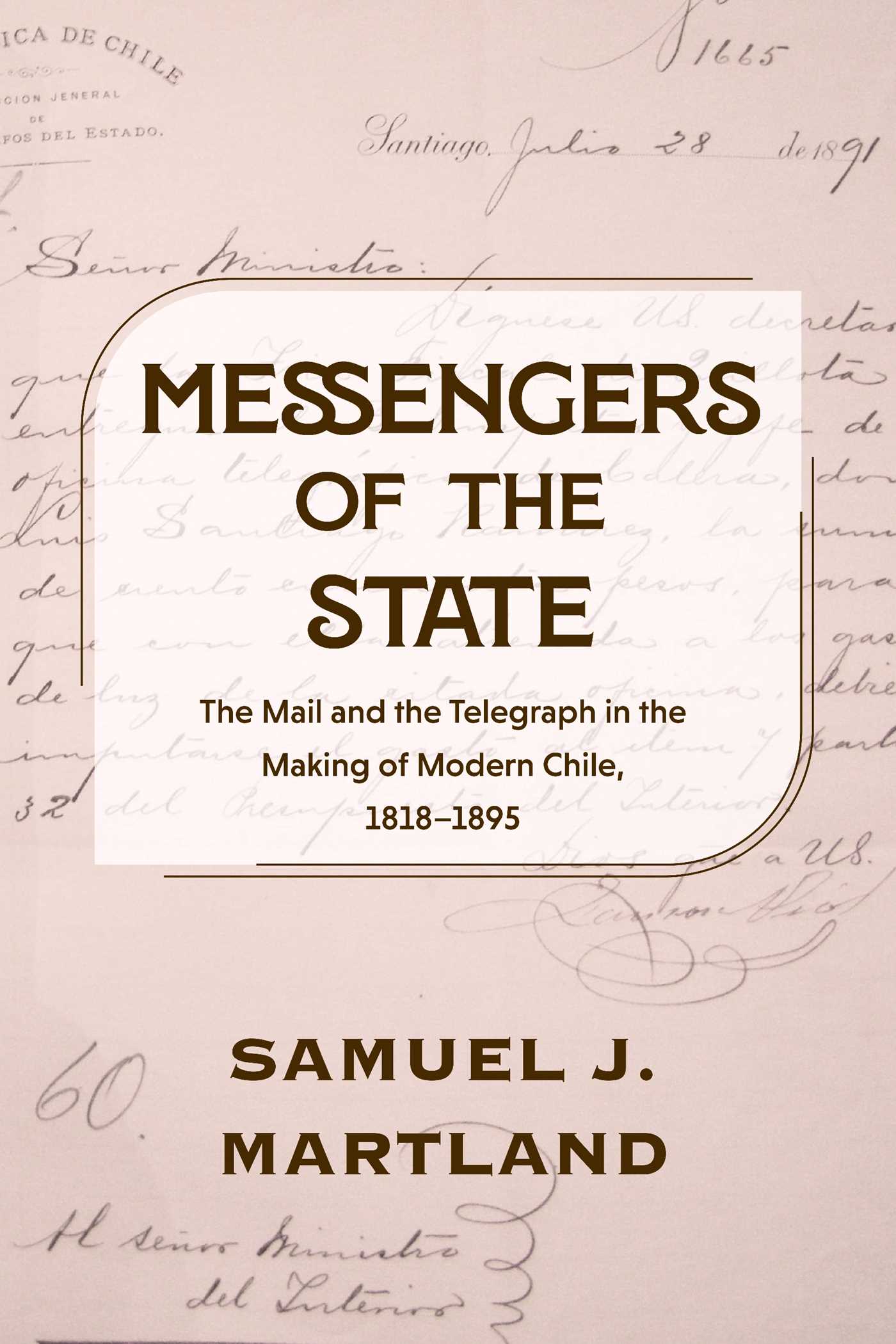
Messengers of the State
The Mail and the Telegraph in the Making of Modern Chile, 1818-1895
Part of Diálogos Series
Published by UNM Press
Distributed by Simon & Schuster
Table of Contents
About The Book
Messengers of the State traces the development of Chile’s mail system and telegraph lines and shows how they expanded central state power and the national economy and helped create a new kind of civilian state worker.
At the time of Chile’s independence in 1818, Chilean officials, landowners, and merchants sent just a thin trickle of letters via post offices in major towns. Postal workers served some main offices, and contracted couriers covered long-distance routes, but mail was mostly a part-time side job. By 1890, government offices sent steady streams of letters via 514 post offices to supervise and coordinate national bureaucracies. Private mail, however, far outnumbered government missives. Businesses, landowners, and private citizens sent tens of millions of letters, packages, and money orders. Contracts and orders, New Year’s postcards, and serious family letters held together a national economy and tied Chile to the world beyond their borders. Busier post offices began to staff full-time employees.
Meanwhile, the state’s 182 telegraph offices provided lightning-fast communication across more than twelve thousand kilometers of wire and employed 278 skilled, highly literate operators—slightly more women than men—composing one of the state’s largest bodies of civilian workers and one of its most centralized and yet most autonomous agencies.
Who delivered these changes? A micromanaging interior minister who nonetheless created the office of postmaster general to manage the mail system instead of him. A courier murdered for the gold he was carrying. A career administrator with no electrical expertise who ran the state telegraphs for twenty-seven years, arguing loudly with ministers and generals. A young woman in a provincial town who without fanfare became Chile’s first female telegraph operator. They and hundreds more were the messengers of the state. This is the story of the systems they made.
At the time of Chile’s independence in 1818, Chilean officials, landowners, and merchants sent just a thin trickle of letters via post offices in major towns. Postal workers served some main offices, and contracted couriers covered long-distance routes, but mail was mostly a part-time side job. By 1890, government offices sent steady streams of letters via 514 post offices to supervise and coordinate national bureaucracies. Private mail, however, far outnumbered government missives. Businesses, landowners, and private citizens sent tens of millions of letters, packages, and money orders. Contracts and orders, New Year’s postcards, and serious family letters held together a national economy and tied Chile to the world beyond their borders. Busier post offices began to staff full-time employees.
Meanwhile, the state’s 182 telegraph offices provided lightning-fast communication across more than twelve thousand kilometers of wire and employed 278 skilled, highly literate operators—slightly more women than men—composing one of the state’s largest bodies of civilian workers and one of its most centralized and yet most autonomous agencies.
Who delivered these changes? A micromanaging interior minister who nonetheless created the office of postmaster general to manage the mail system instead of him. A courier murdered for the gold he was carrying. A career administrator with no electrical expertise who ran the state telegraphs for twenty-seven years, arguing loudly with ministers and generals. A young woman in a provincial town who without fanfare became Chile’s first female telegraph operator. They and hundreds more were the messengers of the state. This is the story of the systems they made.
Product Details
- Publisher: UNM Press (March 9, 2027)
- Length: 296 pages
- ISBN13: 9780826370747
Browse Related Books
Raves and Reviews
“Messengers of the State is a pioneering study of the mail and telegraph systems in nineteenth-century Chile, based on years of meticulous archival research, that reveals a little-considered yet utterly compelling history. . . . It’s a fascinating story, well told, and a significant contribution to the historiography of Chile.”
– Patience Schell, author of The Sociable Sciences: Darwin and His Contemporaries in Chile
Resources and Downloads
High Resolution Images
-
Book Cover Image (jpg): Messengers of the State
eBook 9780826370747
Messengers of the State
The Mail and the Telegraph in the Making of Modern Chile, 1818-1895
Part of Diálogos Series
Published by UNM Press
Distributed by Simon & Schuster
Join our mailing list!
By clicking 'Sign me up' I acknowledge that I have read and agree to the privacy policy and terms of use.