
Get our latest staff recommendations, award news and digital catalog links right to your inbox.
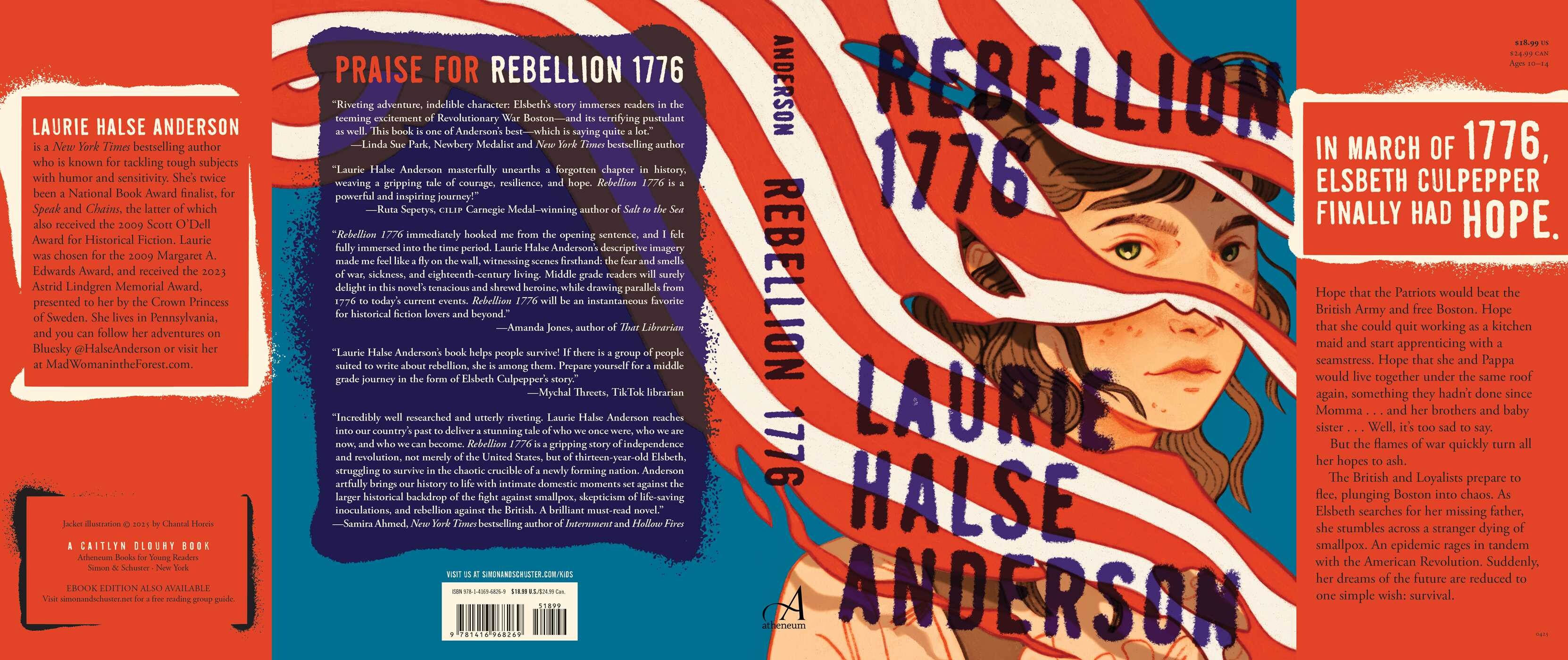
Rebellion 1776
Table of Contents
About The Book
Three starred reviews!
From New York Times bestselling author Laurie Halse Anderson comes an “thoroughly researched, emotionally resonant” (Booklist, starred review) historical fiction middle grade adventure about a girl struggling to survive amid a smallpox epidemic, the public’s fear of inoculation, and the seething Revolutionary War.
In the spring of 1776, thirteen-year-old Elsbeth Culpepper wakes to the sound of cannons. It’s the Siege of Boston, the Patriots’ massive drive to push the Loyalists out that turns the city into a chaotic war zone. Elsbeth’s father—her only living relative—has gone missing, leaving her alone and adrift in a broken town while desperately seeking employment to avoid the orphanage.
Just when things couldn’t feel worse, the smallpox epidemic sweeps across Boston. Now, Bostonians must fight for their lives against an invisible enemy in addition to the visible one. While a treatment is being frantically fine-tuned, thousands of people rush in from the countryside begging for inoculation. At the same time, others refuse protection, for the treatment is crude at best and at times more dangerous than the disease itself.
Elsbeth, who had smallpox as a small child and is now immune, finds work taking care of a large, wealthy family with discord of their own as they await a turn at inoculation, but as the epidemic and the revolution rage on, will she find her father?
From New York Times bestselling author Laurie Halse Anderson comes an “thoroughly researched, emotionally resonant” (Booklist, starred review) historical fiction middle grade adventure about a girl struggling to survive amid a smallpox epidemic, the public’s fear of inoculation, and the seething Revolutionary War.
In the spring of 1776, thirteen-year-old Elsbeth Culpepper wakes to the sound of cannons. It’s the Siege of Boston, the Patriots’ massive drive to push the Loyalists out that turns the city into a chaotic war zone. Elsbeth’s father—her only living relative—has gone missing, leaving her alone and adrift in a broken town while desperately seeking employment to avoid the orphanage.
Just when things couldn’t feel worse, the smallpox epidemic sweeps across Boston. Now, Bostonians must fight for their lives against an invisible enemy in addition to the visible one. While a treatment is being frantically fine-tuned, thousands of people rush in from the countryside begging for inoculation. At the same time, others refuse protection, for the treatment is crude at best and at times more dangerous than the disease itself.
Elsbeth, who had smallpox as a small child and is now immune, finds work taking care of a large, wealthy family with discord of their own as they await a turn at inoculation, but as the epidemic and the revolution rage on, will she find her father?
Excerpt
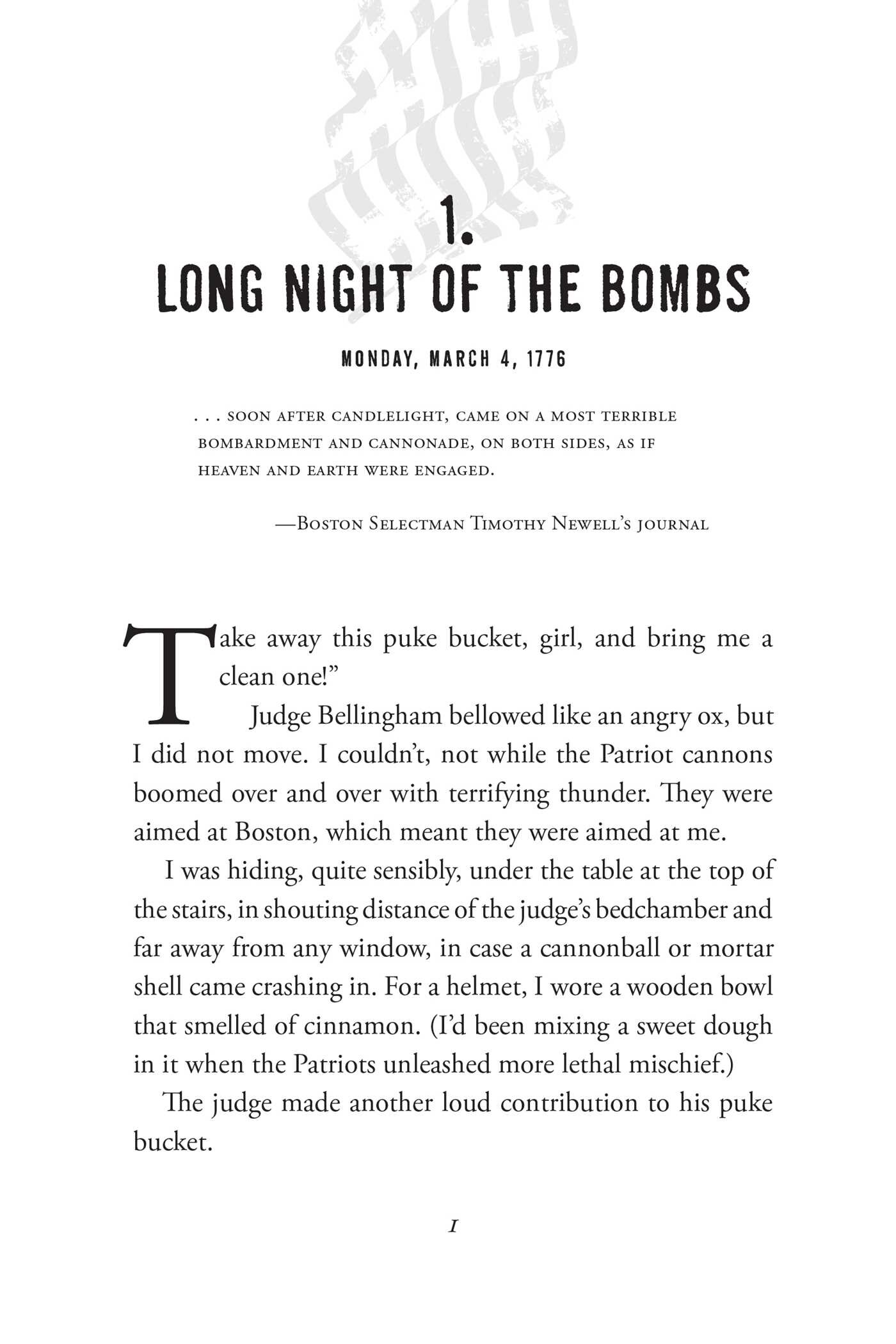
Chapter 1: Long Night of the Bombs
1. LONG NIGHT OF THE BOMBS
MONDAY, MARCH 4, 1776
… SOON AFTER CANDLELIGHT, CAME ON A MOST TERRIBLE BOMBARDMENT AND CANNONADE, ON BOTH SIDES, AS IF HEAVEN AND EARTH WERE ENGAGED.
—BOSTON SELECTMAN TIMOTHY NEWELL’S JOURNAL
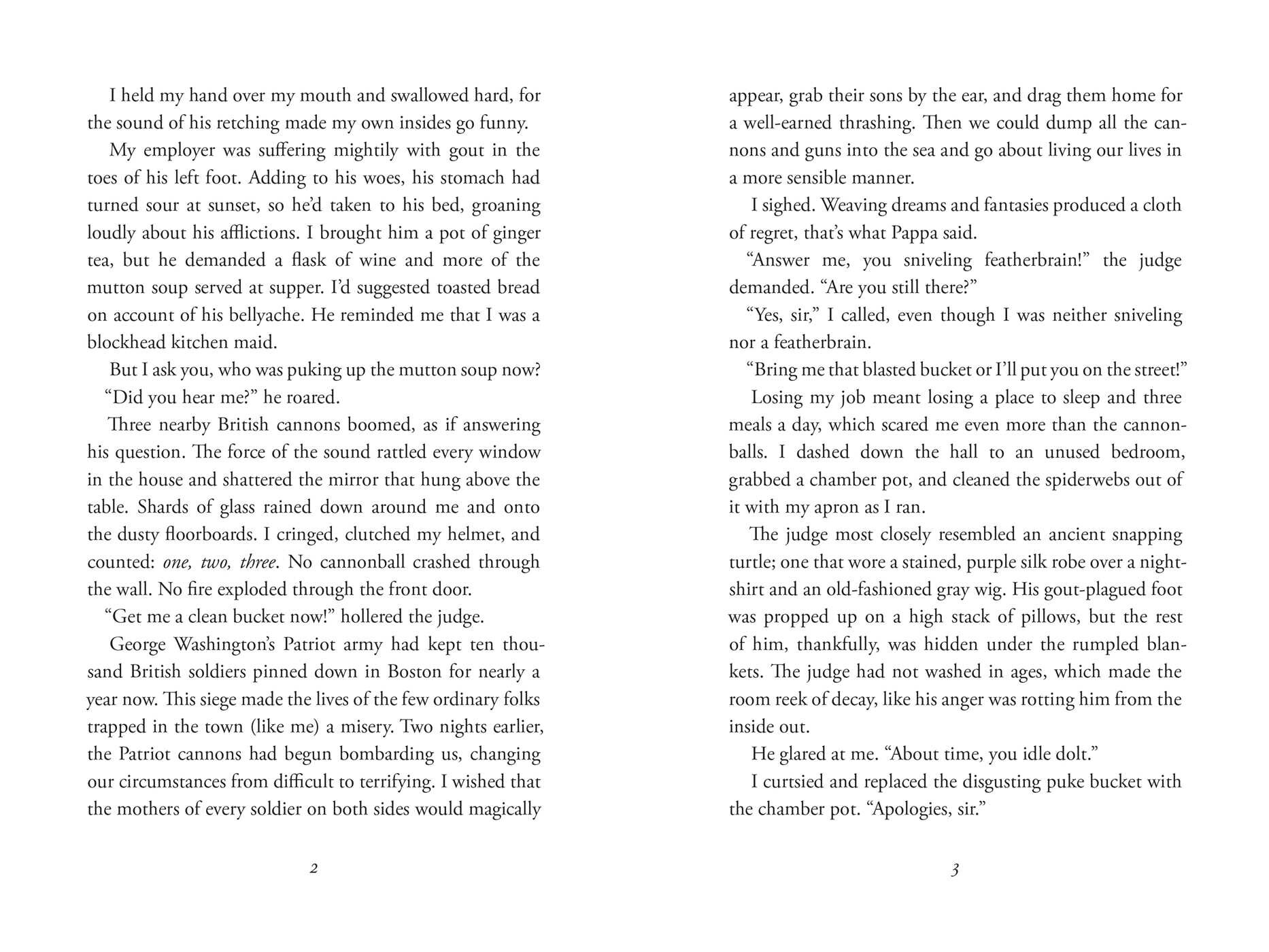
Take away this puke bucket, girl, and bring me a clean one!”
Judge Bellingham bellowed like an angry ox, but I did not move. I couldn’t, not while the Patriot cannons boomed over and over with terrifying thunder. They were aimed at Boston, which meant they were aimed at me.
I was hiding, quite sensibly, under the table at the top of the stairs, in shouting distance of the judge’s bedchamber and far away from any window, in case a cannonball or mortar shell came crashing in. For a helmet, I wore a wooden bowl that smelled of cinnamon. (I’d been mixing a sweet dough in it when the Patriots unleashed more lethal mischief.)
The judge made another loud contribution to his puke bucket.
I held my hand over my mouth and swallowed hard, for the sound of his retching made my own insides go funny.
My employer was suffering mightily with gout in the toes of his left foot. Adding to his woes, his stomach had turned sour at sunset, so he’d taken to his bed, groaning loudly about his afflictions. I brought him a pot of ginger tea, but he demanded a flask of wine and more of the mutton soup served at supper. I’d suggested toasted bread on account of his bellyache. He reminded me that I was a blockhead kitchen maid.
But I ask you, who was puking up the mutton soup now?
“Did you hear me?” he roared.
Three nearby British cannons boomed, as if answering his question. The force of the sound rattled every window in the house and shattered the mirror that hung above the table. Shards of glass rained down around me and onto the dusty floorboards. I cringed, clutched my helmet, and counted: one, two, three. No cannonball crashed through the wall. No fire exploded through the front door.
“Get me a clean bucket now!” hollered the judge.
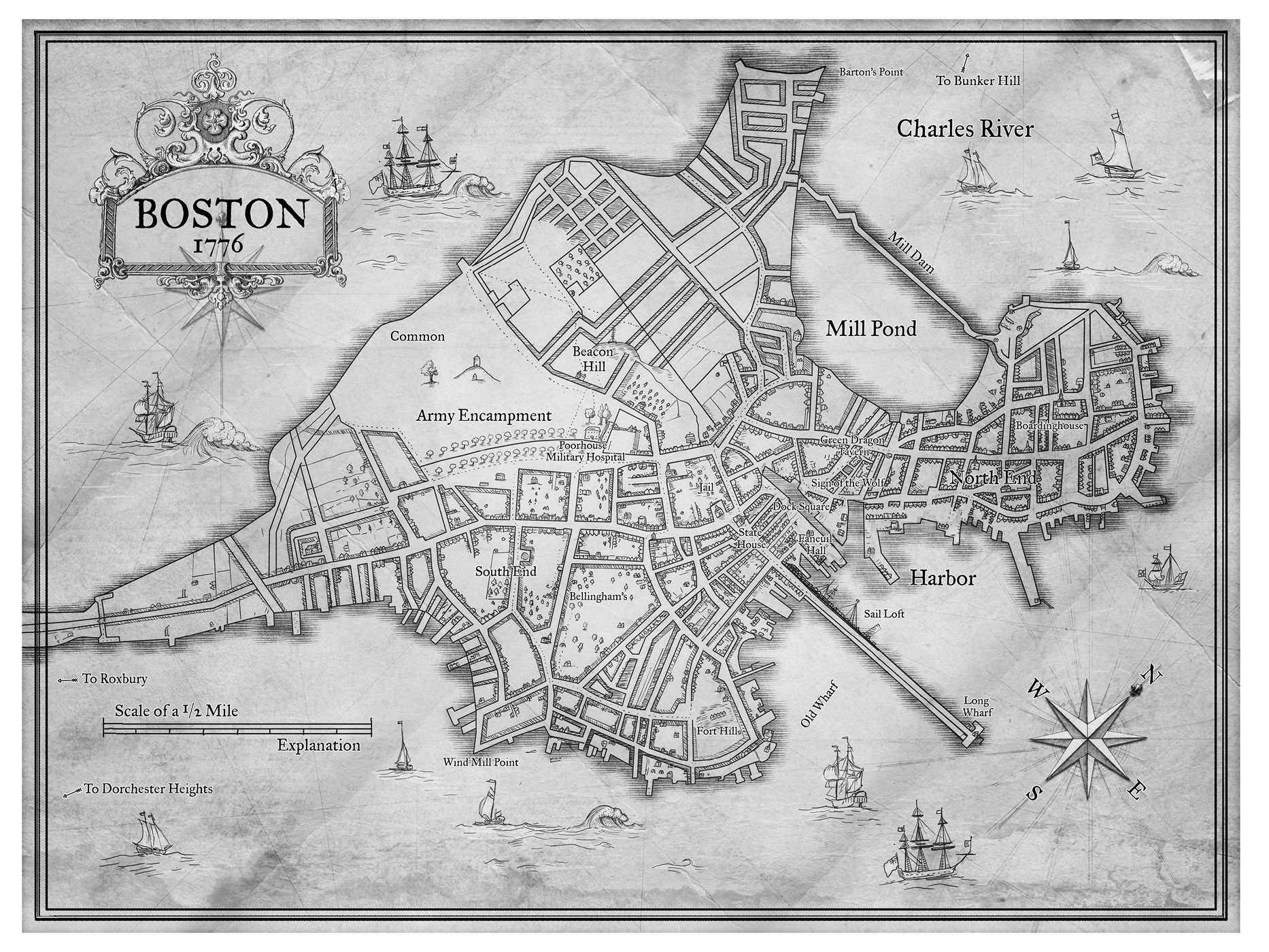
George Washington’s Patriot army had kept ten thousand British soldiers pinned down in Boston for nearly a year now. This siege made the lives of the few ordinary folks trapped in the town (like me) a misery. Two nights earlier, the Patriot cannons had begun bombarding us, changing our circumstances from difficult to terrifying. I wished that the mothers of every soldier on both sides would magically appear, grab their sons by the ear, and drag them home for a well-earned thrashing. Then we could dump all the cannons and guns into the sea and go about living our lives in a more sensible manner.
I sighed. Weaving dreams and fantasies produced a cloth of regret, that’s what Pappa said.
“Answer me, you sniveling featherbrain!” the judge demanded. “Are you still there?”
“Yes, sir,” I called, even though I was neither sniveling nor a featherbrain.
“Bring me that blasted bucket or I’ll put you on the street!”
Losing my job meant losing a place to sleep and three meals a day, which scared me even more than the cannonballs. I dashed down the hall to an unused bedroom, grabbed a chamber pot, and cleaned the spiderwebs out of it with my apron as I ran.
The judge most closely resembled an ancient snapping turtle; one that wore a stained, purple silk robe over a nightshirt and an old-fashioned gray wig. His gout-plagued foot was propped up on a high stack of pillows, but the rest of him, thankfully, was hidden under the rumpled blankets. The judge had not washed in ages, which made the room reek of decay, like his anger was rotting him from the inside out.
He glared at me. “About time, you idle dolt.”
I curtsied and replaced the disgusting puke bucket with the chamber pot. “Apologies, sir.”
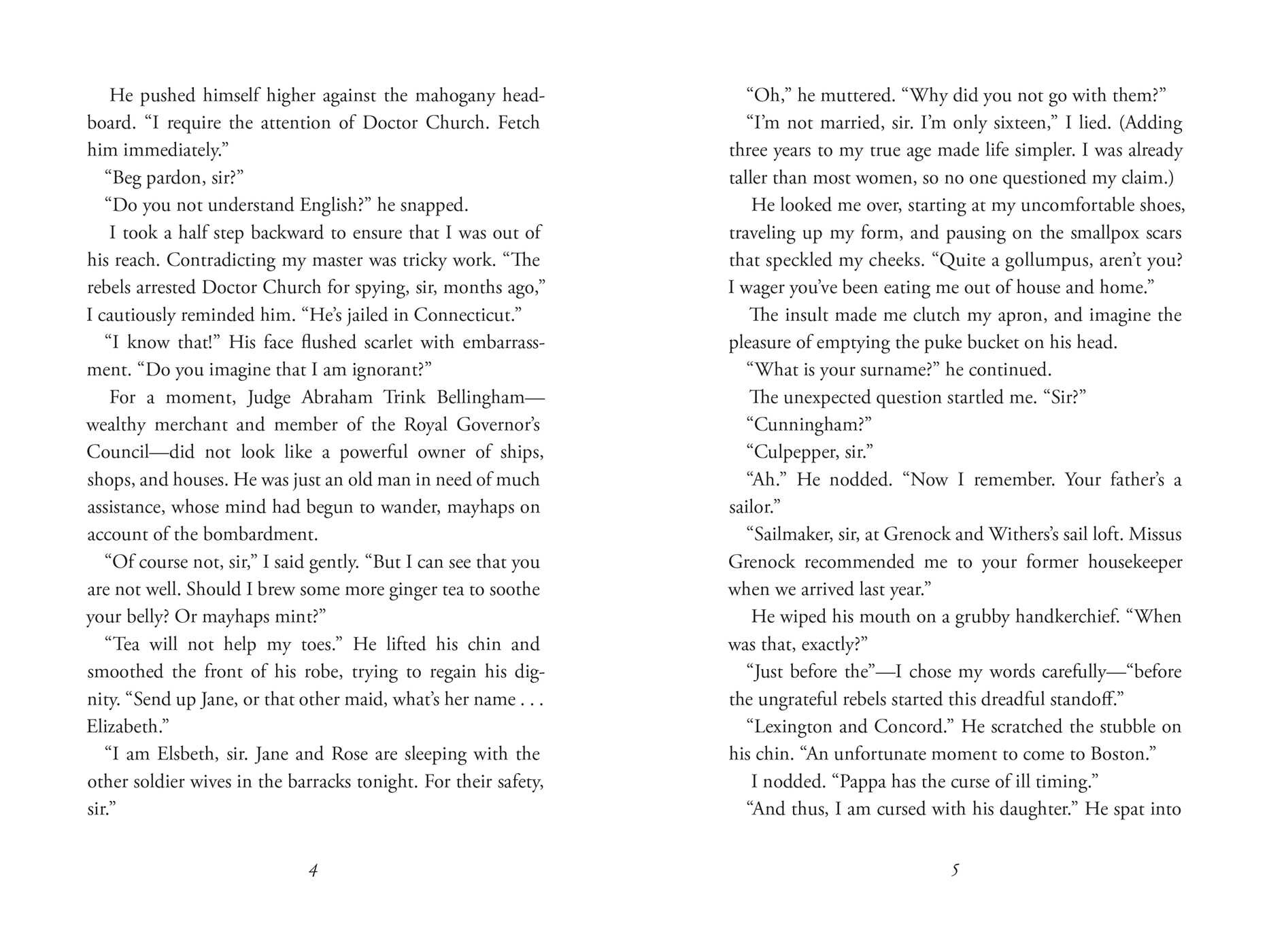
He pushed himself higher against the mahogany headboard. “I require the attention of Doctor Church. Fetch him immediately.”
“Beg pardon, sir?”
“Do you not understand English?” he snapped.
I took a half step backward to ensure that I was out of his reach. Contradicting my master was tricky work. “The rebels arrested Doctor Church for spying, sir, months ago,” I cautiously reminded him. “He’s jailed in Connecticut.”
“I know that!” His face flushed scarlet with embarrassment. “Do you imagine that I am ignorant?”
For a moment, Judge Abraham Trink Bellingham—wealthy merchant and member of the Royal Governor’s Council—did not look like a powerful owner of ships, shops, and houses. He was just an old man in need of much assistance, whose mind had begun to wander, mayhaps on account of the bombardment.
“Of course not, sir,” I said gently. “But I can see that you are not well. Should I brew some more ginger tea to soothe your belly? Or mayhaps mint?”
“Tea will not help my toes.” He lifted his chin and smoothed the front of his robe, trying to regain his dignity. “Send up Jane, or that other maid, what’s her name… Elizabeth.”
“I am Elsbeth, sir. Jane and Rose are sleeping with the other soldier wives in the barracks tonight. For their safety, sir.”
“Oh,” he muttered. “Why did you not go with them?”
“I’m not married, sir. I’m only sixteen,” I lied. (Adding three years to my true age made life simpler. I was already taller than most women, so no one questioned my claim.)
He looked me over, starting at my uncomfortable shoes, traveling up my form, and pausing on the smallpox scars that speckled my cheeks. “Quite a gollumpus, aren’t you? I wager you’ve been eating me out of house and home.”
The insult made me clutch my apron, and imagine the pleasure of emptying the puke bucket on his head.
“What is your surname?” he continued.
The unexpected question startled me. “Sir?”
“Cunningham?”
“Culpepper, sir.”
“Ah.” He nodded. “Now I remember. Your father’s a sailor.”
“Sailmaker, sir, at Grenock and Withers’s sail loft. Missus Grenock recommended me to your former housekeeper when we arrived last year.”
He wiped his mouth on a grubby handkerchief. “When was that, exactly?”
“Just before the”—I chose my words carefully—“before the ungrateful rebels started this dreadful standoff.”
“Lexington and Concord.” He scratched the stubble on his chin. “An unfortunate moment to come to Boston.”
I nodded. “Pappa has the curse of ill timing.”
“And thus, I am cursed with his daughter.” He spat into the chamber pot and looked me over again. “A pockmarked, slothful wench best suited for farmwork.”
His tone had turned sharp again. His wits were no longer wandering.
Ignoring his insults, I tried my best to appear meek, which was not my natural attitude. “We are deeply grateful for your generosity,” I said, gentling my voice, as if trying to calm a rabid dog. “Working in such a respected home is an honor, sir, particularly in this uncertain time.”
Judge Swinehead grabbed his glass. “Fetch me a doctor. I don’t care which one.” He took a big swig of wine. “But I warn you; do not return without a man who will help my toes.”
1. LONG NIGHT OF THE BOMBS
MONDAY, MARCH 4, 1776
… SOON AFTER CANDLELIGHT, CAME ON A MOST TERRIBLE BOMBARDMENT AND CANNONADE, ON BOTH SIDES, AS IF HEAVEN AND EARTH WERE ENGAGED.
—BOSTON SELECTMAN TIMOTHY NEWELL’S JOURNAL
Take away this puke bucket, girl, and bring me a clean one!”
Judge Bellingham bellowed like an angry ox, but I did not move. I couldn’t, not while the Patriot cannons boomed over and over with terrifying thunder. They were aimed at Boston, which meant they were aimed at me.
I was hiding, quite sensibly, under the table at the top of the stairs, in shouting distance of the judge’s bedchamber and far away from any window, in case a cannonball or mortar shell came crashing in. For a helmet, I wore a wooden bowl that smelled of cinnamon. (I’d been mixing a sweet dough in it when the Patriots unleashed more lethal mischief.)
The judge made another loud contribution to his puke bucket.
I held my hand over my mouth and swallowed hard, for the sound of his retching made my own insides go funny.
My employer was suffering mightily with gout in the toes of his left foot. Adding to his woes, his stomach had turned sour at sunset, so he’d taken to his bed, groaning loudly about his afflictions. I brought him a pot of ginger tea, but he demanded a flask of wine and more of the mutton soup served at supper. I’d suggested toasted bread on account of his bellyache. He reminded me that I was a blockhead kitchen maid.
But I ask you, who was puking up the mutton soup now?
“Did you hear me?” he roared.
Three nearby British cannons boomed, as if answering his question. The force of the sound rattled every window in the house and shattered the mirror that hung above the table. Shards of glass rained down around me and onto the dusty floorboards. I cringed, clutched my helmet, and counted: one, two, three. No cannonball crashed through the wall. No fire exploded through the front door.
“Get me a clean bucket now!” hollered the judge.
George Washington’s Patriot army had kept ten thousand British soldiers pinned down in Boston for nearly a year now. This siege made the lives of the few ordinary folks trapped in the town (like me) a misery. Two nights earlier, the Patriot cannons had begun bombarding us, changing our circumstances from difficult to terrifying. I wished that the mothers of every soldier on both sides would magically appear, grab their sons by the ear, and drag them home for a well-earned thrashing. Then we could dump all the cannons and guns into the sea and go about living our lives in a more sensible manner.
I sighed. Weaving dreams and fantasies produced a cloth of regret, that’s what Pappa said.
“Answer me, you sniveling featherbrain!” the judge demanded. “Are you still there?”
“Yes, sir,” I called, even though I was neither sniveling nor a featherbrain.
“Bring me that blasted bucket or I’ll put you on the street!”
Losing my job meant losing a place to sleep and three meals a day, which scared me even more than the cannonballs. I dashed down the hall to an unused bedroom, grabbed a chamber pot, and cleaned the spiderwebs out of it with my apron as I ran.
The judge most closely resembled an ancient snapping turtle; one that wore a stained, purple silk robe over a nightshirt and an old-fashioned gray wig. His gout-plagued foot was propped up on a high stack of pillows, but the rest of him, thankfully, was hidden under the rumpled blankets. The judge had not washed in ages, which made the room reek of decay, like his anger was rotting him from the inside out.
He glared at me. “About time, you idle dolt.”
I curtsied and replaced the disgusting puke bucket with the chamber pot. “Apologies, sir.”
He pushed himself higher against the mahogany headboard. “I require the attention of Doctor Church. Fetch him immediately.”
“Beg pardon, sir?”
“Do you not understand English?” he snapped.
I took a half step backward to ensure that I was out of his reach. Contradicting my master was tricky work. “The rebels arrested Doctor Church for spying, sir, months ago,” I cautiously reminded him. “He’s jailed in Connecticut.”
“I know that!” His face flushed scarlet with embarrassment. “Do you imagine that I am ignorant?”
For a moment, Judge Abraham Trink Bellingham—wealthy merchant and member of the Royal Governor’s Council—did not look like a powerful owner of ships, shops, and houses. He was just an old man in need of much assistance, whose mind had begun to wander, mayhaps on account of the bombardment.
“Of course not, sir,” I said gently. “But I can see that you are not well. Should I brew some more ginger tea to soothe your belly? Or mayhaps mint?”
“Tea will not help my toes.” He lifted his chin and smoothed the front of his robe, trying to regain his dignity. “Send up Jane, or that other maid, what’s her name… Elizabeth.”
“I am Elsbeth, sir. Jane and Rose are sleeping with the other soldier wives in the barracks tonight. For their safety, sir.”
“Oh,” he muttered. “Why did you not go with them?”
“I’m not married, sir. I’m only sixteen,” I lied. (Adding three years to my true age made life simpler. I was already taller than most women, so no one questioned my claim.)
He looked me over, starting at my uncomfortable shoes, traveling up my form, and pausing on the smallpox scars that speckled my cheeks. “Quite a gollumpus, aren’t you? I wager you’ve been eating me out of house and home.”
The insult made me clutch my apron, and imagine the pleasure of emptying the puke bucket on his head.
“What is your surname?” he continued.
The unexpected question startled me. “Sir?”
“Cunningham?”
“Culpepper, sir.”
“Ah.” He nodded. “Now I remember. Your father’s a sailor.”
“Sailmaker, sir, at Grenock and Withers’s sail loft. Missus Grenock recommended me to your former housekeeper when we arrived last year.”
He wiped his mouth on a grubby handkerchief. “When was that, exactly?”
“Just before the”—I chose my words carefully—“before the ungrateful rebels started this dreadful standoff.”
“Lexington and Concord.” He scratched the stubble on his chin. “An unfortunate moment to come to Boston.”
I nodded. “Pappa has the curse of ill timing.”
“And thus, I am cursed with his daughter.” He spat into the chamber pot and looked me over again. “A pockmarked, slothful wench best suited for farmwork.”
His tone had turned sharp again. His wits were no longer wandering.
Ignoring his insults, I tried my best to appear meek, which was not my natural attitude. “We are deeply grateful for your generosity,” I said, gentling my voice, as if trying to calm a rabid dog. “Working in such a respected home is an honor, sir, particularly in this uncertain time.”
Judge Swinehead grabbed his glass. “Fetch me a doctor. I don’t care which one.” He took a big swig of wine. “But I warn you; do not return without a man who will help my toes.”
Reading Group Guide
Join our mailing list! Get our latest staff recommendations, award news and digital catalog links right to your inbox.
By clicking 'Sign me up' I acknowledge that I have read and agree to the privacy policy and terms of use.
Curriculum Guide
Rebellion 1776
By Laurie Halse Anderson
Prereading Activity
1. Discuss the difference between a primary and a secondary source.
2. Read about the Siege of Boston on this website from the Massachusetts Historical Society: https://www.masshist.org/online/siege/index.php. Which type of source are the eyewitness accounts?
3. How does Laurie Halse Anderson make use of primary sources at the beginning of each chapter? Primary sources are considered the “raw materials” of history. Split the class or group into two, then have one team create a list of examples of what would be considered a primary source, and the other team create a list of secondary source examples.
Discussion Questions
1. “Conflict” in a novel is the struggle or problem to be solved. It may be internal, external, or both. What is the conflict within Elsbeth Culpepper? Discuss the external conflict that she faces. How are these conflicts resolved?
2. The antagonist in a work of historical fiction is usually the “bad guy” who stands in the way of the main character. Identify the antagonists in Rebellion 1776. Debate whether the raging rebellion in Boston and the smallpox epidemic may be considered antagonists.
3. What are Elsbeth Culpepper and her father seeking when they move from Philadelphia to Boston? Discuss what they find upon their arrival. How does this change the life they had planned for themselves?
4. Elsbeth’s father is a sailmaker, and he works at the sail loft of Grenock and Withers. Her father never reveals which side of the war he favors. Why is it difficult to stay neutral in Boston at this time? Discuss the circumstances of his disappearance. How does he find his way back to Boston by the end of the novel?
5. Elsbeth Culpepper has been taught that lying is a sin. So why does she lie about her age when she seeks employment at the home of Judge Bellingham? What other lies does she tell, and how does she justify them? Elsbeth says, “One of the many advantages of being a practiced liar was that my ears were sharply tuned to the falsehoods of others.” (Chapter fifteen) Discuss her intuition about the character of Captain Hunter and of Billy Rawdon.
6. Describe the life of a serving girl. Judge Bellingham, a loyalist, flees Boston after the British admit defeat. Why does Elsbeth’s father insist that she stay at the Bellingham house? What forces her to leave?
7. How does Elsbeth end up working for Mister Pike, a shipping tycoon? Explain what Mister Pike means, “‘How remarkable, two rebellious towns in one girl.’” (Chapter seven) Describe Widow Nash, the family’s cook. How do things change when Missus Pike and their seven children arrive?
8. Hannah Sparhawk lives with the Pikes while her guardian, Captain Hunter, is away. What is Elsbeth’s first impression of Hannah? Explain what Elsbeth means, “She [Hannah] was the most puzzlingest person I’d ever met.” (Chapter thirteen) Why does Elsbeth call Hannah a “kindred spirit”?
9. Elsbeth becomes the personal maidservant to Hannah. What are her duties? Explain what she means, “Hannah Sparhawk was the exact opposite of Widow Nash, in the way that summer was to winter or sunshine to rain.” (Chapter eighteen)
10. How does Hannah find out that her grandmother is dead? Why didn’t Missus Pike tell her? Explain how Hannah feels betrayed by Missus Pike. Describe how Elsbeth supports Hannah.
11. Discuss the rules for women and girls in eighteenth-century Boston. How does Elsbeth challenge the rules? Elsbeth goes to the sail loft of Grenock and Withers to see her father. He forbids her to come there again and calls her “‘ignorant of the evils of the world.’” (Chapter four) To what evils is he referring? Cite other times in the novel when her unworldliness gets her in trouble.
12. What is the first clue that the Pikes are broke? Cite evidence that Captain Hunter has the Pikes under his complete control. Why does Elsbeth suspect that the Pikes’ marriage is in “its own sort of battlefield”? (Chapter twenty)
13. Describe Elsbeth’s first encounter with Nyott Doubt. Which side of the war is Doubt on? How do his loyalties confuse Elsbeth? Debate whether his loyalties change as the novel progresses. How does Elsbeth know Mister Doubt has eyes for Hannah?
14. Define epidemic. Describe the smallpox epidemic that is raging in Boston during the novel. How does the city attempt to control the epidemic? Explain what Elsbeth means, “But smallpox interfered with death as much as life.” (Chapter forty)
15. Doctor Crookshank is inoculating patients against smallpox. Describe the procedure. Why is Missus Pike so against inoculation? Explain why Elsbeth doesn’t need to be inoculated. Discuss Elsbeth’s attention to Missus Pike and the children as they become ill after receiving the inoculation. How is she devoted to Hannah in the days leading up to her death?
16. Elsbeth is summoned to a meeting of the Committee of Correspondence, Inspection, and Safety. What is the purpose of the meeting? How does she deduce that Widow Nash is behind this meeting? What makes Widow Nash so sure that Elsbeth is a spy? Explain what happens in the meeting.
17. Discuss what Elsbeth means when she calls Shubel Kent her “boon companion.” (Chapter three) At what point does she fall in love with him?
18. What is the central theme of the novel? Discuss the secondary themes.
Extension Activities
1. Explore and define the differences between inoculation and vaccination. Based on the information gathered, create a Venn Diagram that explains your understanding of the differences in the two procedures, putting any similarities in the overlapping space. Afterward, discuss which of the procedures Dr. Crookshank administers on the Pike family and other citizens of Boston in Rebellion 1776. Why do many people resist his procedure? Research Dr. Edward Jenner, the man credited with developing the smallpox vaccine, on the following website: https://pmc.ncbi.nlm.nih.gov/articles/PMC1200696/. Write a paragraph for a health textbook that discusses how his work eventually eradicated smallpox. Why is his work considered the “foundation of immunology”?
2. Read about the history of the smallpox vaccine on the following website: https://www.who.int/news-room/spotlight/history-of-vaccination/history-of-smallpox-vaccination. Then create a timeline of the vaccine’s development and its use in the United States. Make note of when the last smallpox vaccine was administered. Debate whether it’s likely that smallpox could reemerge in our society.
3. In 1855, Massachusetts became the first state to require that children receive the smallpox vaccine before attending school. Write a letter that the school system might have sent to parents explaining the decision that all school children be vaccinated.
4. Explain why Missus Pike doesn’t approve of young ladies talking about newspapers, politics, and pox. Elsbeth is very much in support of the smallpox vaccine and shares her opinion publicly. Prepare and deliver a speech that Elsbeth might give about the importance of being vaccinated. Make reference to her losing family and friends to the disease.
5. Elsbeth says, “Momma had raised me to do hard things, especially when I didn’t want to.” (Chapter six) Write a letter that Elsbeth might send to Pappa relating the hardest thing she has had to do while living in the Pike household.
6. Historical figures like George Washington, Benjamin Franklin, and Thoman Jefferson are mentioned in the book. Women also played a prominent role in the war. Research one of the following women:
a. Abigail Adams
b. Martha Washington
c. Deborah Sampson
d. Phillis Wheatley
e. Mercy Otis Warren
f. Laura Collins Wolcott
g. Prudence Cummings Wright
Prepare a visual presentation, or write a brief biographical paper about her role in the American Revolution. Include a conclusion that discusses what Elsbeth Culpepper would most admire about this particular female figure.
7. Write a feature article for The Continental Journal about the celebration in Boston on the day the colonies declared independence. Remember to include Who, What, When, and How. Include interviews with Elsbeth Culpepper, Tabitha Pike, Missus Wheeler, Missus Pike, and Shubel Kent.
8. Tabitha Pike considers herself an expert on democracy. Use books in the library or trusted sites on the internet to research the basic tenets of a democratic government. Then write a short paper titled “Democracy and a New Nation” that Tabitha might write for The Continental Journal.
9. Elsbeth says that Billy Rawdon reminds her of a “cunning fox, devious and sly.” (Chapter twenty-five) Discuss the following idioms:
a. Wise as an owl
b. Strong as a bear
c. Fierce as a lion
d. Stubborn as a mule
e. Free as a bird
f. Eyes like a hawk
Select one character from the novel and write a one-page essay that explains which idiom best describes that character. Cite specific scenes or quotes from the novel to support your thoughts.
10. Consider the relationship between Hannah and Elsbeth, and write a eulogy that Elsbeth might deliver at Hannah’s graveside.
Vocabulary and Use of Language
Have students jot down unfamiliar words and define them, taking clues from context. Such words may include:
- lethal (p. 1)
- auspicious (p. 14)
- insolent (p. 68)
- perilous (p. 73)
- perambulate (p. 77)
- desolation (p. 125)
- odious (p. 140)
- demoralizing (p. 161)
- inoculate (p. 178)
- pectoral (p. 327)
Guide written by Pat Scales, a retired middle and high school librarian who is currently a children’s and young adult literature consultant and specializes in curriculum and free speech issues.
This guide has been provided by Simon & Schuster for classroom, library, and reading group use. It may be reproduced in its entirety or excerpted for these purposes
Rebellion 1776
By Laurie Halse Anderson
Prereading Activity
1. Discuss the difference between a primary and a secondary source.
2. Read about the Siege of Boston on this website from the Massachusetts Historical Society: https://www.masshist.org/online/siege/index.php. Which type of source are the eyewitness accounts?
3. How does Laurie Halse Anderson make use of primary sources at the beginning of each chapter? Primary sources are considered the “raw materials” of history. Split the class or group into two, then have one team create a list of examples of what would be considered a primary source, and the other team create a list of secondary source examples.
Discussion Questions
1. “Conflict” in a novel is the struggle or problem to be solved. It may be internal, external, or both. What is the conflict within Elsbeth Culpepper? Discuss the external conflict that she faces. How are these conflicts resolved?
2. The antagonist in a work of historical fiction is usually the “bad guy” who stands in the way of the main character. Identify the antagonists in Rebellion 1776. Debate whether the raging rebellion in Boston and the smallpox epidemic may be considered antagonists.
3. What are Elsbeth Culpepper and her father seeking when they move from Philadelphia to Boston? Discuss what they find upon their arrival. How does this change the life they had planned for themselves?
4. Elsbeth’s father is a sailmaker, and he works at the sail loft of Grenock and Withers. Her father never reveals which side of the war he favors. Why is it difficult to stay neutral in Boston at this time? Discuss the circumstances of his disappearance. How does he find his way back to Boston by the end of the novel?
5. Elsbeth Culpepper has been taught that lying is a sin. So why does she lie about her age when she seeks employment at the home of Judge Bellingham? What other lies does she tell, and how does she justify them? Elsbeth says, “One of the many advantages of being a practiced liar was that my ears were sharply tuned to the falsehoods of others.” (Chapter fifteen) Discuss her intuition about the character of Captain Hunter and of Billy Rawdon.
6. Describe the life of a serving girl. Judge Bellingham, a loyalist, flees Boston after the British admit defeat. Why does Elsbeth’s father insist that she stay at the Bellingham house? What forces her to leave?
7. How does Elsbeth end up working for Mister Pike, a shipping tycoon? Explain what Mister Pike means, “‘How remarkable, two rebellious towns in one girl.’” (Chapter seven) Describe Widow Nash, the family’s cook. How do things change when Missus Pike and their seven children arrive?
8. Hannah Sparhawk lives with the Pikes while her guardian, Captain Hunter, is away. What is Elsbeth’s first impression of Hannah? Explain what Elsbeth means, “She [Hannah] was the most puzzlingest person I’d ever met.” (Chapter thirteen) Why does Elsbeth call Hannah a “kindred spirit”?
9. Elsbeth becomes the personal maidservant to Hannah. What are her duties? Explain what she means, “Hannah Sparhawk was the exact opposite of Widow Nash, in the way that summer was to winter or sunshine to rain.” (Chapter eighteen)
10. How does Hannah find out that her grandmother is dead? Why didn’t Missus Pike tell her? Explain how Hannah feels betrayed by Missus Pike. Describe how Elsbeth supports Hannah.
11. Discuss the rules for women and girls in eighteenth-century Boston. How does Elsbeth challenge the rules? Elsbeth goes to the sail loft of Grenock and Withers to see her father. He forbids her to come there again and calls her “‘ignorant of the evils of the world.’” (Chapter four) To what evils is he referring? Cite other times in the novel when her unworldliness gets her in trouble.
12. What is the first clue that the Pikes are broke? Cite evidence that Captain Hunter has the Pikes under his complete control. Why does Elsbeth suspect that the Pikes’ marriage is in “its own sort of battlefield”? (Chapter twenty)
13. Describe Elsbeth’s first encounter with Nyott Doubt. Which side of the war is Doubt on? How do his loyalties confuse Elsbeth? Debate whether his loyalties change as the novel progresses. How does Elsbeth know Mister Doubt has eyes for Hannah?
14. Define epidemic. Describe the smallpox epidemic that is raging in Boston during the novel. How does the city attempt to control the epidemic? Explain what Elsbeth means, “But smallpox interfered with death as much as life.” (Chapter forty)
15. Doctor Crookshank is inoculating patients against smallpox. Describe the procedure. Why is Missus Pike so against inoculation? Explain why Elsbeth doesn’t need to be inoculated. Discuss Elsbeth’s attention to Missus Pike and the children as they become ill after receiving the inoculation. How is she devoted to Hannah in the days leading up to her death?
16. Elsbeth is summoned to a meeting of the Committee of Correspondence, Inspection, and Safety. What is the purpose of the meeting? How does she deduce that Widow Nash is behind this meeting? What makes Widow Nash so sure that Elsbeth is a spy? Explain what happens in the meeting.
17. Discuss what Elsbeth means when she calls Shubel Kent her “boon companion.” (Chapter three) At what point does she fall in love with him?
18. What is the central theme of the novel? Discuss the secondary themes.
Extension Activities
1. Explore and define the differences between inoculation and vaccination. Based on the information gathered, create a Venn Diagram that explains your understanding of the differences in the two procedures, putting any similarities in the overlapping space. Afterward, discuss which of the procedures Dr. Crookshank administers on the Pike family and other citizens of Boston in Rebellion 1776. Why do many people resist his procedure? Research Dr. Edward Jenner, the man credited with developing the smallpox vaccine, on the following website: https://pmc.ncbi.nlm.nih.gov/articles/PMC1200696/. Write a paragraph for a health textbook that discusses how his work eventually eradicated smallpox. Why is his work considered the “foundation of immunology”?
2. Read about the history of the smallpox vaccine on the following website: https://www.who.int/news-room/spotlight/history-of-vaccination/history-of-smallpox-vaccination. Then create a timeline of the vaccine’s development and its use in the United States. Make note of when the last smallpox vaccine was administered. Debate whether it’s likely that smallpox could reemerge in our society.
3. In 1855, Massachusetts became the first state to require that children receive the smallpox vaccine before attending school. Write a letter that the school system might have sent to parents explaining the decision that all school children be vaccinated.
4. Explain why Missus Pike doesn’t approve of young ladies talking about newspapers, politics, and pox. Elsbeth is very much in support of the smallpox vaccine and shares her opinion publicly. Prepare and deliver a speech that Elsbeth might give about the importance of being vaccinated. Make reference to her losing family and friends to the disease.
5. Elsbeth says, “Momma had raised me to do hard things, especially when I didn’t want to.” (Chapter six) Write a letter that Elsbeth might send to Pappa relating the hardest thing she has had to do while living in the Pike household.
6. Historical figures like George Washington, Benjamin Franklin, and Thoman Jefferson are mentioned in the book. Women also played a prominent role in the war. Research one of the following women:
a. Abigail Adams
b. Martha Washington
c. Deborah Sampson
d. Phillis Wheatley
e. Mercy Otis Warren
f. Laura Collins Wolcott
g. Prudence Cummings Wright
Prepare a visual presentation, or write a brief biographical paper about her role in the American Revolution. Include a conclusion that discusses what Elsbeth Culpepper would most admire about this particular female figure.
7. Write a feature article for The Continental Journal about the celebration in Boston on the day the colonies declared independence. Remember to include Who, What, When, and How. Include interviews with Elsbeth Culpepper, Tabitha Pike, Missus Wheeler, Missus Pike, and Shubel Kent.
8. Tabitha Pike considers herself an expert on democracy. Use books in the library or trusted sites on the internet to research the basic tenets of a democratic government. Then write a short paper titled “Democracy and a New Nation” that Tabitha might write for The Continental Journal.
9. Elsbeth says that Billy Rawdon reminds her of a “cunning fox, devious and sly.” (Chapter twenty-five) Discuss the following idioms:
a. Wise as an owl
b. Strong as a bear
c. Fierce as a lion
d. Stubborn as a mule
e. Free as a bird
f. Eyes like a hawk
Select one character from the novel and write a one-page essay that explains which idiom best describes that character. Cite specific scenes or quotes from the novel to support your thoughts.
10. Consider the relationship between Hannah and Elsbeth, and write a eulogy that Elsbeth might deliver at Hannah’s graveside.
Vocabulary and Use of Language
Have students jot down unfamiliar words and define them, taking clues from context. Such words may include:
- lethal (p. 1)
- auspicious (p. 14)
- insolent (p. 68)
- perilous (p. 73)
- perambulate (p. 77)
- desolation (p. 125)
- odious (p. 140)
- demoralizing (p. 161)
- inoculate (p. 178)
- pectoral (p. 327)
Guide written by Pat Scales, a retired middle and high school librarian who is currently a children’s and young adult literature consultant and specializes in curriculum and free speech issues.
This guide has been provided by Simon & Schuster for classroom, library, and reading group use. It may be reproduced in its entirety or excerpted for these purposes
About The Author
(c) Susanne Kronholm
Laurie Halse Anderson is a New York Times bestselling author known for tackling tough subjects with humor and sensitivity. She’s twice been a National Book Award finalist, for Chains and Speak; Chains also received the Scott O’Dell Award for Historical Fiction. Laurie was chosen for the 2009 Margaret A. Edwards Award and received the Astrid Lindgren Memorial Award in 2023, presented to her by the Crown Princess of Sweden. She lives in Pennsylvania, and you can follow her adventures on X @HalseAnderson or visit her at MadWomanintheForest.com.
Product Details
- Publisher: Atheneum/Caitlyn Dlouhy Books (April 1, 2025)
- Length: 416 pages
- ISBN13: 9781416968269
- Grades: 5 - 9
- Ages: 10 - 14
Browse Related Books
Raves and Reviews
[I]ts themes echo our current tensions: vaccine detractors versus promoters, royalists versus patriots, misogyny versus feminism, old ways of living and loving versus new ways of being true to oneself. [...] There is a fair bit of skulduggery as well — stolen fortunes, false accusations, thefts, betrayals — that adds mystery and suspense.. [...] Filled with immersive detail, expert delineations of complex characters, and both harsh and loving reality, “Rebellion 1776” provides young readers with a true experience of a historic moment in time that resonates with today’s world. To use Elsbeth’s celebratory last word, “Huzzah!”
– New York Times , 3/21/25
One of the narrative’s strengths is Anderson’s ability to create realistically flawed yet often appealing characters and relationships; another is how fully and sensitively she portrays the female characters’ reactions to the limited rights and roles of women in their society. Each chapter opens with a short, relevant quote from the correspondence, journals, or diaries of a notable such as Abigail Adams, John Adams, Ben Franklin, or George Washington. A thoroughly researched, emotionally resonant historical novel.
– Booklist, STARRED Review, 02/01/2025
This well-crafted novel by Anderson (Shout) opens in March 1776, on the eve of the Loyalists’ forced evacuation of Boston. Period details of daily life during the events of the founding of the United State immerse readers in the era, and plot points become compellingly relevant to contemporary times when Boston is hit by the smallpox epidemic and controversies about inoculation abound.
– Publishers Weekly, 2/3/2025
Told through Elsbeth’s clever, feminist, often-humorous perspective, this original and timely story immerses readers in her observations on an epidemic and vaccination, early American politics and society, and the meaning of family. Engrossing, entertaining, and heartfelt.
– Kirkus, 02/1/25
Another masterly account of colonial life from Anderson. [...] The plot is action-packed, reflecting the unprecedented times of the era. Each chapter opens with a quote from a contemporary historical figure, cementing the sense of time and place. Colorful dialogue, including period-accurate insults, i.e., “dunderhead” and “numbskull,” add authenticity. [...] Readers can draw several parallels between Elsbeth’s life and modern times, such as the debate over smallpox inoculation. [...] A must-buy for historical fiction collections, especially where Anderson’s Chains and Fever 1793 are popular.
– School Library Journal, 3/1/25
"Rebellion 1776 is a gripping novel that takes place smack in the middle of a revolution. Laurie Halse Anderson (Speak; Shout; The Seeds of America trilogy) applies her trademark humor, sensitivity, and prodigious other talents to the Revolutionary War, this time from the sharp-witted perspective of a 13-year-old white kitchen maid. [...] Elsbeth's brave though risky stands against unfairness mark her as a feminist in spirit, if not in name. Anderson's fluid and lively storytelling is on full display in Elsbeth's thrilling exploits, clever manipulations, and hilarious wordplay, which shows up in biting parenthetical asides and entertaining insults like "foggy-brained numbskull" and "Captain Fizzlefart." Rebellion 1776 brings the American Revolution to street level, shining a brilliant light on the relevance history always has for the present."
– Shelf Awareness *STARRED REVIEW*, 4/11/25
"Often a footnote in Revolutionary War history, the smallpox epidemic is the focus of Anderson’s compelling and well-researched tale of human frailty and perseverance, fear and courage amid dire circumstances. Through Elsbeth’s whip-smart first-person narration (with asides to readers in parentheses) plus quotes from historical letters opening each chapter, readers learn about the disease, its symptoms and deadliness, the measures taken to contain it, and people’s fear of inoculation. Anderson’s return to historical fiction highlights her mastery of the genre, with well-rounded characters, detailed storytelling, and timely subject matter that make it a must-read for today’s youth."
– Horn Book *STARRED REVIEW*, May/June Issue
Awards and Honors
- ALA Notable Children's Books
- Capital Choices Noteworthy Books for Children's and Teens (DC)
Resources and Downloads
Activity Sheets
High Resolution Images
-
Book Cover Image (jpg): Rebellion 1776
Hardcover 9781416968269
-
Author Photo (jpg): Laurie Halse Anderson (c) Susanne Kronholm(0.1 MB)
Any use of an author photo must include its respective photo credit
Rebellion 1776
Join our mailing list!
By clicking 'Sign me up' I acknowledge that I have read and agree to the privacy policy and terms of use.