Get our latest staff recommendations, award news and digital catalog links right to your inbox.
Published by Manning
Distributed by Simon & Schuster
Table of Contents
About The Book
Get the eBook free when you register your print book at Manning.
"A masterful synthesis of the field’s intellectual roots and its practical tools.”
—Saurabh Sawant, Microsoft
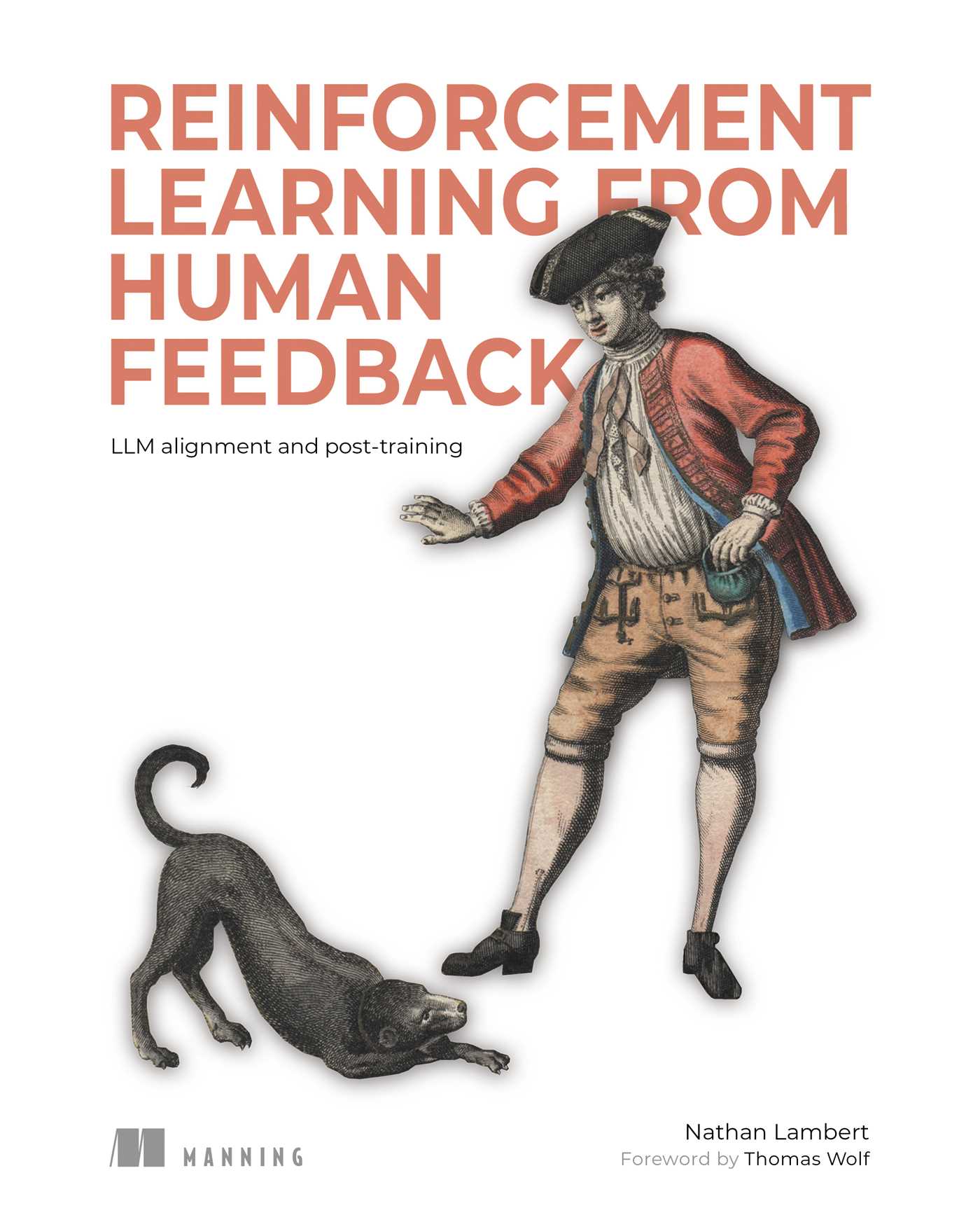
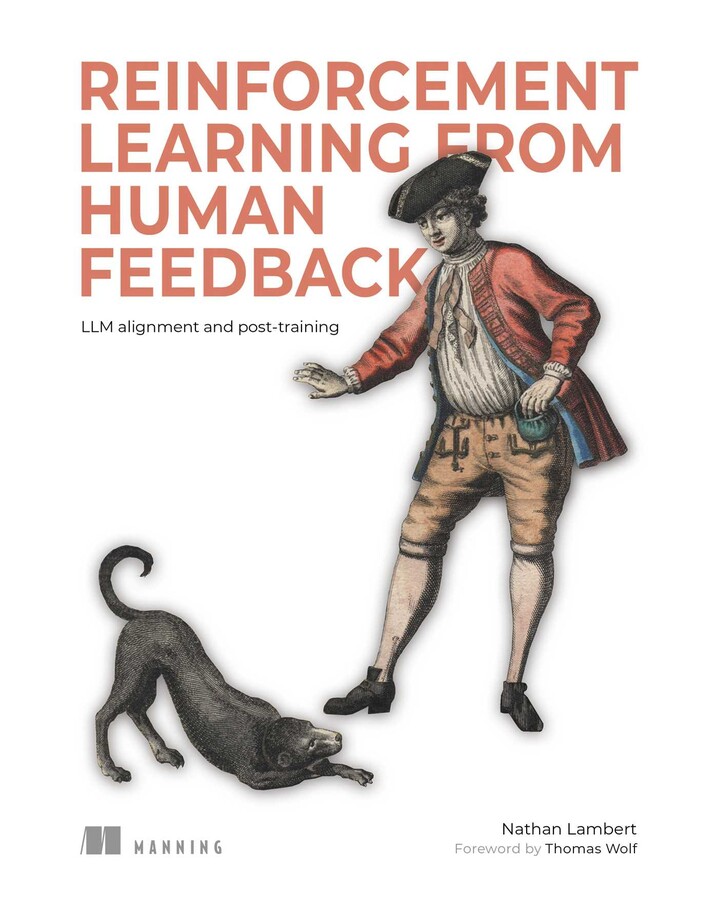
Reinforcement Learning from Human Feedback: LLM alignment and post-training helps you understand how modern AI models can be adapted to better match the needs and expectations of their users. Rather than surveying the vast field of reinforcement learning, elite AI researcher Nathan Lambert concentrates exclusively on RLHF and its immediate importance to post-training generative AI models.
This compact book gets right to the point. Early chapters establish the training overview, explain instruction fine-tuning, and build reliable reward models. The middle chapters transition into the heart of alignment, exploring core policy gradient algorithms, Direct Preference Optimization (DPO), and inference-time scaling. Later chapters tackle the messy reality of data, guiding you through preference data collection, synthetic data generation, and the nuances of function calling.
As you go, you will see how these post-training methods actually work, including their unique compute costs and latency trade-offs. You will explore common failure modes, such as qualitative over-optimization, reward hacking, and the unreliability of external evaluation comparisons. Difficult concepts like KL regularization, proximal policy optimization, and generative reward modeling are clarified with hands-on experiments.
Reinforcement Learning from Human Feedback avoids irrelevant academic details in favor of immediate, practical value. Everything author Nathan Lambert includes appears because a modern RLHF project requires it. He skillfully explains complex post-training pipelines by making every detail concrete, connecting isolated abstractions directly to the goal of making models safer, smarter, and perfectly tuned to a desired style.
The book’s seventeen short chapters lay out the core material, while supplements like vocabulary definitions, compute cost management, evaluation variance, and training performance tracking appear in handy appendixes. The result is a logically flowing book that remains highly navigable and technically deep without getting bogged down in unnecessary theory.
The book covers
• Core RLHF implementations and Direct Alignment Algorithms
• Building robust preference and synthetic data pipelines
• Evaluating models and crafting specific AI personas
About the reader
For established engineers, AI scientists, and students trying to get a practical foothold in AI model alignment.
About the author
Dr. Nathan Lambert is a leading AI researcher known for leading post-training at the Allen Institute for AI. With previous experience at HuggingFace, DeepMind, and Meta, he is a passionate advocate for open models. His work focuses on increasing access to, and the understanding of, AI technology—empowering readers to contribute to the advancement of AI outside closed corporate labs.
Table of Contents
Part 1
1 Introduction
2 A tiny history of RLHF
3 Training overview
Part 2
4 Instruction fine-tuning
5 Reward modeling
6 Reinforcement learning
7 Reasoning and inference-time scaling
8 Direct-alignment algorithms
9 Rejection sampling
Part 3
10 The nature of preferences
11 Preference data
12 Synthetic data
Part 4
13 Tool use and function calling
14 Over-optimization
15 Regularization
16 Evaluation
17 Crafting model character and products
A Definitions
B Beyond “just style”
C Practical Issues
"A masterful synthesis of the field’s intellectual roots and its practical tools.”
—Saurabh Sawant, Microsoft
Reinforcement Learning from Human Feedback: LLM alignment and post-training helps you understand how modern AI models can be adapted to better match the needs and expectations of their users. Rather than surveying the vast field of reinforcement learning, elite AI researcher Nathan Lambert concentrates exclusively on RLHF and its immediate importance to post-training generative AI models.
This compact book gets right to the point. Early chapters establish the training overview, explain instruction fine-tuning, and build reliable reward models. The middle chapters transition into the heart of alignment, exploring core policy gradient algorithms, Direct Preference Optimization (DPO), and inference-time scaling. Later chapters tackle the messy reality of data, guiding you through preference data collection, synthetic data generation, and the nuances of function calling.
As you go, you will see how these post-training methods actually work, including their unique compute costs and latency trade-offs. You will explore common failure modes, such as qualitative over-optimization, reward hacking, and the unreliability of external evaluation comparisons. Difficult concepts like KL regularization, proximal policy optimization, and generative reward modeling are clarified with hands-on experiments.
Reinforcement Learning from Human Feedback avoids irrelevant academic details in favor of immediate, practical value. Everything author Nathan Lambert includes appears because a modern RLHF project requires it. He skillfully explains complex post-training pipelines by making every detail concrete, connecting isolated abstractions directly to the goal of making models safer, smarter, and perfectly tuned to a desired style.
The book’s seventeen short chapters lay out the core material, while supplements like vocabulary definitions, compute cost management, evaluation variance, and training performance tracking appear in handy appendixes. The result is a logically flowing book that remains highly navigable and technically deep without getting bogged down in unnecessary theory.
The book covers
• Core RLHF implementations and Direct Alignment Algorithms
• Building robust preference and synthetic data pipelines
• Evaluating models and crafting specific AI personas
About the reader
For established engineers, AI scientists, and students trying to get a practical foothold in AI model alignment.
About the author
Dr. Nathan Lambert is a leading AI researcher known for leading post-training at the Allen Institute for AI. With previous experience at HuggingFace, DeepMind, and Meta, he is a passionate advocate for open models. His work focuses on increasing access to, and the understanding of, AI technology—empowering readers to contribute to the advancement of AI outside closed corporate labs.
Table of Contents
Part 1
1 Introduction
2 A tiny history of RLHF
3 Training overview
Part 2
4 Instruction fine-tuning
5 Reward modeling
6 Reinforcement learning
7 Reasoning and inference-time scaling
8 Direct-alignment algorithms
9 Rejection sampling
Part 3
10 The nature of preferences
11 Preference data
12 Synthetic data
Part 4
13 Tool use and function calling
14 Over-optimization
15 Regularization
16 Evaluation
17 Crafting model character and products
A Definitions
B Beyond “just style”
C Practical Issues
Product Details
- Publisher: Manning (August 11, 2026)
- Length: 312 pages
- ISBN13: 9781638358152
Browse Related Books
Resources and Downloads
High Resolution Images
-
Book Cover Image (jpg): Reinforcement Learning from Human Feedback
eBook 9781638358152
Published by Manning
Distributed by Simon & Schuster
Join our mailing list!
By clicking 'Sign me up' I acknowledge that I have read and agree to the privacy policy and terms of use.