
Get our latest staff recommendations, award news and digital catalog links right to your inbox.
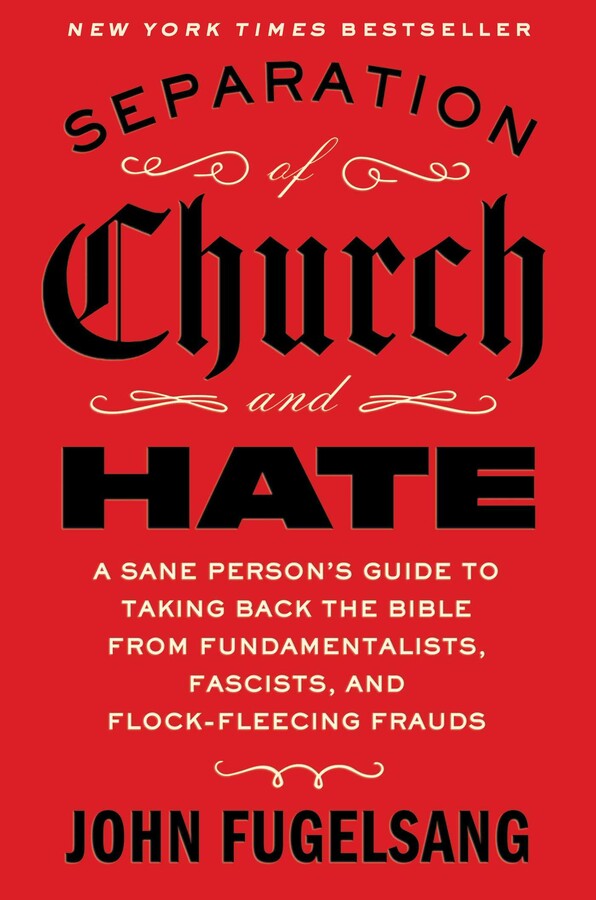
Separation of Church and Hate
A Sane Person's Guide to Taking Back the Bible from Fundamentalists, Fascists, and Flock-Fleecing Frauds
Table of Contents
About The Book
NEW YORK TIMES BESTSELLER * In the spirit of George Carlin and Christopher Hitchens, the son of a former Catholic nun and a Franciscan brother delivers a deeply irreverent and biblically correct takedown of far-right Christian hatred—a book for believers, atheists, agnostics, and anyone who’ll ever have to deal with a Christian nationalist.
For more than two centuries, the United States Constitution has given us the right to a society where church and state exist independently. But Christianity has been hijacked by far-right groups and politicians who seek to impose their narrow views on government, often to justify oppressive and unequal policies. The extremists who weaponize the Bible for earthly power aren’t actually on the side of Jesus—and historically they never have been. How do we fight back against those acting—literally—in bad faith?
Comedian and broadcaster John Fugelsang finally offers the answers. In this informative, perspective-shifting book, Fugelsang takes readers through common fundamentalist arguments on abortion, immigration, LGBTQ rights, and more—exposing their hypocrisy and inaccuracy through scripture, common sense, and deeply inappropriate humor. It offers practical tips on how to debate your loved one, coworker, or neighbor on the issues that divide us using that Bible they claim to follow.
But Fugelsang’s message is about more than just taking down hypocrites. It’s about fighting for the love, mercy, and service that are supposed to make up the heart of Christianity. Told with Fugelsang’s trademark blend of radical honesty, comedy, and deep political and religious knowledge, Separation of Church and Hate is the book every American needs today. It’s a rallying cry for compassion and clarity for anyone of any faith who’s sick of religion being used as a cloaking device for hate.
For more than two centuries, the United States Constitution has given us the right to a society where church and state exist independently. But Christianity has been hijacked by far-right groups and politicians who seek to impose their narrow views on government, often to justify oppressive and unequal policies. The extremists who weaponize the Bible for earthly power aren’t actually on the side of Jesus—and historically they never have been. How do we fight back against those acting—literally—in bad faith?
Comedian and broadcaster John Fugelsang finally offers the answers. In this informative, perspective-shifting book, Fugelsang takes readers through common fundamentalist arguments on abortion, immigration, LGBTQ rights, and more—exposing their hypocrisy and inaccuracy through scripture, common sense, and deeply inappropriate humor. It offers practical tips on how to debate your loved one, coworker, or neighbor on the issues that divide us using that Bible they claim to follow.
But Fugelsang’s message is about more than just taking down hypocrites. It’s about fighting for the love, mercy, and service that are supposed to make up the heart of Christianity. Told with Fugelsang’s trademark blend of radical honesty, comedy, and deep political and religious knowledge, Separation of Church and Hate is the book every American needs today. It’s a rallying cry for compassion and clarity for anyone of any faith who’s sick of religion being used as a cloaking device for hate.
Reading Group Guide
Join our mailing list! Get our latest staff recommendations, award news and digital catalog links right to your inbox.
By clicking 'Sign me up' I acknowledge that I have read and agree to the privacy policy and terms of use.
Reading Group Guide
Separation of Church and Hate
John Fugelsang
Introduction
Separation of Church and Hate is a probing, insightful, and witty look at the ways that Christian nationalists misconstrue the Biblical teachings of Jesus. Written by John Fugelsang, the son of a nun and a Franciscan priest, this book is a guide to taking down hypocrites and to fighting for the love, mercy, and service that are supposed to be at the heart of the Christian faith. Fugelsang writes with heart and humor as he pulls from both his background in comedy and his deep personal knowledge of Biblical teaching.
Discussion Questions
1. Early in the book, the author emphasizes the power of Jesus’s storytelling through parables, his style of communicating in a highly accessible way for the masses. How is this similar to or different from styles of sermonizing and communicating today?
2. Are you surprised by how brief Jesus’s teaching career was? If more people knew that Jesus only taught for three years, do you think that would change how his messages are perceived?
3. What was the Sermon on the Mount? Does the author shine light on any details of this famous speech that you find surprising?
4. The author references Rev. Dr. Susan Thistlethwaite several times. At one instance, he quotes her, saying, “ ‘Jesus’s teachings were codified under oppressive Roman rule . . . The ministry of Jesus is clearly a rejection of the state as religiously sanctified’ ” (26). How is this an example of irony?
5. On pages 48 and 49, the author lists differences between Jesus and the famous New Testament figure of Paul. At the end, the author states that “like most Christians, Paul was a flawed human and not, in fact, Jesus. Paul put his hang-ups into the work, and Jesus’s movement inherited them” (49). Why do you think some Christian nationalists have embraced the teachings of Paul over the teachings of Jesus?
6. Do you agree with the author that the opposite of faith is certainty? The author names figures who exemplify this throughout the book. Can you think of anyone else who embodies this statement in their faith and their politics
7. In the chapter “Master-Race Christians of the Twenty-First Century, and How to Debate Them,” the author challenges the popular belief that the United States was created to be a strictly Christian nation. After reading this, how would you argue with a Christian nationalist relative? What specifically would you cite to try to convince them to question their stance?
8. When debating a Christian nationalist, the author suggests that one “engage gently. Debate if need be. Stay relaxed, don’t be intimidated, and try to frame your points around asking questions” (61). Does this mirror Jesus’s style of debating and refuting the Pharisees? How might someone respond to an argument framed around questions as opposed to an argument framed around absolutes?
9. “Jesus’s longest recorded private conversation with anyone in the Bible” (91) is that in which he speaks with the Samaritan woman (a countercultural act in itself, as Jews and Samaritans were not supposed to interact). After this conversation, many people in the woman’s community came to follow Jesus. What does this say about the power of a simple conversation, of taking the time to speak and to listen? In such a polarized society, how might you gradually move toward peaceful conversations with those who have different backgrounds?
10. John Fugelsang is a comedian engaging, in this book, with an urgent and divisive topic. Other than causing you to laugh aloud while reading, what joys and even advantages does a comedic stance bring to the conversation about Christian nationalism? Do you think you would have been impacted in the same way if this book were not written by a comedian?
11. Jewish law and Christian doctrine vary significantly, including on the topic of abortion and fetal viability. Do you see any parallels between the development and enforcing of Christian doctrine (Pope Pius IX and fetal viability, page 150, for example) and the development and enforcing of laws and right-leaning political ideals today?
12. Much of this book is, ultimately, about the character of Jesus—who he was, what he stood for, and how his teachings are misconstrued. After reading, do you think Jesus is a character many Americans, religious or not, should hold as a role model? Do you think communicating the actual teachings of Jesus would help America heal, or should we move away from spiritual/religious figures entirely?
Separation of Church and Hate
John Fugelsang
Introduction
Separation of Church and Hate is a probing, insightful, and witty look at the ways that Christian nationalists misconstrue the Biblical teachings of Jesus. Written by John Fugelsang, the son of a nun and a Franciscan priest, this book is a guide to taking down hypocrites and to fighting for the love, mercy, and service that are supposed to be at the heart of the Christian faith. Fugelsang writes with heart and humor as he pulls from both his background in comedy and his deep personal knowledge of Biblical teaching.
Discussion Questions
1. Early in the book, the author emphasizes the power of Jesus’s storytelling through parables, his style of communicating in a highly accessible way for the masses. How is this similar to or different from styles of sermonizing and communicating today?
2. Are you surprised by how brief Jesus’s teaching career was? If more people knew that Jesus only taught for three years, do you think that would change how his messages are perceived?
3. What was the Sermon on the Mount? Does the author shine light on any details of this famous speech that you find surprising?
4. The author references Rev. Dr. Susan Thistlethwaite several times. At one instance, he quotes her, saying, “ ‘Jesus’s teachings were codified under oppressive Roman rule . . . The ministry of Jesus is clearly a rejection of the state as religiously sanctified’ ” (26). How is this an example of irony?
5. On pages 48 and 49, the author lists differences between Jesus and the famous New Testament figure of Paul. At the end, the author states that “like most Christians, Paul was a flawed human and not, in fact, Jesus. Paul put his hang-ups into the work, and Jesus’s movement inherited them” (49). Why do you think some Christian nationalists have embraced the teachings of Paul over the teachings of Jesus?
6. Do you agree with the author that the opposite of faith is certainty? The author names figures who exemplify this throughout the book. Can you think of anyone else who embodies this statement in their faith and their politics
7. In the chapter “Master-Race Christians of the Twenty-First Century, and How to Debate Them,” the author challenges the popular belief that the United States was created to be a strictly Christian nation. After reading this, how would you argue with a Christian nationalist relative? What specifically would you cite to try to convince them to question their stance?
8. When debating a Christian nationalist, the author suggests that one “engage gently. Debate if need be. Stay relaxed, don’t be intimidated, and try to frame your points around asking questions” (61). Does this mirror Jesus’s style of debating and refuting the Pharisees? How might someone respond to an argument framed around questions as opposed to an argument framed around absolutes?
9. “Jesus’s longest recorded private conversation with anyone in the Bible” (91) is that in which he speaks with the Samaritan woman (a countercultural act in itself, as Jews and Samaritans were not supposed to interact). After this conversation, many people in the woman’s community came to follow Jesus. What does this say about the power of a simple conversation, of taking the time to speak and to listen? In such a polarized society, how might you gradually move toward peaceful conversations with those who have different backgrounds?
10. John Fugelsang is a comedian engaging, in this book, with an urgent and divisive topic. Other than causing you to laugh aloud while reading, what joys and even advantages does a comedic stance bring to the conversation about Christian nationalism? Do you think you would have been impacted in the same way if this book were not written by a comedian?
11. Jewish law and Christian doctrine vary significantly, including on the topic of abortion and fetal viability. Do you see any parallels between the development and enforcing of Christian doctrine (Pope Pius IX and fetal viability, page 150, for example) and the development and enforcing of laws and right-leaning political ideals today?
12. Much of this book is, ultimately, about the character of Jesus—who he was, what he stood for, and how his teachings are misconstrued. After reading, do you think Jesus is a character many Americans, religious or not, should hold as a role model? Do you think communicating the actual teachings of Jesus would help America heal, or should we move away from spiritual/religious figures entirely?
About The Author
Victor Jeffreys
John Fugelsang has been murdered on CSI and picketed by the Westboro Baptist Church. He’s a Drama League–nominated actor, comedian, and broadcaster who’s hosted many TV shows and podcasts, including the acclaimed Tell Me Everything series on SiriusXM Progress. He’s gotten George Harrison to give his final performance on VH1, debated Jerry Falwell and David Duke, and made many appearances on MSNBC, FOX News, and CNN. His epic PBS road trip film on the American Dream, Dream On, directed by Roger Weisberg, was named Best Documentary at the New York Independent Film Festival. Fugelsang lives in New York City with his family.
Product Details
- Publisher: Avid Reader Press/Simon & Schuster (September 9, 2025)
- Length: 304 pages
- ISBN13: 9781668066898
Browse Related Books
Raves and Reviews
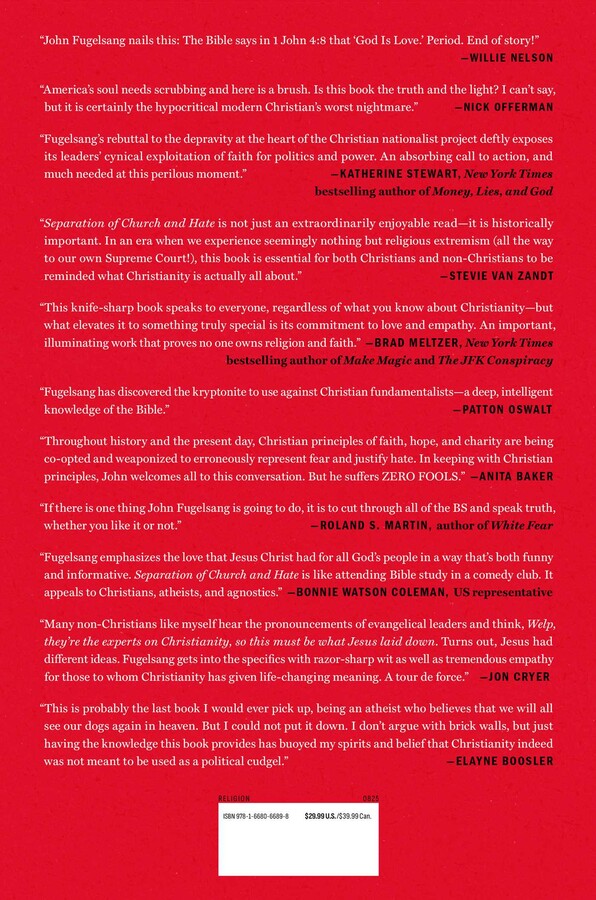
“John Fugelsang nails this in his book, Separation of Church and Hate: The Bible says in 1 John 4:8 that ‘God Is Love.’ Period…end of story!” —Willie Nelson
“America’s soul needs scrubbing and here is a brush. Is this book the truth and the light? I can’t say, but it is certainly the hypocritical modern Christian’s worst nightmare.” —Nick Offerman
“God, I love this book. So brilliant and wise, rich in spiritual knowledge and humor, an exhilarating response to Christian nationalists, and a master class in Jesus, the true and Jesus-y Jesus, of love, caring and forgiveness.” —Anne Lamott
“Commentator and comedian Fugelsang invites readers into an openhearted conversation about the uneasy, unsavory union of politics and religion—not an easy conversation, he allows, but a necessary one. He invites laughter as he walks through scripture in order to reclaim it. . . . What’s a concerned, sane person to do when fundamentalists, frauds, and fascists become the face of a faith? In his first book, Fugelsang’s funny, everyman tone and commonsense approach deliver a compelling call to help fight back.” —Booklist
“A long-overdue and bold endeavor . . . Fugelsang is remarkably respectful of those he debates, at a time when seemingly so few on social media are, and let alone while discussing religion. . . . This is the kind of book that can open a door for many, and afford them some all too rare common ground.” —Pop Matters
“Potent . . . The author’s blend of theology and humor energizes his thought-provoking talking points. Christians looking to push back against fundamentalist teachings will find plenty of ammunition in this acerbic and accessible treatise.” —Publishers Weekly
“Writing as a follower of Jesus steeped in the values of social justice, Fugelsang’s rebuttal to the depravity at the heart of the Christian nationalist project deftly exposes its leaders’ cynical exploitation of faith for politics and power. An absorbing call to action, and much needed at this perilous moment.” —Katherine Stewart, New York Times bestselling author of Money, Lies, and God
“Separation of Church and Hate is not just an extraordinarily enjoyable read—it is historically important. In an era where we experience seemingly nothing but religious extremism (impossibly all the way to our own Supreme Court!), this book is essential for both Christians and non-Christians to be reminded what Christianity is actually all about.” —Stevie Van Zandt
“This knife-sharp book speaks to everyone, regardless of what you know about Christianity—but what elevates it to something truly special is its commitment to love and empathy. John Fugelsang is tired of religion being used as a cover for meanness. He’s not alone. An important, illuminating work that proves no one owns religion and faith.” —Brad Meltzer, New York Times bestselling author of Make Magic and The JFK Conspiracy
“Fugelsang has discovered the Kryptonite to use against Christian fundamentalists—a deep, intelligent knowledge of the Bible.” —Patton Oswalt
“Separation of Church and Hate is a bracing, hilarious repudiation of how far American Christian nationalism has strayed from the teachings of the guy it is literally named after. Many non-Christians like myself hear the pronouncements of evangelical leaders and think, ‘Welp, they’re the experts on Christianity, so this must be what Jesus laid down.’ Turns out, the man himself had very different ideas. Fugelsang gets into the specifics with razor-sharp wit as well as tremendous empathy for those for whom Christianity has given life-changing meaning. It’s a tour de force comedic repossession of biblical Christianity from those who would twist it into unrecognizable ugliness.” —Jon Cryer
“I always thought I grew up very Catholic. Then I met John and realized, I was Diet Catholic. Same guilt; half the calories. This book is a must read in a time where faith seems to leave many with very little faith. It’s not about religion. It’s a book about beliefs. And John does a fantastic job explaining the difference between the two.” —Cristela Alonzo, author of Music to My Years
“As John Fugelsang irreverently documents, that Christian Deity has yet to declare affiliation to, and/or affinity for, any political party! And yet, throughout history and the present day, Christian principles of faith, hope, and charity are being co-opted and weaponized to erroneously represent fear and justify hate. In keeping with Christian principles, John welcomes all to this conversation. But, as always, he suffers ZERO FOOLS.” —Anita Baker
“If there is one thing John Fugelsang is going to do, that is cut through all of the BS and speak truth, whether you like it or not. And he does that in this book. Repeatedly.” —Roland S. Martin, author of White Fear: How the Browning of America Is Making White Folks Lose Their Minds
“Fugelsang, drawing on his personal experience and careful research, emphasizes the love that Jesus Christ had for all God’s people in a way that’s both funny and informative. He deftly excoriates the arguments of the bigots that seek to divide us while injecting humor into a discussion of faith. Separation of Church and Hate is like attending bible study in a comedy club. It appeals to Christians, atheists, and agnostics. Nuggets for all.” —Bonnie Watson Coleman, member of Congress
“This is probably the last book I would ever pick up, being an atheist who believes in spirituality, the golden rule, and that we will all see our dogs again in heaven. But being a huge fan of John’s I wanted to read it. I could not put it down. I don’t argue with brick walls but just having the knowledge this book provides has buoyed my spirits and belief that Christianity indeed was not meant to be used as a political cudgel. This is such an enlightening read.
Separation of Church and Hate is the windswept saga of one woman’s determined gumption to overcome—wait. Sorry. Wrong book. Separation of Church and Hate is the best (and only) book you will ever read that restores biblical quotes to the people who actually said them, putting a halt to the current crop of political ‘religious’ activists using Jesus' alleged sermons to support their own intolerance and campaigns of hate. I learned so much. No, Jesus never said ‘The New York Mets are a good young team.’ That was Thomas Aquinas. Read this book.” —Elayne Boosler
“I don’t recognize the hateful version of ‘Christianity’ a lot of people have sold to the masses. John has written a necessary, HILARIOUS book that breaks down all the ways the hateful have gotten it wrong, while simultaneously giving those of us who believe that Jesus is LOVE the needed reminder that we aren’t crazy. Thank you, John!” —Yvette Nicole Brown
“I laughed out loud. I paused to think. If so many of our nation’s wounds come from the weaponization of Christianity, John reminds us that holding onto faith, hope, and love is essential in our work to tend to our shared trauma. In Separation of Church and Hate, a comedian shall lead them—take and read.” —Joel Edward Goza, author of Rebirth of a Nation: Reparations and Remaking America, and Professor of Ethics at the HBCU Simmons College of Kentucky
“John Fugelsang’s careful reading of the Bible provides hundreds of examples of sacred text which deliver values and messages which diametrically contradict those preached by Christian nationalists. The same Jesus who taught ‘God is Love’ is unlikely to bless hatred, the death of empathy, and the abandonment of the least among us.” —Don Beyer, member of Congress
Resources and Downloads
High Resolution Images
-
Book Cover Image (jpg): Separation of Church and Hate
Hardcover 9781668066898
-
Author Photo (jpg): John Fugelsang Victor Jeffreys(0.1 MB)
Any use of an author photo must include its respective photo credit
Separation of Church and Hate
A Sane Person's Guide to Taking Back the Bible from Fundamentalists, Fascists, and Flock-Fleecing Frauds
Join our mailing list!
By clicking 'Sign me up' I acknowledge that I have read and agree to the privacy policy and terms of use.