
Get our latest staff recommendations, award news and digital catalog links right to your inbox.
Table of Contents
About The Book
For fans of Beth Lincoln’s The Swifts comes a “delightful, charming” (Shelf Awareness, starred review) mystery filled with cryptic clues and wonderful word puzzles as two cousins search for their grandmother’s missing portrait.
Twelve-year-old Bea from Passaic, New Jersey, is visiting her family in Paris for the summer when her grandmother’s most precious heirloom—a drawing by Henri Matisse—goes missing. After a cryptic clue arrives on Bea’s doorstep suggesting its whereabouts, Bea is determined to pursue the lead.
Without the French skills to navigate her way around the landmarks of Paris, she teams up with her cousin, Céline, whose clear-eyed French directness makes her a perfect partner for curious, problem-solving Bea. The girls embark on a city-wide search, deciphering riddles, solving puzzles, and cracking codes as they try to locate the Matisse, find a thief, and identify their mysterious benefactor.
Twelve-year-old Bea from Passaic, New Jersey, is visiting her family in Paris for the summer when her grandmother’s most precious heirloom—a drawing by Henri Matisse—goes missing. After a cryptic clue arrives on Bea’s doorstep suggesting its whereabouts, Bea is determined to pursue the lead.
Without the French skills to navigate her way around the landmarks of Paris, she teams up with her cousin, Céline, whose clear-eyed French directness makes her a perfect partner for curious, problem-solving Bea. The girls embark on a city-wide search, deciphering riddles, solving puzzles, and cracking codes as they try to locate the Matisse, find a thief, and identify their mysterious benefactor.
Excerpt
Chapter 1 • 1 •
The envelope on the floor was sealed with red wax and addressed to “La jeune fille,” elegantly written in fountain pen. There was no stamp or even an apartment number: it had been slipped under the door overnight.
Bea put aside her dog-eared copy of 101 Brain-Bending Puzzles and crouched down to inspect the envelope. Although she was still a beginner at French, she knew enough to understand that it said “The young girl.” She opened the door and swiveled her head both ways to check the landing, but there was no one to be seen.
Back inside she thumbed the ridges of the embossed seal. Why would someone send her a letter? She had been in Paris for only a week, and apart from her aunt and grandmother, she didn’t know anyone in the city. Her parents were both away at a conference, so Bea had been shipped off to stay with family in France. And the only other person in the apartment was Aunt Juliette. The note definitely wasn’t meant for her aunt. Aunt Juliette was a femme not a fille.
Maybe someone had slid it under the wrong door by accident.
“Coucou!” Aunt Juliette called out just then, as she swept into the hallway in her blue cotton pajamas. Even though Aunt Juliette was fluent in English, she liked to sprinkle her sentences with French words to help widen Bea’s vocabulary. She had already explained that coucou was a cross between “hi” and “peekaboo,” which seemed like a pretty childish thing for adults to be saying to one another.
Before her aunt had the chance to ask any questions, Bea shoved the envelope into her pocket—she didn’t want to get in trouble for snooping before she’d even found out anything snoopworthy—and greeted her aunt the way she always did in the morning: “Salut.”
“Can you grab us some pastries for breakfast from La Boulangerie Beaumarchais?” Aunt Juliette pressed a five-euro bill into her palm. “The usual, please.” That meant a chocolate croissant with sliced almonds on top.
“And can you drop this off at your grandmother’s for me?” Aunt Juliette passed her a heavy book with a pastry chef posing next to a pyramid of brightly colored macarons on the cover. “Tell her I’m sorry I’ve kept it so long. Anyway, I need to hop in the shower. I’m late for work.”
Work—that was all Aunt Juliette ever seemed to do. As a journalist at a weekly news magazine, she had been too busy to do anything even remotely fun since Bea had arrived in France. Every morning Bea would gaze out the kitchen window at all the people going about their day, knowing that she’d be stuck inside until her aunt came home at night. Sometimes, she would visit Mamie, her grandmother, and keep her company in the antique store for a few hours, though there was only so much she could do to help since she barely spoke French. She mostly felt like she was taking up space.
What was Bea going to tell everyone back home when they asked about her trip? They probably wouldn’t want to hear about the opera singer across the street who belted out arias from her balcony every morning, or the tone-deaf boy in the apartment next door who screeched his way through violin lessons every afternoon, or the elderly woman with the wheezing pug who shuffled along the street together so sluggishly every evening it looked as though they were competing to see who could move the slowest.
When Bea’s mom and dad first told her they were sending her to France, they’d made it sound like some kind of amazing adventure. Aunt Juliette was going to take her up the Eiffel Tower, she was going to go horseback riding in the Bois de Vincennes, and maybe they would even take a cruise along the River Seine. Now here Bea was, stuck in her aunt’s apartment for another week. So much for an adventure.
Just as she was about to leave the apartment, Bea thought about the mysterious envelope in her pocket. With the faint sound of the shower running in the bathroom, she saw her chance. She put the heavy book and the five-euro bill on the table, took out the envelope, and grabbed a knife from the kitchen, which she used to carefully slice the squiggly symbol on the wax seal in two.
Peering inside the envelope, she found a small padlock key and a handwritten note:
La chasse au trésor
(La date limite : 17h00, jeudi, le 29 juillet)
She had no idea what that meant, except she was pretty sure juillet meant “July.” She flipped the piece of paper over and read the rest:
(1/5)
In eastern Paris, a rock star’s life is not forgotten,
as the path to his grave remains well-trodden.
As for me, my wit is legendary.
I draw a crowd, even in a cemetery.
Loyal fans show their appreciation with a kiss,
and if you follow their footsteps, you’ll find something amiss.
But now, the first order of the day.
Rearrange these letters and you’ll be well on your way:
I, Earl Peaches
Earl Peaches? Who? Was it a riddle?
Bea was used to figuring out puzzles. Logic puzzles, brainteasers, math problems—they were kind of her thing, or at least they used to be. But the bigger puzzle here was why she had received the note in the first place.
At least now she had something that would keep her mind busy during the long day ahead. But Aunt Juliette would be expecting her back from the bakery soon, so she stuffed the note and key back into her pocket, picked up the cookbook and the money, and headed out the door.
After the elevator dinged, Bea pulled the heavy iron door open, moved the crisscrossing gate to one side so that it folded into itself, and entered. The elevator had a birdcage design; its antique metal frame was made up of ornate swirls, allowing passengers to see through the gaps in the metal while traveling between floors. One of her aunt’s neighbors, Monsieur Bertrand from the floor above, was standing inside, wearing a flat cap and a miserable frown. They’d met only once, in the building’s lobby the night before, but she remembered his name from a piece of mail he had dropped. She had chased after him to give it back, and when he turned around, Bea was struck by his resemblance to a cartoon villain, with his twirling black mustache and devilish grin.
Bea turned to face the front. From behind, she heard a voice in a scolding tone: “Bonjour, mademoiselle.” She knew that you had to always say hello and goodbye to people in France, otherwise they would think you were being rude. And they would be rude in retaliation.
“Bonjour,” she replied as quickly as she could, in the best accent she could manage. She cringed, hearing herself. They shared an awkward silence until the elevator reached the first floor.
After the bing Bea stepped out and made sure she was the first one to say “Bonne journée” to wish him a good day as she left the building. He mumbled something in response, but by then she was already out the door.
Outside, Bea was hit with the smell of freshly baked bread wafting down the street from La Boulangerie Beaumarchais on the corner. Everything about Rue Saint-Claude felt so, well, French. A woman passed by, holding a baguette under her arm and pushing a bicycle with a wicker basket piled high with groceries, and opposite the bakery there was a café with the name CHEZ GEORGES printed in gold letters on the window. On the sidewalk, chairs faced out toward the street so customers could watch the passing crowds as they sipped their morning coffee. The Parisians strolling by the storefront didn’t seem to mind. From what she could tell, they liked putting on a show.
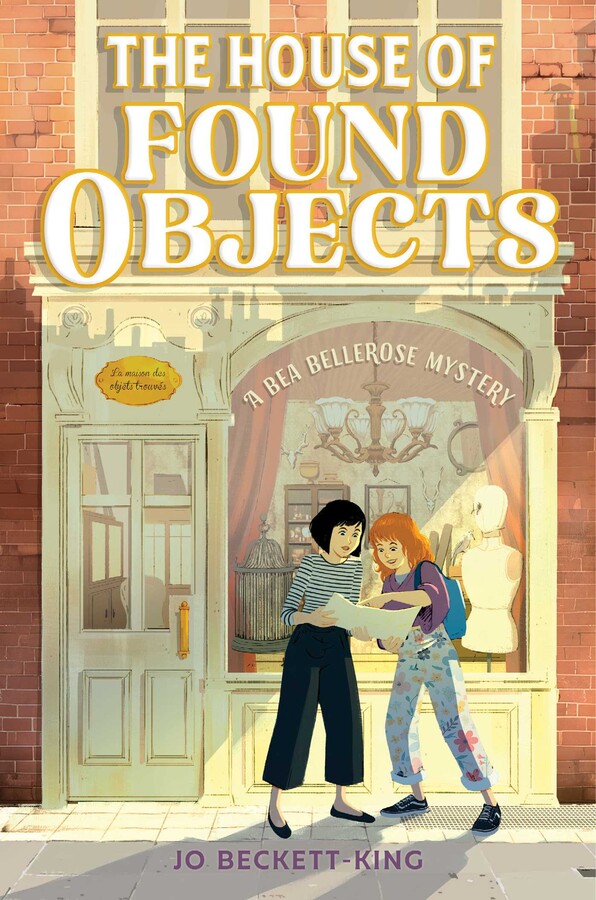
As Bea descended the steps to her grandmother’s store in the basement level of the building, she saw a mannequin in the window being pecked at by Mamie’s pet parakeet. Though it was a slightly odd sight, it was nothing that unusual, if her dad’s stories were anything to go by. Since as far back as she could remember, she’d heard about the mischief he and his siblings had got up to in this strange town house full of seemingly never-ending nooks and cubbyholes.
There was the time Aunt Juliette hid so well during a game of hide-and-seek that their mother, Mamie, panicked and called the police, who eventually found her in the attic, wrapped in an old roll of carpet. Or the time Bea’s dad convinced Aunt Juliette that the house was haunted, and he borrowed a vintage dress, pearls, and high heels, then put on some white makeup and snuck into her room in the middle of the night to give her the shock of her life. Or the time as teenagers when her dad, Aunt Juliette, and their brother Marc were all grounded and they made a rope ladder out of women’s scarves to escape from the second floor to the courtyard to join in Bastille Day celebrations.
That was a long time ago now. These days the House of Found Objects, which had once been a multilevel antique store containing everything from precious collectibles to worthless trinkets, was all crammed into a single room in the basement, with a tiny side office and an adjoining studio apartment in the back of the store. Mamie had lived in the studio for the past ten years, as she was no longer able to afford to rent the whole town house. Still, even after the downsizing, and after new tenants had moved in upstairs, the store kept its original name because the Basement of Found Objects didn’t have quite the same ring to it.
As Bea approached the glass, the bird startled and flew away, leaving a dime-sized gouge in the side of the mannequin’s head. Bea rang the bell. While she waited, she read the golden plaque above the door, La maison des objets trouvés, and practiced sounding out the words in her head, the way her dad had taught her to: la may-zaw daze ob-zjay troo-vay.
The door opened and Mamie appeared.
“Bea!” Mamie leaned in and kissed Bea on both cheeks, filling her nostrils with the distinctive scent of lavender mixed with baby powder. “I am sorry I am so messy,” she said in her thick French accent. She wiped her mouth. “I am just having the breakfast with your cousin.”
The last time Mamie had visited Bea and her parents in Passaic, New Jersey, Bea was only nine years old and barely reached her grandmother’s shoulder. Now, three years later, they were the same height, give or take an inch. Mamie, on the other hand, hadn’t changed one bit. She had the same huge mop of gray-white hair and the same pair of gold dangle earrings she always wore.
“That’s okay, Mamie,” Bea said. “Aunt Juliette asked me to give this to you.” Bea held out the cookbook.
“Ah, my book! Merci.” Mamie shook her head. “Did you know that my daughter has this book since almost two years? She is always busy, busy, busy at that magazine. There is no time left for fun. It is no wonder that she split up with Victor. They have never seen each other!”
Mamie often made little mistakes when speaking in English, but Bea could usually figure out what she meant. And Bea already knew that Aunt Juliette and Uncle Victor had finally gotten divorced the year before, after being separated for years.
“Anyway, since you are here, you will meet Céline, no?” Mamie beckoned her to come inside. “Yesterday she returned from her vacations.”
“Sorry, I have to run to La Boulangerie Beaumarchais to get something for Auntie,” Bea replied.
“It will only take a minute, dear. Come.”
Bea followed down the steps and into the darkened room, watching her grandmother’s blue polka-dot dress swing from side to side.
It took a few moments for Bea’s eyes to adjust as she stepped inside. Heavy red velvet drapes blocked out the daylight from the windows that looked out onto the street, and the only light appeared to be coming from a small lamp in the far corner of the room.
Though she had visited the store a few times in the past week, there was so much inside, Bea always seemed to spot something new. This time it was a black-and-white poster of Albert Einstein with his quote, “I have no special talents. I am only passionately curious.” The poster hung on the wall between a tabletop filled with vintage typewriters and a shelf displaying plates of Queen Elizabeth II. Long wooden bookcases covered the entire opposite wall, which explained the room’s musty library odor. By the window at the front there was a small desk with an antique silver-colored cash register on top. A stool, which Mamie would perch on while customers browsed, was tucked underneath.
The way her dad had described the store, Bea had expected it to feel almost magical, like something from a fairy tale. Instead, all the shelves were piled high with dusty knickknacks, and there were some parts of the store where it was difficult to walk because there was so much merchandise on the floor.
“Céline!” Mamie called through to the back room. “Your cousin is here.”
The door in the far corner of the room opened, and a girl walked in, staring at her phone. She was a little taller than Bea, and her brown hair was cut into a perfect bob. Although she was only a year older, there was something so grown-up about Céline, with her silver stud earrings and black ballet flats. Something so chic. Her neck was long, almost swanlike, and when she finally did look up from the screen, she held her nose in the air, as if she was sniffing a bad smell.
“Bea is wanting to say hi,” Mamie said.
“Hey.” Bea gave a little wave.
“Cool,” Céline said in a way that suggested she did not think it was cool at all.
Bea looked down at her scruffy Vans and began finger combing her wavy red hair, her fingers catching on every knot and tangle.
“I am sorry, she was not always this rude,” Mamie said. “She used to be able to speak in full sentences before she got that thing.” She pointed at Céline’s phone.
After a pause, Céline looked Bea straight in the eye and said in a surprisingly flawless accent, “Where are your parents?”
Céline’s tone sounded innocent, but Bea suspected she had said it on purpose to make her feel awkward. After all, their fathers pretty much hated each other. The details of their feud were fuzzy. All Bea knew was that after Papi died, Mamie urged them to make up, but they were both too stubborn. Now, their falling-out had gone on so long, Bea had never met her cousin before, or her uncle for that matter.
“New Orleans,” Bea said.
“Your mom and dad went on vacation without you?”
“No, they’re at a conf—”
“This is the first time that Bea is visiting Paris,” Mamie interrupted, turning to Céline. “I was thinking that you could help to show her around since unfortunately I am too occupied with the store.”
Céline rolled her eyes and continued texting.
Nice to meet you too, Bea thought. She turned to leave. “I’d better go. I have to get back before Aunt Juliette leaves for work.”
“Okay, darling,” Mamie said, placing the cookbook back on the shelf behind the cash register. “But will you come back and help us in the store again? Céline and I are starting the big cleanup today.”
Bea looked around the room at the overflowing shelves and boxes stacked high to the ceiling. Mamie clearly needed her help. Besides, it beat sitting around in Aunt Juliette’s apartment. All she had to do was put up with Céline for a few hours.
“Sure,” she said, giving her grandmother a smile.
“Thank you, my dear.”
Bea lifted her hand to wave goodbye, but when she saw that Céline was still looking at her phone, she pretended not to wave and put her hand back into her pocket before climbing the steps back up to the street.
By the time Bea returned to the apartment with an armful of pastries, her aunt was in the hallway, fixing her hair in the mirror.
“Where’ve you been?” Aunt Juliette asked.
“Sorry, Mamie asked me inside to meet Céline.”
“She’s back from Nice already?”
“Yep.”
“Well, lucky you,” Aunt Juliette said, seeing the look on Bea’s face.
“Mamie also asked me to help out in the store again,” Bea said.
“That’ll be a change of scenery for you, at least. I feel terrible that you’ve been cooped up in here.”
Bea didn’t say anything. Aunt Juliette had promised to take time off for all the fun activities they’d planned to do during her two-and-a-half-week trip, and then “an important assignment came up at the last minute.”
Aunt Juliette grabbed her jacket to leave. “I’m afraid I’m going to be back late tonight, and I have to work again this weekend, but I’ll make it up to you on Monday. Pizza and ice cream, what do you say? We have to celebrate your good news!”
Bea forced a smile.
There it was again, that familiar sinking feeling. Why did her parents have to tell everyone she’d made her school’s Mathlete team for the second year in a row? Now it was too late to come clean. Her little lie had gone international.
“Sounds nice,” Bea said. Anyway, something “urgent” would probably crop up before then and cancel their dinner plans. “Don’t forget this.” She handed her aunt the chocolate croissant.
“Merci beaucoup,” Aunt Juliette said. “Call me if you need anything.” Before closing the door behind her, she added, “And maybe give Céline a chance. I know she can be a little”—she paused and searched for the right word—“frosty, but she is family, after all.”
The envelope on the floor was sealed with red wax and addressed to “La jeune fille,” elegantly written in fountain pen. There was no stamp or even an apartment number: it had been slipped under the door overnight.
Bea put aside her dog-eared copy of 101 Brain-Bending Puzzles and crouched down to inspect the envelope. Although she was still a beginner at French, she knew enough to understand that it said “The young girl.” She opened the door and swiveled her head both ways to check the landing, but there was no one to be seen.
Back inside she thumbed the ridges of the embossed seal. Why would someone send her a letter? She had been in Paris for only a week, and apart from her aunt and grandmother, she didn’t know anyone in the city. Her parents were both away at a conference, so Bea had been shipped off to stay with family in France. And the only other person in the apartment was Aunt Juliette. The note definitely wasn’t meant for her aunt. Aunt Juliette was a femme not a fille.
Maybe someone had slid it under the wrong door by accident.
“Coucou!” Aunt Juliette called out just then, as she swept into the hallway in her blue cotton pajamas. Even though Aunt Juliette was fluent in English, she liked to sprinkle her sentences with French words to help widen Bea’s vocabulary. She had already explained that coucou was a cross between “hi” and “peekaboo,” which seemed like a pretty childish thing for adults to be saying to one another.
Before her aunt had the chance to ask any questions, Bea shoved the envelope into her pocket—she didn’t want to get in trouble for snooping before she’d even found out anything snoopworthy—and greeted her aunt the way she always did in the morning: “Salut.”
“Can you grab us some pastries for breakfast from La Boulangerie Beaumarchais?” Aunt Juliette pressed a five-euro bill into her palm. “The usual, please.” That meant a chocolate croissant with sliced almonds on top.
“And can you drop this off at your grandmother’s for me?” Aunt Juliette passed her a heavy book with a pastry chef posing next to a pyramid of brightly colored macarons on the cover. “Tell her I’m sorry I’ve kept it so long. Anyway, I need to hop in the shower. I’m late for work.”
Work—that was all Aunt Juliette ever seemed to do. As a journalist at a weekly news magazine, she had been too busy to do anything even remotely fun since Bea had arrived in France. Every morning Bea would gaze out the kitchen window at all the people going about their day, knowing that she’d be stuck inside until her aunt came home at night. Sometimes, she would visit Mamie, her grandmother, and keep her company in the antique store for a few hours, though there was only so much she could do to help since she barely spoke French. She mostly felt like she was taking up space.
What was Bea going to tell everyone back home when they asked about her trip? They probably wouldn’t want to hear about the opera singer across the street who belted out arias from her balcony every morning, or the tone-deaf boy in the apartment next door who screeched his way through violin lessons every afternoon, or the elderly woman with the wheezing pug who shuffled along the street together so sluggishly every evening it looked as though they were competing to see who could move the slowest.
When Bea’s mom and dad first told her they were sending her to France, they’d made it sound like some kind of amazing adventure. Aunt Juliette was going to take her up the Eiffel Tower, she was going to go horseback riding in the Bois de Vincennes, and maybe they would even take a cruise along the River Seine. Now here Bea was, stuck in her aunt’s apartment for another week. So much for an adventure.
Just as she was about to leave the apartment, Bea thought about the mysterious envelope in her pocket. With the faint sound of the shower running in the bathroom, she saw her chance. She put the heavy book and the five-euro bill on the table, took out the envelope, and grabbed a knife from the kitchen, which she used to carefully slice the squiggly symbol on the wax seal in two.
Peering inside the envelope, she found a small padlock key and a handwritten note:
La chasse au trésor
(La date limite : 17h00, jeudi, le 29 juillet)
She had no idea what that meant, except she was pretty sure juillet meant “July.” She flipped the piece of paper over and read the rest:
(1/5)
In eastern Paris, a rock star’s life is not forgotten,
as the path to his grave remains well-trodden.
As for me, my wit is legendary.
I draw a crowd, even in a cemetery.
Loyal fans show their appreciation with a kiss,
and if you follow their footsteps, you’ll find something amiss.
But now, the first order of the day.
Rearrange these letters and you’ll be well on your way:
I, Earl Peaches
Earl Peaches? Who? Was it a riddle?
Bea was used to figuring out puzzles. Logic puzzles, brainteasers, math problems—they were kind of her thing, or at least they used to be. But the bigger puzzle here was why she had received the note in the first place.
At least now she had something that would keep her mind busy during the long day ahead. But Aunt Juliette would be expecting her back from the bakery soon, so she stuffed the note and key back into her pocket, picked up the cookbook and the money, and headed out the door.
After the elevator dinged, Bea pulled the heavy iron door open, moved the crisscrossing gate to one side so that it folded into itself, and entered. The elevator had a birdcage design; its antique metal frame was made up of ornate swirls, allowing passengers to see through the gaps in the metal while traveling between floors. One of her aunt’s neighbors, Monsieur Bertrand from the floor above, was standing inside, wearing a flat cap and a miserable frown. They’d met only once, in the building’s lobby the night before, but she remembered his name from a piece of mail he had dropped. She had chased after him to give it back, and when he turned around, Bea was struck by his resemblance to a cartoon villain, with his twirling black mustache and devilish grin.
Bea turned to face the front. From behind, she heard a voice in a scolding tone: “Bonjour, mademoiselle.” She knew that you had to always say hello and goodbye to people in France, otherwise they would think you were being rude. And they would be rude in retaliation.
“Bonjour,” she replied as quickly as she could, in the best accent she could manage. She cringed, hearing herself. They shared an awkward silence until the elevator reached the first floor.
After the bing Bea stepped out and made sure she was the first one to say “Bonne journée” to wish him a good day as she left the building. He mumbled something in response, but by then she was already out the door.
Outside, Bea was hit with the smell of freshly baked bread wafting down the street from La Boulangerie Beaumarchais on the corner. Everything about Rue Saint-Claude felt so, well, French. A woman passed by, holding a baguette under her arm and pushing a bicycle with a wicker basket piled high with groceries, and opposite the bakery there was a café with the name CHEZ GEORGES printed in gold letters on the window. On the sidewalk, chairs faced out toward the street so customers could watch the passing crowds as they sipped their morning coffee. The Parisians strolling by the storefront didn’t seem to mind. From what she could tell, they liked putting on a show.
As Bea descended the steps to her grandmother’s store in the basement level of the building, she saw a mannequin in the window being pecked at by Mamie’s pet parakeet. Though it was a slightly odd sight, it was nothing that unusual, if her dad’s stories were anything to go by. Since as far back as she could remember, she’d heard about the mischief he and his siblings had got up to in this strange town house full of seemingly never-ending nooks and cubbyholes.
There was the time Aunt Juliette hid so well during a game of hide-and-seek that their mother, Mamie, panicked and called the police, who eventually found her in the attic, wrapped in an old roll of carpet. Or the time Bea’s dad convinced Aunt Juliette that the house was haunted, and he borrowed a vintage dress, pearls, and high heels, then put on some white makeup and snuck into her room in the middle of the night to give her the shock of her life. Or the time as teenagers when her dad, Aunt Juliette, and their brother Marc were all grounded and they made a rope ladder out of women’s scarves to escape from the second floor to the courtyard to join in Bastille Day celebrations.
That was a long time ago now. These days the House of Found Objects, which had once been a multilevel antique store containing everything from precious collectibles to worthless trinkets, was all crammed into a single room in the basement, with a tiny side office and an adjoining studio apartment in the back of the store. Mamie had lived in the studio for the past ten years, as she was no longer able to afford to rent the whole town house. Still, even after the downsizing, and after new tenants had moved in upstairs, the store kept its original name because the Basement of Found Objects didn’t have quite the same ring to it.
As Bea approached the glass, the bird startled and flew away, leaving a dime-sized gouge in the side of the mannequin’s head. Bea rang the bell. While she waited, she read the golden plaque above the door, La maison des objets trouvés, and practiced sounding out the words in her head, the way her dad had taught her to: la may-zaw daze ob-zjay troo-vay.
The door opened and Mamie appeared.
“Bea!” Mamie leaned in and kissed Bea on both cheeks, filling her nostrils with the distinctive scent of lavender mixed with baby powder. “I am sorry I am so messy,” she said in her thick French accent. She wiped her mouth. “I am just having the breakfast with your cousin.”
The last time Mamie had visited Bea and her parents in Passaic, New Jersey, Bea was only nine years old and barely reached her grandmother’s shoulder. Now, three years later, they were the same height, give or take an inch. Mamie, on the other hand, hadn’t changed one bit. She had the same huge mop of gray-white hair and the same pair of gold dangle earrings she always wore.
“That’s okay, Mamie,” Bea said. “Aunt Juliette asked me to give this to you.” Bea held out the cookbook.
“Ah, my book! Merci.” Mamie shook her head. “Did you know that my daughter has this book since almost two years? She is always busy, busy, busy at that magazine. There is no time left for fun. It is no wonder that she split up with Victor. They have never seen each other!”
Mamie often made little mistakes when speaking in English, but Bea could usually figure out what she meant. And Bea already knew that Aunt Juliette and Uncle Victor had finally gotten divorced the year before, after being separated for years.
“Anyway, since you are here, you will meet Céline, no?” Mamie beckoned her to come inside. “Yesterday she returned from her vacations.”
“Sorry, I have to run to La Boulangerie Beaumarchais to get something for Auntie,” Bea replied.
“It will only take a minute, dear. Come.”
Bea followed down the steps and into the darkened room, watching her grandmother’s blue polka-dot dress swing from side to side.
It took a few moments for Bea’s eyes to adjust as she stepped inside. Heavy red velvet drapes blocked out the daylight from the windows that looked out onto the street, and the only light appeared to be coming from a small lamp in the far corner of the room.
Though she had visited the store a few times in the past week, there was so much inside, Bea always seemed to spot something new. This time it was a black-and-white poster of Albert Einstein with his quote, “I have no special talents. I am only passionately curious.” The poster hung on the wall between a tabletop filled with vintage typewriters and a shelf displaying plates of Queen Elizabeth II. Long wooden bookcases covered the entire opposite wall, which explained the room’s musty library odor. By the window at the front there was a small desk with an antique silver-colored cash register on top. A stool, which Mamie would perch on while customers browsed, was tucked underneath.
The way her dad had described the store, Bea had expected it to feel almost magical, like something from a fairy tale. Instead, all the shelves were piled high with dusty knickknacks, and there were some parts of the store where it was difficult to walk because there was so much merchandise on the floor.
“Céline!” Mamie called through to the back room. “Your cousin is here.”
The door in the far corner of the room opened, and a girl walked in, staring at her phone. She was a little taller than Bea, and her brown hair was cut into a perfect bob. Although she was only a year older, there was something so grown-up about Céline, with her silver stud earrings and black ballet flats. Something so chic. Her neck was long, almost swanlike, and when she finally did look up from the screen, she held her nose in the air, as if she was sniffing a bad smell.
“Bea is wanting to say hi,” Mamie said.
“Hey.” Bea gave a little wave.
“Cool,” Céline said in a way that suggested she did not think it was cool at all.
Bea looked down at her scruffy Vans and began finger combing her wavy red hair, her fingers catching on every knot and tangle.
“I am sorry, she was not always this rude,” Mamie said. “She used to be able to speak in full sentences before she got that thing.” She pointed at Céline’s phone.
After a pause, Céline looked Bea straight in the eye and said in a surprisingly flawless accent, “Where are your parents?”
Céline’s tone sounded innocent, but Bea suspected she had said it on purpose to make her feel awkward. After all, their fathers pretty much hated each other. The details of their feud were fuzzy. All Bea knew was that after Papi died, Mamie urged them to make up, but they were both too stubborn. Now, their falling-out had gone on so long, Bea had never met her cousin before, or her uncle for that matter.
“New Orleans,” Bea said.
“Your mom and dad went on vacation without you?”
“No, they’re at a conf—”
“This is the first time that Bea is visiting Paris,” Mamie interrupted, turning to Céline. “I was thinking that you could help to show her around since unfortunately I am too occupied with the store.”
Céline rolled her eyes and continued texting.
Nice to meet you too, Bea thought. She turned to leave. “I’d better go. I have to get back before Aunt Juliette leaves for work.”
“Okay, darling,” Mamie said, placing the cookbook back on the shelf behind the cash register. “But will you come back and help us in the store again? Céline and I are starting the big cleanup today.”
Bea looked around the room at the overflowing shelves and boxes stacked high to the ceiling. Mamie clearly needed her help. Besides, it beat sitting around in Aunt Juliette’s apartment. All she had to do was put up with Céline for a few hours.
“Sure,” she said, giving her grandmother a smile.
“Thank you, my dear.”
Bea lifted her hand to wave goodbye, but when she saw that Céline was still looking at her phone, she pretended not to wave and put her hand back into her pocket before climbing the steps back up to the street.
By the time Bea returned to the apartment with an armful of pastries, her aunt was in the hallway, fixing her hair in the mirror.
“Where’ve you been?” Aunt Juliette asked.
“Sorry, Mamie asked me inside to meet Céline.”
“She’s back from Nice already?”
“Yep.”
“Well, lucky you,” Aunt Juliette said, seeing the look on Bea’s face.
“Mamie also asked me to help out in the store again,” Bea said.
“That’ll be a change of scenery for you, at least. I feel terrible that you’ve been cooped up in here.”
Bea didn’t say anything. Aunt Juliette had promised to take time off for all the fun activities they’d planned to do during her two-and-a-half-week trip, and then “an important assignment came up at the last minute.”
Aunt Juliette grabbed her jacket to leave. “I’m afraid I’m going to be back late tonight, and I have to work again this weekend, but I’ll make it up to you on Monday. Pizza and ice cream, what do you say? We have to celebrate your good news!”
Bea forced a smile.
There it was again, that familiar sinking feeling. Why did her parents have to tell everyone she’d made her school’s Mathlete team for the second year in a row? Now it was too late to come clean. Her little lie had gone international.
“Sounds nice,” Bea said. Anyway, something “urgent” would probably crop up before then and cancel their dinner plans. “Don’t forget this.” She handed her aunt the chocolate croissant.
“Merci beaucoup,” Aunt Juliette said. “Call me if you need anything.” Before closing the door behind her, she added, “And maybe give Céline a chance. I know she can be a little”—she paused and searched for the right word—“frosty, but she is family, after all.”
About The Author
Photograph by Jo Beckett-King
Jo Beckett-King is the author of the Bea Bellerose Mystery series. Originally from the north of England, she spent several years in Paris after graduating from university. Following several recent years in New York, she now lives with her husband and son in San Francisco, where she writes and works as a French-to-English translator. In addition to her middle grade fiction, Jo writes for adults; her short stories have been listed for the Bridport Prize and the Bristol Short Story Prize in the UK.
Product Details
- Publisher: Simon & Schuster Books for Young Readers (July 29, 2025)
- Length: 288 pages
- ISBN13: 9781665967174
- Grades: 3 - 7
- Ages: 8 - 12
Browse Related Books
Raves and Reviews
Newly acquainted cousins must solve a cryptic, puzzle-filled scavenger hunt to rescue a family heirloom in the gutsy middle-grade mystery The House of Found Objects by debut author Jo Beckett-King.
Twelve-year-old American Bea Bellerose is staying with her Aunt Juliette in Paris while her parents are away at a conference. Unfortunately, Aunt Juliette is working a lot more than planned and Bea is spending most of her time alone in the apartment or downstairs in her grandmother's antiques shop, La maison des objets trouvés. Bea has been in France for a week when the first letter (addressed to "La jeune fille") is slipped under the door. She doesn't know why she has received the letter but is excited by the prospect of solving the riddle it contains. That same day, Bea meets her cousin Céline in Mamie's store. Céline is 13 and "so grown-up" that it seems to Bea they have little in common. When a treasured family painting by Henri Matisse goes missing, Bea is certain the letter is connected. But she's on a clock—the riddle writer gave her just four days to find the drawing. Bea convinces Céline to help her navigate the city and the girls race through the streets of Paris to solve the puzzle.
Beckett-King fills this fun mystery with the sights and sounds of Paris, as well as brain teasers readers can solve along with Céline and Bea. The girls are fantastic foils, each bringing skills and qualities the other needs. This first installment in the Bea Bellerose Mystery series is delightful, charming, and full of unexpected twists. —Kyla Paterno, freelance reviewer
– Shelf Awareness
STARRED REVIEW, 8/1/25
Twelve-year-old Bea Bellerose (from New Jersey) is spending her summer vacation in Paris. Bea longs to explore the city’s landmarks, but, alas, she is confined to Aunt Juliette’s apartment while her aunt works long days. ?e only place Bea is permitted to go is her grandmother’s antique store, the titular House of Found Objects. When a sketch of her great-great-grandfather drawn by a young Henri Matisse goes missing and a clue to its whereabouts appears under her aunt’s door, Bea decides to take up the case. She and her French cousin, Céline, travel all over Paris, from the Jardin des Plantes to Sacré-Coeur, searching for mysteriously placed clues and solving puzzles. ?ough they are hardly friends at first sight, Bea and Céline learn to work together to find the missing heirloom. ?e story is lighthearted and entertaining, with the sweetness of self-discovery sprinkled throughout as Bea becomes more confident and more proud of the person she’s becoming. Readers with an eye for puzzles and a knack for code-cracking will enjoy this first entry in a projected new mystery series.
– Hornbook, September/October 2025 Issue
While 12-year-old Bea’s parents are attending an out-of-town conference, Bea flies from New Jersey to Paris to stay for three weeks with an aunt who is too busy with work to show her around the city. One morning, Bea finds a cryptic letter addressed to her. She spends the day helping her grandmother, Mamie, at her failing antique shop. There, she meets her cousin, Céline, who is one year older but vastly more sophisticated and preoccupied with her friends. When Mamie discovers that a family treasure, a portrait painting by Matisse, has been stolen from the shop, Bea links the crime to the clues in her puzzling letter. Soon, Bea and Céline follow the clues to solve the mystery. Young readers will sympathize with Bea and her convincingly tween-age dilemmas, but only devoted cryptography fans will attempt to decode the clues delivered to her. Still, readers who know a little French will enjoy the occasional use of common phrases, which are explained within the text. A relatively quiet mystery story with a surprising solution.
– Booklist, 05/01/2025
While visiting family in Paris, a 12-year-old from New Jersey embarks on a treasure hunt to find her grandmother’s missing Matisse—and help save her antiques shop.
Red-haired mathlete Bea’s parents have sent her to stay with Aunt Juliette, a busy journalist, but Bea is stuck at home with little to do, until someone slips a mysterious note containing a riddle under their apartment door. Methodical Bea and her spontaneous 13-year-old cousin, Céline, work together to solve the clues, hoping they’ll lead to the family’s treasured Matisse sketch, which has gone missing from their grandmother Mamie’s shop, the House of Found Objects. The precious artwork was collateral for the loan Mamie needed to carry out much-needed repairs; without it, the landlord could force her out. As the girls visit Parisian landmarks, they become close, discuss why their dads (who are brothers) are feuding, and break rules in the name of saving Mamie’s shop. Through their adventures, Bea gains the courage to reveal a truth to her parents that she’d been covering up out of fear of disappointing them and uncertainty over what she really wanted. The metamorphosis of the cousins’ relationship, which starts off prickly and softens into mutual respect and affection, is realistic and relatable, and the explanation behind the mysterious notes is a pleasant surprise. The family is cued white.
Codebreakers and mystery fans will want to read this fun adventure, tout de suite. (Mystery. 9-13)
– Kirkus, 05/15/2025
Beckett-King whisks readers into a Parisian summer alongside Bea Bellerose on her vacation to visit her French family. Bea and her inconsiderate cousin Cèline must work together to save their grandmother’s antique shop, The House of Found Objects, after a family heirloom is stolen. The girls follow mysterious clues around the city, and learn, alongside with the readers, new skills in code-breaking and sneaking around. Bea and Céline’s relationship, central to the plot, develops into a satisfying conclusion as the two deepen their understanding and appreciation of one another while mending family rifts, breaking rules, and exploring the city. While the plot comes off as a bit jejune, the happy ending sweeps the entire family into a closer relationship. Main characters are cued white. VERDICT Kids interested in developing their sleuthing and French skills will benefit from encountering Bea’s journey in this series debut. A general purchase for the fiction shelves
– School Library Journal, 8/8/25
Resources and Downloads
High Resolution Images
-
Book Cover Image (jpg): The House of Found Objects
Hardcover 9781665967174
-
Author Photo (jpg): Jo Beckett-King Photograph by Jo Beckett-King(0.1 MB)
Any use of an author photo must include its respective photo credit
Join our mailing list!
By clicking 'Sign me up' I acknowledge that I have read and agree to the privacy policy and terms of use.