Get our latest staff recommendations, award news and digital catalog links right to your inbox.
Published by Inner Traditions
Distributed by Simon & Schuster
Table of Contents
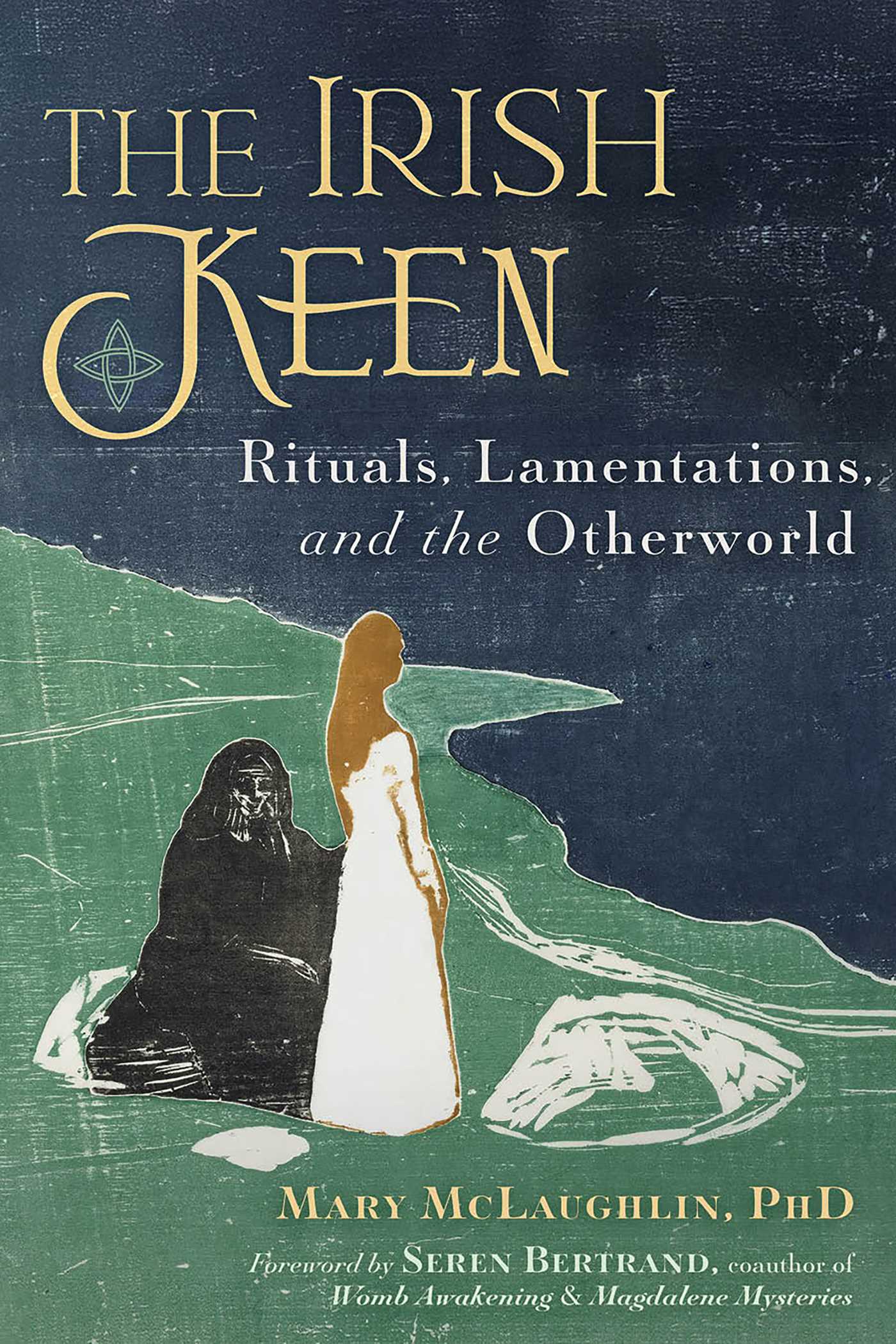
About The Book
• Provides context and history for the traditional Irish lament known as the keen, examining the origins of the ritual and its history from paganism through Christianity
• Explores keening’s shamanic dimensions and mythological connections to the Otherworld, including the world of Faerie while drawing on archaeology and traditional Irish folklore
• Looks at the practicalities of keening, considering the wake as a rite of passage, the role and burden of keeners, the structure and music of the keen, and the contemporary rebirth of the practice
Combining scholarship, storytelling, and embodied wisdom, Mary Mc Laughlin offers an authoritative yet accessible guide to the Irish keen as both an ancient funeral rite and a modern tool to help you navigate bereavement.
A singer and instructor of Irish singing and Gaelic song, Mc Laughlin reveals the keening lament as a ritualized practice that bears aspects of ancient shamanism as well as the pre-Christian spiritual traditions of Ireland. She draws on her own personal experience, interviews, and historic texts to provide a comprehensive and inspiring study of this Irish practice.
As she examines the origins of the keen in pre-Celtic Ireland and its mythological connections to the fairies, she compares its similarities to archetypal lamentation rituals in North America and Asia. Mc Laughlin also explores the keen’s transformation over time—the influence and integration of Christianity, its subsequent suppression, and its rebirth in recent years.
But the true magic of the keen goes beyond its role in expressing grief. In addition to comforting the bereaved and honoring the deceased, the keeners aided the soul of the departed in making its journey to the Otherworld. Contemporary death doulas and hospice workers bear some similarities to keeners as they too help provide tools to process the transition from life to death amid the pain and sorrow at the loss of loved ones.
• Explores keening’s shamanic dimensions and mythological connections to the Otherworld, including the world of Faerie while drawing on archaeology and traditional Irish folklore
• Looks at the practicalities of keening, considering the wake as a rite of passage, the role and burden of keeners, the structure and music of the keen, and the contemporary rebirth of the practice
Combining scholarship, storytelling, and embodied wisdom, Mary Mc Laughlin offers an authoritative yet accessible guide to the Irish keen as both an ancient funeral rite and a modern tool to help you navigate bereavement.
A singer and instructor of Irish singing and Gaelic song, Mc Laughlin reveals the keening lament as a ritualized practice that bears aspects of ancient shamanism as well as the pre-Christian spiritual traditions of Ireland. She draws on her own personal experience, interviews, and historic texts to provide a comprehensive and inspiring study of this Irish practice.
As she examines the origins of the keen in pre-Celtic Ireland and its mythological connections to the fairies, she compares its similarities to archetypal lamentation rituals in North America and Asia. Mc Laughlin also explores the keen’s transformation over time—the influence and integration of Christianity, its subsequent suppression, and its rebirth in recent years.
But the true magic of the keen goes beyond its role in expressing grief. In addition to comforting the bereaved and honoring the deceased, the keeners aided the soul of the departed in making its journey to the Otherworld. Contemporary death doulas and hospice workers bear some similarities to keeners as they too help provide tools to process the transition from life to death amid the pain and sorrow at the loss of loved ones.
Excerpt
1
What Is the Irish Keen?
The prevailing question that underpins this book seems on the surface relatively simple but, as I found, the answer is highly complex!
The question is: “What is the Irish Keen?” A simplistic answer would go something like this: The keen is an improvised Irish lament sung over a dead body within the context of a wake and funeral, partly in the Irish language and partly in vocables.
An extension of that definition could read:
Traditionally it was an improvised vocalization, consisting of speech and singing that was governed by certain conventions. Sometimes performed by relatives, it was more usually performed by hired keeners and would be sung throughout the wake, funeral procession, and burial. At times keens, although improvised at the wake, would be remembered and sung over and over as a form of comfort for the bereaved. The shadows of the keen are also to be found in Irish poetry and song.
The truth is that there is a great deal more to it than that. The Irish Keen has had a long and tumultuous history going back thousands of years and cannot be captured in a couple of sentences. There have been periods during which it was celebrated as an integral part of Irish culture; other times where it was denigrated and encased in extreme secrecy; a time where it became intertwined with Christianity; another where it was not practiced but its echoes were woven through Irish tradition; and now in the twenty-first century it is experiencing a renaissance of sorts both within and beyond the island of Ireland.
At each stage of its evolution, it has borne the marks of the society that practiced it, and as such, is somewhat of a historical document. The essential focus of the keen has always been about lamenting the dead but what that lament was specifically intended to achieve, and how, is in many ways the greater question!
Lamentation is universal and more often than not led by women. Ireland is no exception and the keeners are usually noted as being female. This doesn’t mean that men did not also keen; in fact, there are specific references to male lamentation that I discuss later. It is women, though, who are associated with keening, as Donegal singer Gearoidín Breathnach pointed out in our conversation when talking about the different roles taken in the early part of the twentieth century (see chapter 3).
An interesting aspect of the keen is that a great deal of mystique has grown around it. The principal keener—the leader of the ritual—was known as the Bean Chaointe (Ban Kweencha—Keening Woman), although there are different spellings of her name throughout the available literature. In times gone by, the Bean Chaointe was a very powerful woman who orchestrated and controlled the “death rite of passage.” Her cry was legendary and this is one area where there is confusion. There is a particular woman in Irish mythology called the Bean Sidhe (Ban Shee—woman of the fairy tribe known as the Sidhe) who wails for certain families when death in that family is imminent.1 Some have heard this wail and likened it to the wail of the Keening Woman; others have heard it differently.
The Bean Sidhe is a separate entity to the Bean Chaointe, but given the common denominator of death, it’s easy to see how these two characters became entwined. It is even more complex than that, though, as spiritually there is a kind of synthesis between the two, and in terms of the voices of women being heard, their wails were emblematic of the importance of the keen throughout the ages.
Over the course of this book, I will be addressing all of these aspects to try to unpick the complex web of what we know as keening and how it has developed in Ireland, while sharing characteristics with the death laments of other cultures.
Having been born in a time when the keen lay fallow and underground, I was in my early forties when I woke up to it and began to realize just how much Irish tradition was driven by it. I discovered this in my own work as a recording singer/songwriter, especially during the recording of Celtic Requiem,2 an album dedicated to my mother, who had passed a few years previously. That album was permeated with the keen, although I did not appreciate it at the time.
The original theme of the album had been Celtic chant, but as I wrote and arranged the older songs that I had collected, I realized that they all had to do with death. It was another decade before I discovered that the keen is Ireland’s version of chant. The project was a joint one with William Coulter, a very fine guitarist and aficionado of Irish music—or as it was called in the United States, Celtic music. The rough recording of three songs that were on the original demo (which I seem to remember we did in a garage to save expense) found themselves in the hands of a recording company executive—a Californian record company that dealt in folk-based music. I was stunned as I couldn’t believe, after decades of disappointment and rejections, that I was finally getting a record deal! So Celtic Requiem was born and I buried myself in the project researching and arranging material for the next several months.
Some years later, I recorded an album called Crystal Shoe that was themed as esoteric and contained magical fairy-tale songs. One of them was called “The Light of the Darkness,” a song that I wrote after an exceptionally powerful dream where my mother—who had passed in 1995—appeared to me. It was probably around then that I began to understand what Celtic Requiem had actually been about. In 2009 I returned to Ireland to study the keen in depth as part of an MA in Chant and Ritual Song, offered by the World Academy of Music and Dance based at the University of Limerick. During the course of my studies, I revisited what had happened to me in 1995 and set a steady path of investigating the influence of the keen on the Irish tradition that I had loved so dearly since my initiation into Gaelic singing at eleven years of age.
The significance of 1995 was that was when my beloved mother was enduring a traumatic death.
The Passing
Eighteen hours before she passed my mother said to me, “I’m scared, will you come with me?” There was no point in being dishonest—it wasn’t “going to be grand,” as we Irish say, so I answered her honestly. “I can only come so far but I will come with you as far as I can.”
I had a vivid impression of taking her to the shore of a river and knowing that she had to cross that river but that I couldn’t. In Greek mythology the river is called the River Styx—the boat is guided by Charon the ferryman. A coin was placed in the mouth of the person passing over to “pay” the ferryman.
In pre-Christian Ireland, it was believed that the soul (ideally) went to Tír na nÓg, the land of plenty in the Otherworld and the abode of fairy folk. Some believed that fairies are actually the spirits of the dead.
That week when my mother was dying changed my life. I knew at the time that it would, but I didn’t comprehend in what ways or how far-reaching the effects would be. It all sounds calm when I write this down, but to say I was in turmoil at the time would be an understatement. I loved my mother so much that the thought of losing her was too heartbreaking to even consider.
This was the week when my dream of being an Irish singer (an ambition declared by my eleven-year-old self thirty years previously) looked like it was finally going to happen. I had just had my initiation into the Gaelic language and singing in the Donegal Gweedore Gaeltacht (Gwayl-tokht—Irish-speaking area). The Donegal Gaeltachts held summer schools lasting three weeks at a time for children from all over Ireland to help support the learning of Irish language and traditional culture.
On my return from this life-changing three weeks, I had announced to my mother, “I know what I’m going to be when I grow up—a famous Irish singer,” and expected her to be as excited as I was. Her reaction was rather the opposite. “Over my dead body,” she said. “There’s no money in music, you’re a smart girl. . . .” She wanted me to be a teacher, and the height of her ambition, dictated in many ways by the country and era we lived in, was that I would one day be a school principal. While I did end up training as a teacher, my path has not been the usual predictable one, and certainly not the one that either myself or my mother had envisioned. My aspiration, though, was still about achieving recognition as a singer, so like many of my peers at that time, I led a double life. Teaching was the aspect that supported my musical ambitions and it continued to do so in different forms throughout my life.
What Is the Irish Keen?
The prevailing question that underpins this book seems on the surface relatively simple but, as I found, the answer is highly complex!
The question is: “What is the Irish Keen?” A simplistic answer would go something like this: The keen is an improvised Irish lament sung over a dead body within the context of a wake and funeral, partly in the Irish language and partly in vocables.
An extension of that definition could read:
Traditionally it was an improvised vocalization, consisting of speech and singing that was governed by certain conventions. Sometimes performed by relatives, it was more usually performed by hired keeners and would be sung throughout the wake, funeral procession, and burial. At times keens, although improvised at the wake, would be remembered and sung over and over as a form of comfort for the bereaved. The shadows of the keen are also to be found in Irish poetry and song.
The truth is that there is a great deal more to it than that. The Irish Keen has had a long and tumultuous history going back thousands of years and cannot be captured in a couple of sentences. There have been periods during which it was celebrated as an integral part of Irish culture; other times where it was denigrated and encased in extreme secrecy; a time where it became intertwined with Christianity; another where it was not practiced but its echoes were woven through Irish tradition; and now in the twenty-first century it is experiencing a renaissance of sorts both within and beyond the island of Ireland.
At each stage of its evolution, it has borne the marks of the society that practiced it, and as such, is somewhat of a historical document. The essential focus of the keen has always been about lamenting the dead but what that lament was specifically intended to achieve, and how, is in many ways the greater question!
Lamentation is universal and more often than not led by women. Ireland is no exception and the keeners are usually noted as being female. This doesn’t mean that men did not also keen; in fact, there are specific references to male lamentation that I discuss later. It is women, though, who are associated with keening, as Donegal singer Gearoidín Breathnach pointed out in our conversation when talking about the different roles taken in the early part of the twentieth century (see chapter 3).
An interesting aspect of the keen is that a great deal of mystique has grown around it. The principal keener—the leader of the ritual—was known as the Bean Chaointe (Ban Kweencha—Keening Woman), although there are different spellings of her name throughout the available literature. In times gone by, the Bean Chaointe was a very powerful woman who orchestrated and controlled the “death rite of passage.” Her cry was legendary and this is one area where there is confusion. There is a particular woman in Irish mythology called the Bean Sidhe (Ban Shee—woman of the fairy tribe known as the Sidhe) who wails for certain families when death in that family is imminent.1 Some have heard this wail and likened it to the wail of the Keening Woman; others have heard it differently.
The Bean Sidhe is a separate entity to the Bean Chaointe, but given the common denominator of death, it’s easy to see how these two characters became entwined. It is even more complex than that, though, as spiritually there is a kind of synthesis between the two, and in terms of the voices of women being heard, their wails were emblematic of the importance of the keen throughout the ages.
Over the course of this book, I will be addressing all of these aspects to try to unpick the complex web of what we know as keening and how it has developed in Ireland, while sharing characteristics with the death laments of other cultures.
Having been born in a time when the keen lay fallow and underground, I was in my early forties when I woke up to it and began to realize just how much Irish tradition was driven by it. I discovered this in my own work as a recording singer/songwriter, especially during the recording of Celtic Requiem,2 an album dedicated to my mother, who had passed a few years previously. That album was permeated with the keen, although I did not appreciate it at the time.
The original theme of the album had been Celtic chant, but as I wrote and arranged the older songs that I had collected, I realized that they all had to do with death. It was another decade before I discovered that the keen is Ireland’s version of chant. The project was a joint one with William Coulter, a very fine guitarist and aficionado of Irish music—or as it was called in the United States, Celtic music. The rough recording of three songs that were on the original demo (which I seem to remember we did in a garage to save expense) found themselves in the hands of a recording company executive—a Californian record company that dealt in folk-based music. I was stunned as I couldn’t believe, after decades of disappointment and rejections, that I was finally getting a record deal! So Celtic Requiem was born and I buried myself in the project researching and arranging material for the next several months.
Some years later, I recorded an album called Crystal Shoe that was themed as esoteric and contained magical fairy-tale songs. One of them was called “The Light of the Darkness,” a song that I wrote after an exceptionally powerful dream where my mother—who had passed in 1995—appeared to me. It was probably around then that I began to understand what Celtic Requiem had actually been about. In 2009 I returned to Ireland to study the keen in depth as part of an MA in Chant and Ritual Song, offered by the World Academy of Music and Dance based at the University of Limerick. During the course of my studies, I revisited what had happened to me in 1995 and set a steady path of investigating the influence of the keen on the Irish tradition that I had loved so dearly since my initiation into Gaelic singing at eleven years of age.
The significance of 1995 was that was when my beloved mother was enduring a traumatic death.
The Passing
Eighteen hours before she passed my mother said to me, “I’m scared, will you come with me?” There was no point in being dishonest—it wasn’t “going to be grand,” as we Irish say, so I answered her honestly. “I can only come so far but I will come with you as far as I can.”
I had a vivid impression of taking her to the shore of a river and knowing that she had to cross that river but that I couldn’t. In Greek mythology the river is called the River Styx—the boat is guided by Charon the ferryman. A coin was placed in the mouth of the person passing over to “pay” the ferryman.
In pre-Christian Ireland, it was believed that the soul (ideally) went to Tír na nÓg, the land of plenty in the Otherworld and the abode of fairy folk. Some believed that fairies are actually the spirits of the dead.
That week when my mother was dying changed my life. I knew at the time that it would, but I didn’t comprehend in what ways or how far-reaching the effects would be. It all sounds calm when I write this down, but to say I was in turmoil at the time would be an understatement. I loved my mother so much that the thought of losing her was too heartbreaking to even consider.
This was the week when my dream of being an Irish singer (an ambition declared by my eleven-year-old self thirty years previously) looked like it was finally going to happen. I had just had my initiation into the Gaelic language and singing in the Donegal Gweedore Gaeltacht (Gwayl-tokht—Irish-speaking area). The Donegal Gaeltachts held summer schools lasting three weeks at a time for children from all over Ireland to help support the learning of Irish language and traditional culture.
On my return from this life-changing three weeks, I had announced to my mother, “I know what I’m going to be when I grow up—a famous Irish singer,” and expected her to be as excited as I was. Her reaction was rather the opposite. “Over my dead body,” she said. “There’s no money in music, you’re a smart girl. . . .” She wanted me to be a teacher, and the height of her ambition, dictated in many ways by the country and era we lived in, was that I would one day be a school principal. While I did end up training as a teacher, my path has not been the usual predictable one, and certainly not the one that either myself or my mother had envisioned. My aspiration, though, was still about achieving recognition as a singer, so like many of my peers at that time, I led a double life. Teaching was the aspect that supported my musical ambitions and it continued to do so in different forms throughout my life.
Product Details
- Publisher: Inner Traditions (September 1, 2026)
- Length: 352 pages
- ISBN13: 9798888504093
Browse Related Books
Raves and Reviews
“As if the Banshee and Bean Chaointe themselves have called out through the echoes of time, Mary has translated their call for us all to learn . . . to remember the significance of the keen. As grief continues to compound and ferment in our societies, the keen gives us permission to vocalize and churn stagnant sorrows into a medicine that we all could benefit from.”
– Anne-Marie Keppel, author of Death Nesting
“This is much more than just a book. It’s a cauldron spilling over with the wisdom of the Irish seabhean (wise woman). Step inside, keen with Mary, and heal with the Irish sinsear (ancestors).”
– Phyllida Anam-Áire, author of A Celtic Book of Dying
“Mary Mc Laughlin sensitively and expertly brings us the deep, authentic history, lore, and practice of the keen, from the ancestral wailing of the Goddess Brighid through to the grief circles of our own time; by weaving together the ancient craft of the keen as a conduit for personal and communal grief, she brings it into fresh use and remembrance. This classic handbook is for all who grieve and those who would lift their mourning into the praise of memory.”
– Caitlín Matthews, author of The Art of Celtic Seership and coauthor of The Original Petit Ettei
“Open any page of this masterpiece to be enchanted and educated in this mystical world of an caoineadh—the ancient Irish, multi-faceted ritual of grieving for the dead. Mary Mc Laughlin has beautifully and artistically defined the Irish Keen on every level, from the academic to the historical, from the spiritual to the mythological, situating it all within a wide global overview. This valuable book excavates a new pathway through hitherto uncharted territories, and I cannot overstress my enthusiasm for this tour de force.”
– Rev. Nóirín Ní Riain, PhD, singer, theologian, and author of Theosony
“Mary Mc Laughlin gives us a tantalizing look into a world of feminine magic where the Keening Woman guided souls through the death doorway to the Banshee of the Fairy Faith. Mary’s in-depth academic knowledge, mystical experience, and love for the subject shine through every page, reviving this sacred tradition.”
– Seren Bertrand, coauthor of Magdalene Mysteries
“Mary Mc Laughlin’s The Irish Keen exquisitely resurrects a mystical and ancient tradition at a time when it is most needed. Her lived devotion to unearthing its history and mystery opens a pathway toward healing and peace around the one thing we all share, and many of us fear—death. This book is a gift to both the living and the ancestors.”
– Kate Murphy, founder of the Feminine Code Priestess School
“Mc Laughlin approaches this delicate subject with sensitivity and empathy. Her detailed exploration of this pre-Celtic tradition is undertaken with the academic rigor one would expect in light of her knowledge and experience. Known here in the West of Ireland more widely as ‘Keeling,’ this tradition may still be witnessed in Christian and pagan funeral rites throughout the West and is truly a practice that touches the soul and remains fixed in the memory of all who experience it.”
– Jon G. Hughes, author of Love Philtres
“Mary is such a treasure of wisdom when it comes to the Irish Keen and the ancestors who carried these traditions. I consider Mary herself to be an elder of these traditions, holding them with deep respect and reverence, rooted in true relationship and understanding. This book is a gift to all who long to remember the ritual of the keen as a sacred piece of Ireland’s culture, past and present."
– Tara Brading, women’s educator, storyteller, and songstress
“I have had the pleasure of working with Mary over the years. She is a lady with unsurpassed knowledge, love, and passion for the ancient practice of keening.”
– Aldo Jordan, shamanic practitioner and teacher at The Irish School of Shamanic Studies
“The Irish Keen is about a mysterious, deep, and complex subject. Mary Mc Laughlin writes about it with a vivid clarity that offers not just insight into the mystery, but also into our shared, and sometimes lost, traditions and history.”
– Adrian May, community fellow and former deputy director of creative writing at Essex University, UK
Resources and Downloads
High Resolution Images
-
Book Cover Image (jpg): The Irish Keen
eBook 9798888504093
Published by Inner Traditions
Distributed by Simon & Schuster
Join our mailing list!
By clicking 'Sign me up' I acknowledge that I have read and agree to the privacy policy and terms of use.