
Get our latest staff recommendations, award news and digital catalog links right to your inbox.
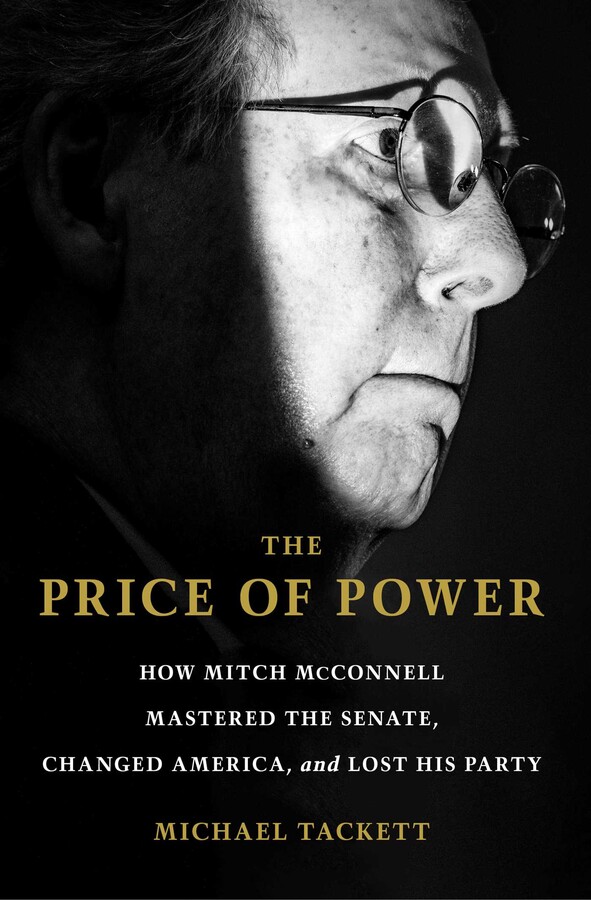
The Price of Power
How Mitch McConnell Mastered the Senate, Changed America, and Lost His Party
Table of Contents
About The Book
The first definitive biography of Mitch McConnell, revealing an intimate look at the personal and political life of one of the most powerful senators in American history.
In the long history of American government, few senators have wielded as much power as Kentucky’s Mitch McConnell. That’s no accident; he worked his entire life to cultivate his dominance.
In The Price of Power, award-winning journalist Michael Tackett pulls back the curtain on one of the most influential figures to ever set foot in the American Senate, offering you an intimate, personal view of his life and career. Drawing on thousands of pages of archival materials, letters, and more than a hundred interviews with associates, colleagues, and McConnell himself, Tackett pieces together the story of McConnell’s early life, his formative battle with polio as a young child, and details his forty-plus-year career as one of the Senate’s most impactful leaders.
A lifelong Republican, McConnell was known as a pragmatic moderate legislator when he joined the Senate in 1985. Tackett traces his steady rightward drift, as McConnell’s politics evolved with his masterful ability to consolidate and wield power. But such success comes at a cost. The Trump years brought with them the rise of an almost unrecognizable Republican party, suffused with a reactive populism that even McConnell himself would struggle to control.
Featuring expert reporting, unprecedented access, and never-before-published revelations, The Price of Power is an inside portrait of exactly that—what it takes to achieve power, maintain it, deploy it, and, finally, watch it slip out of your hands.
In the long history of American government, few senators have wielded as much power as Kentucky’s Mitch McConnell. That’s no accident; he worked his entire life to cultivate his dominance.
In The Price of Power, award-winning journalist Michael Tackett pulls back the curtain on one of the most influential figures to ever set foot in the American Senate, offering you an intimate, personal view of his life and career. Drawing on thousands of pages of archival materials, letters, and more than a hundred interviews with associates, colleagues, and McConnell himself, Tackett pieces together the story of McConnell’s early life, his formative battle with polio as a young child, and details his forty-plus-year career as one of the Senate’s most impactful leaders.
A lifelong Republican, McConnell was known as a pragmatic moderate legislator when he joined the Senate in 1985. Tackett traces his steady rightward drift, as McConnell’s politics evolved with his masterful ability to consolidate and wield power. But such success comes at a cost. The Trump years brought with them the rise of an almost unrecognizable Republican party, suffused with a reactive populism that even McConnell himself would struggle to control.
Featuring expert reporting, unprecedented access, and never-before-published revelations, The Price of Power is an inside portrait of exactly that—what it takes to achieve power, maintain it, deploy it, and, finally, watch it slip out of your hands.
Excerpt
Chapter One: Polio ONE POLIO
On July 20, 1944, a ninety-degree day in the town of Five Points, Alabama, two-year-old Mitchie McConnell was in tears. His mother, Dean, tried to comfort her only child, but the unexplained burning pain and redness in a finger on Mitchie’s left hand did not subside.
They were living with her oldest sister, Edrie Mae, and her husband, Julius Smartt, in a modest wood-frame home set along the curve in the road of a place so small it didn’t need a stoplight. Her husband, Mac, was with his Army unit at Fort Bliss in El Paso, Texas, preparing to deploy to fight in World War II.
When the pain and redness in Mitchie’s finger did not resolve, Dean took him to the nearby town of LaFayette to see Dr. Aaron Wheeler, who concluded the boy had an infection and enlarged lymph nodes, but nothing serious. Up to that point, Mitchie had been a healthy child and a source of great pride for Dean and Mac.
Until that July day, Dean had meticulously recorded the normal milestones of her son’s infancy in his “Baby Book.” Mitchie stood at eight and half months, took a step at ten months, and was walking consistently at about eleven months. He began saying words at about the same time: “Daddy,” “Mamie” for his grandmother, and “birdie” for an airplane. She also observed that her infant son had a “habit which has lasted some time, his sucking index and middle finger on his left hand and feeling his eyelashes with his finger on his right hand.” On his first Christmas the family had a tree, but no lights due to a war-related shortage. Dean recorded that Santa brought her son a teddy bear, rag doll, a hobbyhorse, toys with bells that ring, Mickey Mouse rattles, and a washable Democratic donkey.
Seven months later, that sense of normalcy was swept away when twenty-five-year-old Dean realized she was dealing with something far more serious than a common infection. By the end of the week, her son complained of pain in his legs and back. She noticed that his legs were “cold and clammy.” She kept him in bed until the second week in August. Then she noticed he “limped badly” when he walked. She decided to get another opinion and took him to see Dr. W. Park Phillips, in LaGrange, Georgia, a much larger town about twenty-five miles east, with a thriving commercial sector and a local college. Dr. Phillips’s diagnosis was far more profound: “acute anterior poliomyelitis”—polio.
It was a terrifying moment for Dean. The word “polio” had been striking fear in American parents for years, and now the disease had infected her young son. At the time, the world was a decade away from an effective vaccine, and parents struggled to find treatments for their children as doctors tried to assess the damage that the virus caused to the body. One prominent clinician likened polio to a “guided missile that does one thing: seek out, damage, and destroy the neurons that ‘activate’ you—the ones that activate your brain and muscles. The poliovirus is the perfect human ‘OFF switch.’?” In its worst form, polio caused serious and sometimes lifelong paralysis, even death. Beyond this, little was known about the disease, and rates were spiking across the United States.
With her husband headed to Europe for a long and dangerous deployment, Dean was left to figure out how to deal with her son’s potentially crippling illness largely on her own.
Though the South’s polio rates had historically lagged behind other regions of the country, an outbreak in the early 1940s had begun to chip away at the gap. Even so, Alabama was hardly a hot spot for the virus. The day Mitchie first complained to his mother, the Associated Press noted that only eight new cases of polio had been reported to the Alabama Health Department, and just five had been reported the previous week. The more dominant stories were about Democrats nominating Harry Truman to be President Franklin Roosevelt’s running mate at their convention in Chicago, and numerous accounts of the war raging in Europe and in the Pacific.
Though polio was in many ways mysterious, Americans were more aware of the disease than other viruses because they knew it had afflicted President Roosevelt. The president, who used a wheelchair or walked with heavy braces because of the ravages of polio, had started a national charity that would become known as the March of Dimes. FDR often sought treatment in Warm Springs, Georgia, a town of just over six hundred people, where he could come for comfort and healing in the warm mineral waters, and where he had established the nation’s best-known polio rehabilitation facility. Fortuitously, it was also only an hour’s drive from Five Points. Dean arranged to have her son evaluated there.
The two-lane road from Five Points to Warm Springs carves through rural areas, framed by pines and oaks and marked by an occasional farm. But Warm Springs was known well beyond its borders because of Roosevelt. On the winding road leading to the facility, deep purple wisteria curled around the pine trees, and visitors said it had the feel of a park or college campus.
In his memoir, My Place to Stand, Bentz Plagemann described how “we came upon a hidden group of buildings, a small principality, like an eighteenth-century manor house. A great pillared building faced a lawn, before which the driveway curved; grouped about this were low outbuildings, set among gardens with a formal air; all of it giving an impression of completeness and self sufficiency.”
All of it, Plagemann wrote, came to be seen as a refuge against the backdrop of a world at war and a virulent virus that struck children far more often than adults. Some researchers thought that the virus destroyed muscle, but that was not the case. “Actually it’s not the muscles themselves which are struck by the polio virus but the nerves which control them,” Plagemann wrote. “The impulse from the brain does not reach them. The knowledge that the muscles are there but useless is particularly distressing.”
The care at Warm Springs was geared not only toward physical rehabilitation but also toward the idea that patients could triumph even if polio left them with a disability. Plagemann went on to recount a conversation with Miss Alice Lou Plastridge, the head of physical therapists, who told him, “Only a particular group of people contract polio. It indicates a highly organized central nervous system, which usually means talent, or special ability of some kind.” She could have been telling patients that to boost their confidence rather than relying on empirical evidence, but the message had the desired effect.
While the facility had the look of a campus with a grassy quad, there was one major difference: it also had a shop for making braces to help polio patients walk upright. Some patients, like Plagemann, referred to themselves as “a polio,” a marker of the stigma the virus carried after rendering so many people fully or partially paralyzed.
Roosevelt’s case was acute, the muscles in his legs incapable of holding him in a standing position. As a person of wealth and means, he had access to the best care and treatment, but could never recover full use of his lower limbs. He made his first trip to Warm Springs on October 3, 1924, in what the World War II Museum says was his “last hope for finding a cure for the polio that had left him crippled three years earlier.”
The following day, by the museum’s account, he swam in the Warm Springs pool and “soon he was able to stand in four feet of water—something he had been unable to do previously.”
In a rare interview, he told Cleburne Gregory of the Atlanta Journal that he was able to move his right leg for the first time in three years. The headline on the article published October 26, 1924, read “Franklin Roosevelt Will Swim to Health.” An accompanying photograph showed his shriveled legs, and that inspired polio patients to travel to Warm Springs in search of healing. The episode also prompted Roosevelt to open the Georgia Warm Springs Foundation in 1927 as a polio therapeutic treatment center.
FDR traveled by train to Warm Springs frequently, and each visit set off a festive, parade-like atmosphere, with locals and tourists alike trying to get a glimpse of the president. His trips received favorable coverage in newspapers, and photographers honored the code of the time to not portray his obvious disability. In that era, the American South was overwhelmingly Democratic, and FDR was a hero.
McConnell was treated at the facility at least twice when the president was staying on the grounds in the Little White House, a cabin-like home Roosevelt consciously built to modest scale so as not to seem ostentatious. When FDR arrived—and patients would know by the sudden arrival and movement of Marines protecting him—he often talked with the patients and tried to bring cheer and optimism. Movie stars of the era also traveled to Warm Springs to be in the president’s aura and reinforce his message of hope. McConnell said his mother once held him up when the president’s car drove past. Roosevelt died at Warm Springs on April 12, 1945, around the time of one of McConnell’s visits.
For Dean and her son, the first visit to doctors in Warm Springs on August 22, 1944, previewed the arduous road ahead. “Patient was extremely uncooperative and muscle test should be considered probably quite inaccurate,” his medical records state. “The best idea of his weakness was obtained from watching the child walk.” But doctors also determined that his case was not severe enough to require in-patient treatment. Instead, his recovery and progress fell almost entirely on his mother. His doctors wrote that the boy “will return for examination and further instruction each week. Mother was advised to enforce complete bed rest and not to allow the child to stand on his feet at any time. There seems no necessity to apply hot packs but passive motion should be carried out 4 times a day.”
Each patient had a general physical, a muscle exam by a trained physiotherapist, and an orthopedic review. The cost was roughly $25, which would equal more than $425 in 2024. More than four decades later, McConnell said his family “almost went broke” paying for his treatment, but Dean persisted, relying on money that her husband sent home from the war, and probably money from “Sister” and McConnell’s paternal grandparents. At one point, Dean had to ask doctors to write to the gasoline rationing board in Alabama so she could buy the extra fuel needed to make the trip to Warm Springs.
McConnell’s examination revealed “minimal tightness in posterior group with marked weakness in anterior group.” His back and abdomen were “apparently good to normal,” as were his upper extremities. The impact of polio was most pronounced in his left leg, where doctors noted “diffuse involvement, definitely more severe than on the right, with greatest weakness in quadriceps and gastrocnemius. The left knee is markedly hyperextended when walking.”
Doctors and physical therapists gave Dean precise instructions for passive motion exercises to be conducted four times a day at home, about forty-five minutes at a time, how to bend or lift the leg, engaging the other major muscles in the area, turning and stretching to try to regain a full range of motion and to restore strength. McConnell would later refer to his mother as both a “stern disciplinarian” and a benevolent “drill sergeant” when it came to the routine.
Most important, though, was the vexing order to keep her son off his feet to prevent further damage to the muscles. Somehow, she was being asked to force her toddler son to unlearn the ability to walk and essentially spend all of his time lying down.
“They said, ‘We don’t want him to become a psychological cripple, but you must somehow convey to this child that he can walk,’?” McConnell said in an oral history. “What they’re saying was ‘We don’t want him to think he can’t walk, but at the same time, we don’t want him to walk yet, because if he starts walking too soon, his leg is going to be stiff. We won’t be able to rehabilitate the muscle.’?”
So McConnell and his mother were, for the most part, confined to their small house in a remote town, with an uncertain future and the fear that even the doctors at Warm Springs could not guarantee he would ever recover. There are several photos from that era, most of them showing Mitchie sitting in the grass or on the porch. In one photo that Dean sent to Mac, she wrote a caption on the back: “Five Points Lonely Hearts Club.”
There was a grinding tedium to the daily ritual of rehabilitation at home, interrupted by the trips to Warm Springs. After one such journey, Dean called one of her brothers, Arnold Shockley, who lived in Birmingham, to tell him the grim news about Mitchie. “I will never forget this,” his daughter Nell said of her father in an interview almost eighty years later. “He cried most of the night.” His reaction reflected the panic that the word “polio” could engender, and the next day he packed his family in a car to show support for his sister and her stricken son. “It was almost like if you contracted polio you may not make it,” Nell recalled.
Shortly after they arrived, Nell watched as Dean, composed and—to Nell’s nine-year-old eyes—looking “like a movie star,” showed them how she put Mitch through physical therapy. She laid quilts on a table in a room just off the kitchen, then placed her son on them face up. She would take each straightened leg and bend it toward the abdomen, again and again. “This was a very trying time for his mother,” Nell said. “I was struck by how good she was constantly.”
Mitchie was confined to a bedroom just off the living room. Dean read to him; they would color and draw, and “create little towns on his bed with his toys.” But otherwise, when he wasn’t receiving physical therapy from his mother, he spent hours alone, passing time by drawing a train along the walls just above the baseboard. His mother was aghast, but his aunt thought it was charming and at first asked that Dean not clean the walls.
“Sister” had been Dean’s surrogate mother. Their mother died when Dean was five months old and Sister was only eleven. Sister and her husband, Julius, did not have children. Their home was across the street from the center of town life, the general store that they owned. Sister, with a stern demeanor, often staffed the cash register, and she kept detailed entries in the ledger book for those who bought on credit, which was most people. She was also a substitute teacher, and students recalled her as kind and patient in the classroom. Julius was well known in the area, and it was common for him—a sturdy five foot ten and 180 pounds—to go door-to-door to demand payment from those too far in arrears. He would go on to become wealthy by the standards of Five Points, owning eleven rental properties, more than 1,400 acres of farmland, and several commercial buildings. He eventually bequeathed one quarter of his estate, $250,000, to McConnell in 1996.
Most people in the area made their living from farming, either crops or timber. The town had a Baptist church and a Methodist one, which Sister attended, along with a bank, post office, and a small drugstore. When McConnell visited in 2021, the general store was a weathered shell of itself, and most other businesses were closed. Officials in Five Points had to fight simply to keep the post office. The population had withered from 780 when McConnell was a boy to 114 by 2020.
By October 1944, McConnell began to show signs of improvement, which doctors described as “very gratifying.” He still had significant problems in his “gluteus maximus, hip abductors, internal rotators and quadriceps… left knee tends to go into the back knee position.”
By January 9, 1945, his progress had advanced such that Dean was asked to bring him in every three or four weeks. His appointment that July, months after his first visit, found him in “excellent condition.” By May 1946, he was walking well, but with “noticeable atrophy of the left thigh.” At age two, his left thigh was three-quarters of an inch smaller in circumference than his right. That gap would grow to at least two inches in adulthood.
Later inquiry would question the value of some of the treatment McConnell underwent. A British researcher, W. J .W. Sharrard, did a three-year study of polio patients and concluded that there was “little further benefit” from “physical therapy 10 months after the polio attack.”
The immobility he was prescribed early on also may have harmed more than helped. Dr. Richard Bruno, director of the International Centre for Polio Education in New Jersey and an authority on the aftereffects of polio—who reviewed McConnell’s records at my request—said doctors may have prescribed the strict isolation and lack of movement because McConnell was an outpatient and they were concerned that he would move too much and inhibit his recovery. “It seems like he was kind of shut down for those two years, and it possibly was not necessary, and it may have limited him when he did start to walk,” Bruno added.
While Dean tended to her son, her husband was serving on the battlefront in Europe, eventually reaching what was then Czechoslovakia. When the two were apart, either during the war or even when Mac was away for a few days, they were prolific letter writers. Much of their correspondence while he was deployed was lost, but some letters were saved. When Mac was doing his basic training, he would encourage his wife to “rough up the boy for me,” and talk of missing them both dearly. But he did not, at least in the letters I reviewed, write specifically about polio. Neither did Dean.
It is possible that Mac did not fully appreciate what his wife and son were going through, particularly given that he had his own literal battles to fight in a unit that had suffered serious casualties. His memories of his son were those of a thriving toddler.
As the war wound down, with victory at hand, one day stood out as joyous. On VE Day, May 8, 1945, McConnell wrote to his wife from the Czech city of Pilsen. “My dearest one,” he began. “At last I have time to write and as you can see I can tell you where I am. I have been here several days—of course I can’t tell you how many.” He spoke of “10,000 things I want to tell you about but it will take several letters. First, I want to tell you that I was in the big middle of everything until the very last but now peace has come here…. There is no way of expressing how I feel about peace even to you. I trained to be a soldier and then I fought as well as I knew how but now it’s over here and I believe that soon Japan will be whipped.” He described women and children lining the streets in celebration, giving the American soldiers cognac, cookies, and kisses.
“For the first time I’m really homesick,” he confessed, “but we won’t talk about that. You are so very pretty, honey, and Mitch is looking so well. He is really practically 100% recovered, isn’t he? He is so fine looking—like his mommie. You are right, he is really all boy now and I long to see him and his mommie.”
Mac went on: “I have thought of our dead President [FDR] quite a bit today and we have talked about how happy he would be if he were here. I guess he knows about it tho. I wish he could have lived until this day at least.”
For his part, McConnell has no tangible memory of his struggle with polio, other than what the records provide, but he believes his mother’s strict regimen saved him from a much more challenging life. “There’s not a doubt in my mind that I would have been disabled, at least in the sense that I would have walked with a limp,” he said in his oral history.
Instead, he later recalled, polio was in some ways a positive. “I have many faults, but I think one of my strengths is discipline and planning and tenaciousness,” McConnell said. “And I think it really must surely have been a lesson imparted at that very early age by this experience.”
In McConnell’s telling, there is a storybook ending. After he had been released from treatment at Warm Springs at age four, his mother bought him his first pair of shoes: low-top saddle oxfords, most likely at Solomon’s, a still-thriving shoe store in LaGrange. After two years of being told not to walk, he could walk again, without a brace or a limp.
The story of polio’s effect on McConnell’s life, though, is far more layered and consequential than his account, both physically and psychologically. His version tracks with what a leading medical historian, Daniel J. Wilson, called “a mid-century post–World War II stoicism” that has been documented in studies of polio survivors and their families. Many of those survivors became intensely driven high achievers, but ones who were also highly sensitive to criticism and deeply fearful of failure.
Like others who had polio in that era, McConnell and his parents clearly wanted to put the struggle behind them. The fact that McConnell’s parents didn’t mention polio in the letters I reviewed, and that their son chose not to emphasize it in his own life, is in keeping with how most families who had a child with polio in the 1940s behaved. Those who did not have to use a wheelchair or crutches were seen as “cured” and were expected to move on with life.
But there were little reminders. Those lace-up oxfords that McConnell could finally wear required a 3/16 inch posterior heel wedge on the left shoe, which was designed to compensate for weakness in the calf and other parts of the leg, his medical records show. McConnell’s father, after returning from service, also wrote to Warm Springs, inquiring about special shoes.
Wilson, who had polio himself, found that polio patients then were subject to a “try harder” mentality to overcome the disease. “The cultural expectations of the mid-twentieth-century American compounded polio patients’ difficulties in coming to terms with their illness and disabilities,” he wrote. “Prevailing cultural values held that the only acceptable response to the disabilities caused by polio was to try as hard as possible to overcome any disability.”
McConnell’s life often followed such a pattern. “The fact that McConnell has become who he has become is consistent with what a polio survivor would do,” Bruno said. “Manipulate the circumstances to their benefit, take the focus away from disability-related issues, and then achieve tremendous things.”
It is not clear whether McConnell’s polio was the reason his parents had only one child. But what is evident is that they focused on Mitchie with a loving but hovering presence, always there to nurture his dreams. “Candidly, I think it was a great advantage,” McConnell said of being an only child. “Far from all the comments about being spoiled and all the rest, I think there’s something to be said for getting enough attention in terms of how you see yourself and your willingness to compete and all the rest. I think it had an enormous positive impact on me, and I really don’t feel badly about not having had brothers and sisters.”
In the decades that have passed since the polio vaccine was developed, researchers have studied “the polios” to see how the disease might have affected patients throughout their lives, both physically and psychologically.
Dr. Bruno has studied more than seven thousand survivors. He is one himself. And he focused his life’s work on the impact of the virus.
When polio survivors first came to him in 1982, he discovered that polio had a profound effect on earning and learning. He realized that, more than the expected, percentages of polio survivors are corporate executives, members of both houses of Congress, and professionals of all types—teachers, lawyers, doctors, and nurses. This level of achievement was “startling,” he wrote. Polio survivors who were told that they would never go to college or even get a job became America’s ‘best and brightest.’?”
Polio survivors also had common personality traits: “hard-driving, time-conscious, competitive, self-denying, perfectionist, overachieving ‘Type A’ personality.” That hard-charging ethos for some also exacted a psychic toll. The more Type A behavior that was exhibited, the more sensitive that person would likely be to criticism. Bruno found in later research that polio survivors were more prone to “thinking of themselves as failures.” That is among the reasons why polio survivors “discarded in childhood any evidence of polio.” They wanted to “both act and appear ‘normal.’?” For most polio survivors, Bruno wrote, “it’s more important to appear ‘normal’ and take care of others than it is to physically or emotionally care for themselves.”
Among those who recovered from polio was the Supreme Court justice William O. Douglas, who wrote, “I struggle valiantly to be as much like, or better than, especially better than, every other child in every way that I could.” Since he couldn’t compete physically, he vowed to be smarter. “The idea that I was a weakling festered and grew in my mind…. I decided to prove my superiority over my contemporaries in other ways.” This was the instinct behind the successful careers of Olympians Wilma Rudolph and Johnny Weissmuller, Washington Post editor Ben Bradlee, and the actors Alan Alda and Mia Farrow, all of whom were stricken with polio.
Even so, polio continued to surprise. By the 1970s, two decades after the Salk and Sabin vaccines nearly eradicated polio in the United States, doctors had started hearing from former polio patients complaining about unexplained muscle weakness and fatigue.
In 1984, Newsweek magazine published an article called “The Late Effects of Polio,” as an increasing number of people who had polio in their youth or young adulthood were now seeing the virus, in effect, manifest in a different but still troubling way. Bruno wrote in his book The Polio Paradox that “Polio was thought to be a ‘stable disease.’ Once polio survivors recovered muscle strength after the polio attack, their physical abilities were supposed to remain for the rest of their lives.” Contrary to this common belief, many polio survivors saw their physical strength in affected parts of the body start to waste away.
“Several thousand victims of polio epidemics during the 1940s and 1950s have come down recently with ‘recurrent polio’—new symptoms of muscle and joint pain and weakness that in a few cases have been more serious than the original disease,” Victor Cohn wrote in the Washington Post. Two years later, he wrote that an estimated three hundred thousand Americans had “post polio syndrome,” often involving muscle degeneration that “goes beyond mere aging.”
By 1991, three special issues of the medical journal Orthopedics were devoted to “post-polio sequelae,” or sequel. For many people with post-polio syndrome, researchers found that the symptoms prompted them to try to speed up, rather than slow down. They were disinclined to delegate or let others help them, and they exhibited a need for control. Another health risk was also present for many: heart disease.
In McConnell’s case, the most he will say is that a comeback of the disease seems to have affected his mobility. In a 1995 interview for the oral history project, he said: “The only way it affects me today is I do have a hard time going down stairs.” The difficulty started a decade earlier, he acknowledged, which would fit within the time frame for the onset of post-polio syndrome. But later in life, the physical signs would be even more profound.
Polio would remain his unwanted gift, and his haunting ghost.
On July 20, 1944, a ninety-degree day in the town of Five Points, Alabama, two-year-old Mitchie McConnell was in tears. His mother, Dean, tried to comfort her only child, but the unexplained burning pain and redness in a finger on Mitchie’s left hand did not subside.
They were living with her oldest sister, Edrie Mae, and her husband, Julius Smartt, in a modest wood-frame home set along the curve in the road of a place so small it didn’t need a stoplight. Her husband, Mac, was with his Army unit at Fort Bliss in El Paso, Texas, preparing to deploy to fight in World War II.
When the pain and redness in Mitchie’s finger did not resolve, Dean took him to the nearby town of LaFayette to see Dr. Aaron Wheeler, who concluded the boy had an infection and enlarged lymph nodes, but nothing serious. Up to that point, Mitchie had been a healthy child and a source of great pride for Dean and Mac.
Until that July day, Dean had meticulously recorded the normal milestones of her son’s infancy in his “Baby Book.” Mitchie stood at eight and half months, took a step at ten months, and was walking consistently at about eleven months. He began saying words at about the same time: “Daddy,” “Mamie” for his grandmother, and “birdie” for an airplane. She also observed that her infant son had a “habit which has lasted some time, his sucking index and middle finger on his left hand and feeling his eyelashes with his finger on his right hand.” On his first Christmas the family had a tree, but no lights due to a war-related shortage. Dean recorded that Santa brought her son a teddy bear, rag doll, a hobbyhorse, toys with bells that ring, Mickey Mouse rattles, and a washable Democratic donkey.
Seven months later, that sense of normalcy was swept away when twenty-five-year-old Dean realized she was dealing with something far more serious than a common infection. By the end of the week, her son complained of pain in his legs and back. She noticed that his legs were “cold and clammy.” She kept him in bed until the second week in August. Then she noticed he “limped badly” when he walked. She decided to get another opinion and took him to see Dr. W. Park Phillips, in LaGrange, Georgia, a much larger town about twenty-five miles east, with a thriving commercial sector and a local college. Dr. Phillips’s diagnosis was far more profound: “acute anterior poliomyelitis”—polio.
It was a terrifying moment for Dean. The word “polio” had been striking fear in American parents for years, and now the disease had infected her young son. At the time, the world was a decade away from an effective vaccine, and parents struggled to find treatments for their children as doctors tried to assess the damage that the virus caused to the body. One prominent clinician likened polio to a “guided missile that does one thing: seek out, damage, and destroy the neurons that ‘activate’ you—the ones that activate your brain and muscles. The poliovirus is the perfect human ‘OFF switch.’?” In its worst form, polio caused serious and sometimes lifelong paralysis, even death. Beyond this, little was known about the disease, and rates were spiking across the United States.
With her husband headed to Europe for a long and dangerous deployment, Dean was left to figure out how to deal with her son’s potentially crippling illness largely on her own.
Though the South’s polio rates had historically lagged behind other regions of the country, an outbreak in the early 1940s had begun to chip away at the gap. Even so, Alabama was hardly a hot spot for the virus. The day Mitchie first complained to his mother, the Associated Press noted that only eight new cases of polio had been reported to the Alabama Health Department, and just five had been reported the previous week. The more dominant stories were about Democrats nominating Harry Truman to be President Franklin Roosevelt’s running mate at their convention in Chicago, and numerous accounts of the war raging in Europe and in the Pacific.
Though polio was in many ways mysterious, Americans were more aware of the disease than other viruses because they knew it had afflicted President Roosevelt. The president, who used a wheelchair or walked with heavy braces because of the ravages of polio, had started a national charity that would become known as the March of Dimes. FDR often sought treatment in Warm Springs, Georgia, a town of just over six hundred people, where he could come for comfort and healing in the warm mineral waters, and where he had established the nation’s best-known polio rehabilitation facility. Fortuitously, it was also only an hour’s drive from Five Points. Dean arranged to have her son evaluated there.
The two-lane road from Five Points to Warm Springs carves through rural areas, framed by pines and oaks and marked by an occasional farm. But Warm Springs was known well beyond its borders because of Roosevelt. On the winding road leading to the facility, deep purple wisteria curled around the pine trees, and visitors said it had the feel of a park or college campus.
In his memoir, My Place to Stand, Bentz Plagemann described how “we came upon a hidden group of buildings, a small principality, like an eighteenth-century manor house. A great pillared building faced a lawn, before which the driveway curved; grouped about this were low outbuildings, set among gardens with a formal air; all of it giving an impression of completeness and self sufficiency.”
All of it, Plagemann wrote, came to be seen as a refuge against the backdrop of a world at war and a virulent virus that struck children far more often than adults. Some researchers thought that the virus destroyed muscle, but that was not the case. “Actually it’s not the muscles themselves which are struck by the polio virus but the nerves which control them,” Plagemann wrote. “The impulse from the brain does not reach them. The knowledge that the muscles are there but useless is particularly distressing.”
The care at Warm Springs was geared not only toward physical rehabilitation but also toward the idea that patients could triumph even if polio left them with a disability. Plagemann went on to recount a conversation with Miss Alice Lou Plastridge, the head of physical therapists, who told him, “Only a particular group of people contract polio. It indicates a highly organized central nervous system, which usually means talent, or special ability of some kind.” She could have been telling patients that to boost their confidence rather than relying on empirical evidence, but the message had the desired effect.
While the facility had the look of a campus with a grassy quad, there was one major difference: it also had a shop for making braces to help polio patients walk upright. Some patients, like Plagemann, referred to themselves as “a polio,” a marker of the stigma the virus carried after rendering so many people fully or partially paralyzed.
Roosevelt’s case was acute, the muscles in his legs incapable of holding him in a standing position. As a person of wealth and means, he had access to the best care and treatment, but could never recover full use of his lower limbs. He made his first trip to Warm Springs on October 3, 1924, in what the World War II Museum says was his “last hope for finding a cure for the polio that had left him crippled three years earlier.”
The following day, by the museum’s account, he swam in the Warm Springs pool and “soon he was able to stand in four feet of water—something he had been unable to do previously.”
In a rare interview, he told Cleburne Gregory of the Atlanta Journal that he was able to move his right leg for the first time in three years. The headline on the article published October 26, 1924, read “Franklin Roosevelt Will Swim to Health.” An accompanying photograph showed his shriveled legs, and that inspired polio patients to travel to Warm Springs in search of healing. The episode also prompted Roosevelt to open the Georgia Warm Springs Foundation in 1927 as a polio therapeutic treatment center.
FDR traveled by train to Warm Springs frequently, and each visit set off a festive, parade-like atmosphere, with locals and tourists alike trying to get a glimpse of the president. His trips received favorable coverage in newspapers, and photographers honored the code of the time to not portray his obvious disability. In that era, the American South was overwhelmingly Democratic, and FDR was a hero.
McConnell was treated at the facility at least twice when the president was staying on the grounds in the Little White House, a cabin-like home Roosevelt consciously built to modest scale so as not to seem ostentatious. When FDR arrived—and patients would know by the sudden arrival and movement of Marines protecting him—he often talked with the patients and tried to bring cheer and optimism. Movie stars of the era also traveled to Warm Springs to be in the president’s aura and reinforce his message of hope. McConnell said his mother once held him up when the president’s car drove past. Roosevelt died at Warm Springs on April 12, 1945, around the time of one of McConnell’s visits.
For Dean and her son, the first visit to doctors in Warm Springs on August 22, 1944, previewed the arduous road ahead. “Patient was extremely uncooperative and muscle test should be considered probably quite inaccurate,” his medical records state. “The best idea of his weakness was obtained from watching the child walk.” But doctors also determined that his case was not severe enough to require in-patient treatment. Instead, his recovery and progress fell almost entirely on his mother. His doctors wrote that the boy “will return for examination and further instruction each week. Mother was advised to enforce complete bed rest and not to allow the child to stand on his feet at any time. There seems no necessity to apply hot packs but passive motion should be carried out 4 times a day.”
Each patient had a general physical, a muscle exam by a trained physiotherapist, and an orthopedic review. The cost was roughly $25, which would equal more than $425 in 2024. More than four decades later, McConnell said his family “almost went broke” paying for his treatment, but Dean persisted, relying on money that her husband sent home from the war, and probably money from “Sister” and McConnell’s paternal grandparents. At one point, Dean had to ask doctors to write to the gasoline rationing board in Alabama so she could buy the extra fuel needed to make the trip to Warm Springs.
McConnell’s examination revealed “minimal tightness in posterior group with marked weakness in anterior group.” His back and abdomen were “apparently good to normal,” as were his upper extremities. The impact of polio was most pronounced in his left leg, where doctors noted “diffuse involvement, definitely more severe than on the right, with greatest weakness in quadriceps and gastrocnemius. The left knee is markedly hyperextended when walking.”
Doctors and physical therapists gave Dean precise instructions for passive motion exercises to be conducted four times a day at home, about forty-five minutes at a time, how to bend or lift the leg, engaging the other major muscles in the area, turning and stretching to try to regain a full range of motion and to restore strength. McConnell would later refer to his mother as both a “stern disciplinarian” and a benevolent “drill sergeant” when it came to the routine.
Most important, though, was the vexing order to keep her son off his feet to prevent further damage to the muscles. Somehow, she was being asked to force her toddler son to unlearn the ability to walk and essentially spend all of his time lying down.
“They said, ‘We don’t want him to become a psychological cripple, but you must somehow convey to this child that he can walk,’?” McConnell said in an oral history. “What they’re saying was ‘We don’t want him to think he can’t walk, but at the same time, we don’t want him to walk yet, because if he starts walking too soon, his leg is going to be stiff. We won’t be able to rehabilitate the muscle.’?”
So McConnell and his mother were, for the most part, confined to their small house in a remote town, with an uncertain future and the fear that even the doctors at Warm Springs could not guarantee he would ever recover. There are several photos from that era, most of them showing Mitchie sitting in the grass or on the porch. In one photo that Dean sent to Mac, she wrote a caption on the back: “Five Points Lonely Hearts Club.”
There was a grinding tedium to the daily ritual of rehabilitation at home, interrupted by the trips to Warm Springs. After one such journey, Dean called one of her brothers, Arnold Shockley, who lived in Birmingham, to tell him the grim news about Mitchie. “I will never forget this,” his daughter Nell said of her father in an interview almost eighty years later. “He cried most of the night.” His reaction reflected the panic that the word “polio” could engender, and the next day he packed his family in a car to show support for his sister and her stricken son. “It was almost like if you contracted polio you may not make it,” Nell recalled.
Shortly after they arrived, Nell watched as Dean, composed and—to Nell’s nine-year-old eyes—looking “like a movie star,” showed them how she put Mitch through physical therapy. She laid quilts on a table in a room just off the kitchen, then placed her son on them face up. She would take each straightened leg and bend it toward the abdomen, again and again. “This was a very trying time for his mother,” Nell said. “I was struck by how good she was constantly.”
Mitchie was confined to a bedroom just off the living room. Dean read to him; they would color and draw, and “create little towns on his bed with his toys.” But otherwise, when he wasn’t receiving physical therapy from his mother, he spent hours alone, passing time by drawing a train along the walls just above the baseboard. His mother was aghast, but his aunt thought it was charming and at first asked that Dean not clean the walls.
“Sister” had been Dean’s surrogate mother. Their mother died when Dean was five months old and Sister was only eleven. Sister and her husband, Julius, did not have children. Their home was across the street from the center of town life, the general store that they owned. Sister, with a stern demeanor, often staffed the cash register, and she kept detailed entries in the ledger book for those who bought on credit, which was most people. She was also a substitute teacher, and students recalled her as kind and patient in the classroom. Julius was well known in the area, and it was common for him—a sturdy five foot ten and 180 pounds—to go door-to-door to demand payment from those too far in arrears. He would go on to become wealthy by the standards of Five Points, owning eleven rental properties, more than 1,400 acres of farmland, and several commercial buildings. He eventually bequeathed one quarter of his estate, $250,000, to McConnell in 1996.
Most people in the area made their living from farming, either crops or timber. The town had a Baptist church and a Methodist one, which Sister attended, along with a bank, post office, and a small drugstore. When McConnell visited in 2021, the general store was a weathered shell of itself, and most other businesses were closed. Officials in Five Points had to fight simply to keep the post office. The population had withered from 780 when McConnell was a boy to 114 by 2020.
By October 1944, McConnell began to show signs of improvement, which doctors described as “very gratifying.” He still had significant problems in his “gluteus maximus, hip abductors, internal rotators and quadriceps… left knee tends to go into the back knee position.”
By January 9, 1945, his progress had advanced such that Dean was asked to bring him in every three or four weeks. His appointment that July, months after his first visit, found him in “excellent condition.” By May 1946, he was walking well, but with “noticeable atrophy of the left thigh.” At age two, his left thigh was three-quarters of an inch smaller in circumference than his right. That gap would grow to at least two inches in adulthood.
Later inquiry would question the value of some of the treatment McConnell underwent. A British researcher, W. J .W. Sharrard, did a three-year study of polio patients and concluded that there was “little further benefit” from “physical therapy 10 months after the polio attack.”
The immobility he was prescribed early on also may have harmed more than helped. Dr. Richard Bruno, director of the International Centre for Polio Education in New Jersey and an authority on the aftereffects of polio—who reviewed McConnell’s records at my request—said doctors may have prescribed the strict isolation and lack of movement because McConnell was an outpatient and they were concerned that he would move too much and inhibit his recovery. “It seems like he was kind of shut down for those two years, and it possibly was not necessary, and it may have limited him when he did start to walk,” Bruno added.
While Dean tended to her son, her husband was serving on the battlefront in Europe, eventually reaching what was then Czechoslovakia. When the two were apart, either during the war or even when Mac was away for a few days, they were prolific letter writers. Much of their correspondence while he was deployed was lost, but some letters were saved. When Mac was doing his basic training, he would encourage his wife to “rough up the boy for me,” and talk of missing them both dearly. But he did not, at least in the letters I reviewed, write specifically about polio. Neither did Dean.
It is possible that Mac did not fully appreciate what his wife and son were going through, particularly given that he had his own literal battles to fight in a unit that had suffered serious casualties. His memories of his son were those of a thriving toddler.
As the war wound down, with victory at hand, one day stood out as joyous. On VE Day, May 8, 1945, McConnell wrote to his wife from the Czech city of Pilsen. “My dearest one,” he began. “At last I have time to write and as you can see I can tell you where I am. I have been here several days—of course I can’t tell you how many.” He spoke of “10,000 things I want to tell you about but it will take several letters. First, I want to tell you that I was in the big middle of everything until the very last but now peace has come here…. There is no way of expressing how I feel about peace even to you. I trained to be a soldier and then I fought as well as I knew how but now it’s over here and I believe that soon Japan will be whipped.” He described women and children lining the streets in celebration, giving the American soldiers cognac, cookies, and kisses.
“For the first time I’m really homesick,” he confessed, “but we won’t talk about that. You are so very pretty, honey, and Mitch is looking so well. He is really practically 100% recovered, isn’t he? He is so fine looking—like his mommie. You are right, he is really all boy now and I long to see him and his mommie.”
Mac went on: “I have thought of our dead President [FDR] quite a bit today and we have talked about how happy he would be if he were here. I guess he knows about it tho. I wish he could have lived until this day at least.”
For his part, McConnell has no tangible memory of his struggle with polio, other than what the records provide, but he believes his mother’s strict regimen saved him from a much more challenging life. “There’s not a doubt in my mind that I would have been disabled, at least in the sense that I would have walked with a limp,” he said in his oral history.
Instead, he later recalled, polio was in some ways a positive. “I have many faults, but I think one of my strengths is discipline and planning and tenaciousness,” McConnell said. “And I think it really must surely have been a lesson imparted at that very early age by this experience.”
In McConnell’s telling, there is a storybook ending. After he had been released from treatment at Warm Springs at age four, his mother bought him his first pair of shoes: low-top saddle oxfords, most likely at Solomon’s, a still-thriving shoe store in LaGrange. After two years of being told not to walk, he could walk again, without a brace or a limp.
The story of polio’s effect on McConnell’s life, though, is far more layered and consequential than his account, both physically and psychologically. His version tracks with what a leading medical historian, Daniel J. Wilson, called “a mid-century post–World War II stoicism” that has been documented in studies of polio survivors and their families. Many of those survivors became intensely driven high achievers, but ones who were also highly sensitive to criticism and deeply fearful of failure.
Like others who had polio in that era, McConnell and his parents clearly wanted to put the struggle behind them. The fact that McConnell’s parents didn’t mention polio in the letters I reviewed, and that their son chose not to emphasize it in his own life, is in keeping with how most families who had a child with polio in the 1940s behaved. Those who did not have to use a wheelchair or crutches were seen as “cured” and were expected to move on with life.
But there were little reminders. Those lace-up oxfords that McConnell could finally wear required a 3/16 inch posterior heel wedge on the left shoe, which was designed to compensate for weakness in the calf and other parts of the leg, his medical records show. McConnell’s father, after returning from service, also wrote to Warm Springs, inquiring about special shoes.
Wilson, who had polio himself, found that polio patients then were subject to a “try harder” mentality to overcome the disease. “The cultural expectations of the mid-twentieth-century American compounded polio patients’ difficulties in coming to terms with their illness and disabilities,” he wrote. “Prevailing cultural values held that the only acceptable response to the disabilities caused by polio was to try as hard as possible to overcome any disability.”
McConnell’s life often followed such a pattern. “The fact that McConnell has become who he has become is consistent with what a polio survivor would do,” Bruno said. “Manipulate the circumstances to their benefit, take the focus away from disability-related issues, and then achieve tremendous things.”
It is not clear whether McConnell’s polio was the reason his parents had only one child. But what is evident is that they focused on Mitchie with a loving but hovering presence, always there to nurture his dreams. “Candidly, I think it was a great advantage,” McConnell said of being an only child. “Far from all the comments about being spoiled and all the rest, I think there’s something to be said for getting enough attention in terms of how you see yourself and your willingness to compete and all the rest. I think it had an enormous positive impact on me, and I really don’t feel badly about not having had brothers and sisters.”
In the decades that have passed since the polio vaccine was developed, researchers have studied “the polios” to see how the disease might have affected patients throughout their lives, both physically and psychologically.
Dr. Bruno has studied more than seven thousand survivors. He is one himself. And he focused his life’s work on the impact of the virus.
When polio survivors first came to him in 1982, he discovered that polio had a profound effect on earning and learning. He realized that, more than the expected, percentages of polio survivors are corporate executives, members of both houses of Congress, and professionals of all types—teachers, lawyers, doctors, and nurses. This level of achievement was “startling,” he wrote. Polio survivors who were told that they would never go to college or even get a job became America’s ‘best and brightest.’?”
Polio survivors also had common personality traits: “hard-driving, time-conscious, competitive, self-denying, perfectionist, overachieving ‘Type A’ personality.” That hard-charging ethos for some also exacted a psychic toll. The more Type A behavior that was exhibited, the more sensitive that person would likely be to criticism. Bruno found in later research that polio survivors were more prone to “thinking of themselves as failures.” That is among the reasons why polio survivors “discarded in childhood any evidence of polio.” They wanted to “both act and appear ‘normal.’?” For most polio survivors, Bruno wrote, “it’s more important to appear ‘normal’ and take care of others than it is to physically or emotionally care for themselves.”
Among those who recovered from polio was the Supreme Court justice William O. Douglas, who wrote, “I struggle valiantly to be as much like, or better than, especially better than, every other child in every way that I could.” Since he couldn’t compete physically, he vowed to be smarter. “The idea that I was a weakling festered and grew in my mind…. I decided to prove my superiority over my contemporaries in other ways.” This was the instinct behind the successful careers of Olympians Wilma Rudolph and Johnny Weissmuller, Washington Post editor Ben Bradlee, and the actors Alan Alda and Mia Farrow, all of whom were stricken with polio.
Even so, polio continued to surprise. By the 1970s, two decades after the Salk and Sabin vaccines nearly eradicated polio in the United States, doctors had started hearing from former polio patients complaining about unexplained muscle weakness and fatigue.
In 1984, Newsweek magazine published an article called “The Late Effects of Polio,” as an increasing number of people who had polio in their youth or young adulthood were now seeing the virus, in effect, manifest in a different but still troubling way. Bruno wrote in his book The Polio Paradox that “Polio was thought to be a ‘stable disease.’ Once polio survivors recovered muscle strength after the polio attack, their physical abilities were supposed to remain for the rest of their lives.” Contrary to this common belief, many polio survivors saw their physical strength in affected parts of the body start to waste away.
“Several thousand victims of polio epidemics during the 1940s and 1950s have come down recently with ‘recurrent polio’—new symptoms of muscle and joint pain and weakness that in a few cases have been more serious than the original disease,” Victor Cohn wrote in the Washington Post. Two years later, he wrote that an estimated three hundred thousand Americans had “post polio syndrome,” often involving muscle degeneration that “goes beyond mere aging.”
By 1991, three special issues of the medical journal Orthopedics were devoted to “post-polio sequelae,” or sequel. For many people with post-polio syndrome, researchers found that the symptoms prompted them to try to speed up, rather than slow down. They were disinclined to delegate or let others help them, and they exhibited a need for control. Another health risk was also present for many: heart disease.
In McConnell’s case, the most he will say is that a comeback of the disease seems to have affected his mobility. In a 1995 interview for the oral history project, he said: “The only way it affects me today is I do have a hard time going down stairs.” The difficulty started a decade earlier, he acknowledged, which would fit within the time frame for the onset of post-polio syndrome. But later in life, the physical signs would be even more profound.
Polio would remain his unwanted gift, and his haunting ghost.
About The Author
Doug Mills
Michael Tackett is an award-winning journalist with more than three decades of experience covering national politics, including nine presidential elections. He is currently the Deputy Washington Bureau Chief for the Associated Press. Before that, he was an editor and reporter for The New York Times, Washington Bureau Chief for both Bloomberg News and the Chicago Tribune, and National Editor for US News & World Report. He is a recipient of the White House Correspondents Association’s Edgar A. Poe Award for National Reporting. His first book, The Baseball Whisperer, tells the story of a summer league baseball team in Clarinda, Iowa, that helped shape dozens of major league players. He lives in Alexandria, Virginia.
Product Details
- Publisher: Simon & Schuster (October 20, 2026)
- Length: 416 pages
- ISBN13: 9781668005859
Browse Related Books
Raves and Reviews
"Tackett's riveting and inspirational book is a valuable contribution and a must-read...a superb reminder that politics is the art of the possible."—Kelly D. Johnston, Against the Grain
"Highly readable...A staunchly evenhanded narrative from the perspective of a perceptive and knowledgeable outsider."—Jean Parvin Bordewich, Washington Monthly
"The most comprehensive and fair-minded account of McConnell’s life and career."—Ira Shapiro, Washington Independent
“Here is the story of arguably the most consequential leader of the United States Senate in American history. Drawing on remarkable access to Mitch McConnell and to the senator’s lifetime of papers, Michael Tackett has given us a clear-eyed account of a lawmaker and a politician who, for better or for worse, has fundamentally shaped the way we live now.”—Jon Meacham, Pulitzer Prize-winning biographer
"Fascinating...A superb insider’s portrait of the sphinx of the Senate."—Kirkus
"[A] fine, evenhanded McConnell biography"—George F. Will, Washington Post
"Excellent...A very important book."—Wolf Blitzer, The Situation Room
"Detailed and informative biography... assiduously researched..."—Jacob Heilbrunn, Washington Post
"Tackett's riveting and inspirational book is a valuable contribution and a must-read...a superb reminder that politics is the art of the possible."—Kelly D. Johnston, Against the Grain
"Highly readable...A staunchly evenhanded narrative from the perspective of a perceptive and knowledgeable outsider."—Jean Parvin Bordewich, Washington Monthly
"The most comprehensive and fair-minded account of McConnell’s life and career."—Ira Shapiro, Washington Independent
“Here is the story of arguably the most consequential leader of the United States Senate in American history. Drawing on remarkable access to Mitch McConnell and to the senator’s lifetime of papers, Michael Tackett has given us a clear-eyed account of a lawmaker and a politician who, for better or for worse, has fundamentally shaped the way we live now.”—Jon Meacham, Pulitzer Prize-winning biographer
"Fascinating...A superb insider’s portrait of the sphinx of the Senate."—Kirkus
"[A] fine, evenhanded McConnell biography"—George F. Will, Washington Post
"Excellent...A very important book."—Wolf Blitzer, The Situation Room
"Detailed and informative biography... assiduously researched..."—Jacob Heilbrunn, Washington Post
Resources and Downloads
High Resolution Images
-
Book Cover Image (jpg): The Price of Power
Trade Paperback 9781668005859
-
Author Photo (jpg): Michael Tackett Doug Mills(0.1 MB)
Any use of an author photo must include its respective photo credit
The Price of Power
How Mitch McConnell Mastered the Senate, Changed America, and Lost His Party
Join our mailing list!
By clicking 'Sign me up' I acknowledge that I have read and agree to the privacy policy and terms of use.