Get our latest staff recommendations, award news and digital catalog links right to your inbox.
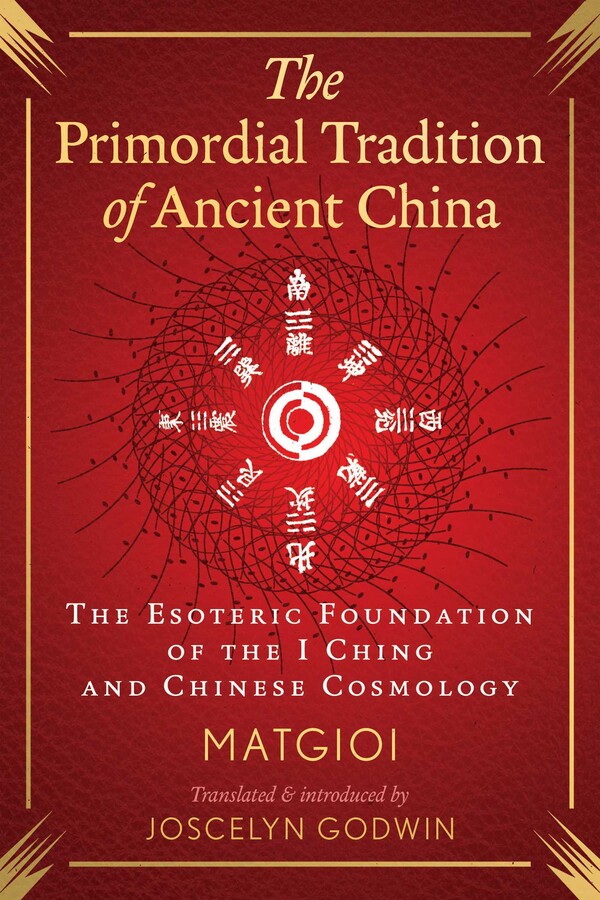
The Primordial Tradition of Ancient China
The Esoteric Foundation of the I Ching and Chinese Cosmology
By Matgioi
Translated by Joscelyn Godwin
Published by Inner Traditions
Distributed by Simon & Schuster
Table of Contents
About The Book
• Shares a deep understanding of the I Ching’s cosmological foundation
• Offers the meanings of the straight and broken lines of the 64 hexagrams
• Explains how the symbol of the yin-yang represents the individual’s destiny, including his emanation from, and reintegration into, Perfection
First published in French in 1905, and now translated into English for the first time, Matgioi’s book became the metaphysical core of the Traditionalist movement established by French occultist René Guénon, Julius Evola, and Ananda Coomaraswamy.
Translator Joscelyn Godwin tells how Matgioi was initiated into a Taoist secret society and was given rare access to the perennial wisdom of that tradition. His work reveals the great antiquity of Emperor Fohi, who set down the cosmogonic principles upon which the I Ching is based and lived more than 2,000 years before Moses. Matgioi regarded Fohi as representing a school of sages unbound to any century since their wisdom is as old as humanity itself. The I Ching crystallizes a first and truest insight into the nature of reality from which the ancients derived a practical philosophy. Chinese traditionalists regard the I Ching as the first monument of consciousnes, and Matgioi explores it and equally important treatises by Fohi’s successors. In this book, readers will discover the divine nature of Chinese script, the relationship of logos and symbol, and the multiple shapes of the universe. Matgioi also explains how the yin-yang symbolizes one’s destiny and emanation from, and reintegration into, Perfection.
This key work echoes Emperor Fohi’s belief that the solutions to all questions can be found by bringing them back to their sources.
• Offers the meanings of the straight and broken lines of the 64 hexagrams
• Explains how the symbol of the yin-yang represents the individual’s destiny, including his emanation from, and reintegration into, Perfection
First published in French in 1905, and now translated into English for the first time, Matgioi’s book became the metaphysical core of the Traditionalist movement established by French occultist René Guénon, Julius Evola, and Ananda Coomaraswamy.
Translator Joscelyn Godwin tells how Matgioi was initiated into a Taoist secret society and was given rare access to the perennial wisdom of that tradition. His work reveals the great antiquity of Emperor Fohi, who set down the cosmogonic principles upon which the I Ching is based and lived more than 2,000 years before Moses. Matgioi regarded Fohi as representing a school of sages unbound to any century since their wisdom is as old as humanity itself. The I Ching crystallizes a first and truest insight into the nature of reality from which the ancients derived a practical philosophy. Chinese traditionalists regard the I Ching as the first monument of consciousnes, and Matgioi explores it and equally important treatises by Fohi’s successors. In this book, readers will discover the divine nature of Chinese script, the relationship of logos and symbol, and the multiple shapes of the universe. Matgioi also explains how the yin-yang symbolizes one’s destiny and emanation from, and reintegration into, Perfection.
This key work echoes Emperor Fohi’s belief that the solutions to all questions can be found by bringing them back to their sources.
Excerpt
INTRODUCTION
The Masterpiece of a Warrior Metaphysician
Joscelyn Godwin
The Metaphysical Way is the first of Matgioi’s many books to appear in English translation.* In one sense, it is a landmark in the West’s discovery of Eastern philosophy, specifically Daoism (or Taoism). Secondly, it is a foundation stone of the modern Traditionalist current because of the crucial influence of Matgioi, and especially this work, on René Guénon. In a third sense, it contains a personal philosophy that some may find of lasting value and inspiration.
The Metaphysical Way takes its rise from the Yijing (Yiking or I Ching), the ancient Chinese “Book of Changes.” This is not a guide to that book, much less a manual for divination, but goes to the very basis of its conception. Matgioi concentrates on three features: the meaning of the straight versus the broken line; the first hexagram of six unbroken lines, visualized as the rise of the Dragon; and the four opening words of the ancient commentary. Legend ascribes the Yijing to the Chinese emperor Fuxi (Fohi or Fu Hsi), a figure so mythical that he is sometimes pictured as having snakes for legs. Matgioi regards him as representing a school of magi or sages, unbound to any century because their wisdom is as old as humanity itself. The Yijing crystallizes the “Primordial Tradition,” a first and truest insight into the nature of reality, from which the ancients deduced a practical philosophy applicable to all departments of life. Only in later and degenerate ages did they adapt it to the needs of the less gifted, first by inventing writing, then in the form of religions with their sacred books and institutions.
Matgioi was writing at the end of the nineteenth century for an intelligentsia disillusioned with religion, yet unsatisfied with the rank atheism and materialism that had become dogmatic in the sciences and, with Marxism, in politics. His experience in the Far East had brought him into contact with a “metaphysical way” that transcended both options. Its more immediate source was the Daodejing (or Tao Te Ching), attributed to the sage Laotseu (Lao Tzu or Laozi, fl. ca. 600 BCE), of which Matgioi made a new French version with the help of an Annamite* mandarin family. Under the dual influence of the Yijing and of Daoism, he then recast the primordial wisdom in modern language, resulting in the present book and its companion, The Rational Way.
The ancient texts have since received another century of scholarly and popular attention, and readers less interested in Matgioi’s interpretation can turn to Chapter 6, where his own metaphysical insights emerge. It is these later chapters that made a lasting impression on me fifty years ago, when some footnotes in the writings of René Guénon (1886–1951) aroused my curiosity. Since Matgioi is almost unknown in the Anglosphere, either under that pseudonym or his birth name of Albert de Pouvourville, I take this opportunity to introduce his life and works, which are not without interest on their own account.
Eugène Albert Puyou, comte de Pouvourville (7 August 1861–30 December 1939) owed his surname to a district in the south of Toulouse, and his inherited title to the family’s rise in the noblesse de robe, the high functionaries of Louis XIV’s court. Guy de Pouvourville (Albert’s cousin once removed) recorded what was known of his ancestry:
I first find a fifth great-grandfather, capitoul [chief magistrate]
of Toulouse in 1695; his son, the fourth great-grandfather, royal
counselor in the presidial seat of Toulouse; then his son, the third
great-grandfather, who left Toulouse and never returned. He was an
officer, received the Cross of Saint Louis, and married in Landau,
then in French Alsace. His son, my second great-grandfather,
1770–1851, was also an officer. He emigrated in 1791, returned in
1801, and also married in Alsace. He settled in Mulhouse, where he
lived and died, not at all rich, and, like his father, having the Saint
Louis Cross as his only honor. My great-grandfather was a banker
in Mulhouse. Prosperity seemed to be dawning for the family, but
it crashed in 1870. Two of his sons were officers, Albert’s father
[Théodore] and my grandfather.1
In 1860 Théodore de Pouvourville (1830–1921) married Alexandrine Jenny Perrotey de Jandin, and they had two children, Albert and René.2 The sons’ childhood was overshadowed by the Franco-Prussian war (1870), which left Alsace and part of Lorraine in German possession. Théodore had earned the Legion of Honor for his war service and was promoted to chief of staff of the second infantry division at Nancy, then lieutenant colonel of the 35th infantry regiment at Belfort. After the war he was instrumental in rebuilding the Grande Couronnée, the circuit of forts protecting Nancy, until on Bismarck’s orders the forts facing the German frontier had to be demolished. Albert reminisces: “During those tragic days I was a small child of twelve, but one who from his earliest days had heard talk of war, even in the cradle; who had learned to read in the daily orders of the imperial camp of Châlons, and shot at his first pistol targets with the arms of General Saussier.”3 Théodore lived to witness the next war at first hand. In August 1914, while the Germans advanced through Lorraine, the aged colonel refused to leave Nancy for a safer haven. The fortifications held, the Germans turned their attention elsewhere, and eight months later Albert observed that the town was “perhaps the best place in France.”4
Returning to Albert’s youth, a different world opened when he entered secondary school (lycée) in Nancy and found among his classmates Maurice Barrès, Paul Adam, and Stanislas de Guaita.* Barrès (1862–1923) would become a famous novelist and politician. Adam (1862–1920) was scarcely less famous in his time as a novelist and promoter of the Symbolist movement. Guaita (1861–1897) was a major figure in the esoteric movements of the fin de siècle.
Together with a couple of others, the boys formed a coterie of cultural outsiders and aspiring poets, while Guaita led the way into more arcane domains. Barrès, in his preface to Guaita’s Au seuil du mystère (On the Threshold of the Mystery, 1915) recalls: “It is now thirty-five years since my friend and I were walking beside the Étang de Lindre under the low groves of oaks, talking of the occult sciences and problems of gnosis that beset his mind with an extraordinary force.”5
Albert graduated from the lycée with flying colors: a double baccalaureate in science and the humanities. After a period of law studies, he entered the military academy of Saint-Cyr, breeding- ground of France’s generals, graduating in 1883. His record mixes praise of his abilities with evidence for what Guy de Pouvourville calls “a scarcely credible insolence with regard to all administrations.” Albert’s father kept an eye on him, stationing him in his own former regiment at Nancy, from which the son repeatedly asked to be transferred. On the positive side, he was commended for his survey of the forested frontiers of Alsace, and for writing a report on the importance of the Vosges Mountains as frontier: regions that would see action in both world wars. But he was constantly in disciplinary trouble, and in April 1887 was decommissioned. On November 5 he joined the Foreign Legion as a simple soldier under a false name,* and in December 1887 he disembarked at Tonkin, the northern capital of French Indochina.†
Pouvourville’s first Annamite adventure was a five-month expedition up the Black River, from Hanoi almost to the Chinese frontier. Directed by Auguste Pavie (1847–1925), its purpose was pacification, surveying, and installing a primitive telegraph system. Thirty years later, when discretion was no longer necessary, Pouvourville described the dangers, diseases, and fatal accidents that beset the party in Chasseurs de pirates! . . . (Pirate Hunters), a narrative that rivals Joseph Conrad’s novels of colonial misadventure. On his return, he found that the Legion’s journal had reported him as dead: his trunks and effects had been sold, and it was difficult to get reinstated. That done, he spent the following months comfortably in Hanoi, constructing an enormous map of the sixteen chaus (districts) flanking the river, chatting with the Catholic Fathers, accompanying arias from Offenbach’s operettas, and reflecting on his experiences.6
He had arrived in the protectorate equipped with an elite education and a cultural depth that put him at odds with the majority of his colleagues and even some of his superiors. He gives credit where it is due, but on the whole his verdict is damning: that beside pervasive ignorance, greed, and egotism, every administrator, on arrival, sets out to demolish what his predecessor has done, while their masters in Paris dither and argue. In contrast, the “grave mandarins . . . who have been obeying the same laws ever since their race existed, and who learn their language in the primordial books, note that we cannot keep the same ideas or follow the same measures for a year on end; that for the six years they have known us, we have gone through more changes than China has since the Great Wall was built.”7
The Masterpiece of a Warrior Metaphysician
Joscelyn Godwin
The Metaphysical Way is the first of Matgioi’s many books to appear in English translation.* In one sense, it is a landmark in the West’s discovery of Eastern philosophy, specifically Daoism (or Taoism). Secondly, it is a foundation stone of the modern Traditionalist current because of the crucial influence of Matgioi, and especially this work, on René Guénon. In a third sense, it contains a personal philosophy that some may find of lasting value and inspiration.
The Metaphysical Way takes its rise from the Yijing (Yiking or I Ching), the ancient Chinese “Book of Changes.” This is not a guide to that book, much less a manual for divination, but goes to the very basis of its conception. Matgioi concentrates on three features: the meaning of the straight versus the broken line; the first hexagram of six unbroken lines, visualized as the rise of the Dragon; and the four opening words of the ancient commentary. Legend ascribes the Yijing to the Chinese emperor Fuxi (Fohi or Fu Hsi), a figure so mythical that he is sometimes pictured as having snakes for legs. Matgioi regards him as representing a school of magi or sages, unbound to any century because their wisdom is as old as humanity itself. The Yijing crystallizes the “Primordial Tradition,” a first and truest insight into the nature of reality, from which the ancients deduced a practical philosophy applicable to all departments of life. Only in later and degenerate ages did they adapt it to the needs of the less gifted, first by inventing writing, then in the form of religions with their sacred books and institutions.
Matgioi was writing at the end of the nineteenth century for an intelligentsia disillusioned with religion, yet unsatisfied with the rank atheism and materialism that had become dogmatic in the sciences and, with Marxism, in politics. His experience in the Far East had brought him into contact with a “metaphysical way” that transcended both options. Its more immediate source was the Daodejing (or Tao Te Ching), attributed to the sage Laotseu (Lao Tzu or Laozi, fl. ca. 600 BCE), of which Matgioi made a new French version with the help of an Annamite* mandarin family. Under the dual influence of the Yijing and of Daoism, he then recast the primordial wisdom in modern language, resulting in the present book and its companion, The Rational Way.
The ancient texts have since received another century of scholarly and popular attention, and readers less interested in Matgioi’s interpretation can turn to Chapter 6, where his own metaphysical insights emerge. It is these later chapters that made a lasting impression on me fifty years ago, when some footnotes in the writings of René Guénon (1886–1951) aroused my curiosity. Since Matgioi is almost unknown in the Anglosphere, either under that pseudonym or his birth name of Albert de Pouvourville, I take this opportunity to introduce his life and works, which are not without interest on their own account.
Eugène Albert Puyou, comte de Pouvourville (7 August 1861–30 December 1939) owed his surname to a district in the south of Toulouse, and his inherited title to the family’s rise in the noblesse de robe, the high functionaries of Louis XIV’s court. Guy de Pouvourville (Albert’s cousin once removed) recorded what was known of his ancestry:
I first find a fifth great-grandfather, capitoul [chief magistrate]
of Toulouse in 1695; his son, the fourth great-grandfather, royal
counselor in the presidial seat of Toulouse; then his son, the third
great-grandfather, who left Toulouse and never returned. He was an
officer, received the Cross of Saint Louis, and married in Landau,
then in French Alsace. His son, my second great-grandfather,
1770–1851, was also an officer. He emigrated in 1791, returned in
1801, and also married in Alsace. He settled in Mulhouse, where he
lived and died, not at all rich, and, like his father, having the Saint
Louis Cross as his only honor. My great-grandfather was a banker
in Mulhouse. Prosperity seemed to be dawning for the family, but
it crashed in 1870. Two of his sons were officers, Albert’s father
[Théodore] and my grandfather.1
In 1860 Théodore de Pouvourville (1830–1921) married Alexandrine Jenny Perrotey de Jandin, and they had two children, Albert and René.2 The sons’ childhood was overshadowed by the Franco-Prussian war (1870), which left Alsace and part of Lorraine in German possession. Théodore had earned the Legion of Honor for his war service and was promoted to chief of staff of the second infantry division at Nancy, then lieutenant colonel of the 35th infantry regiment at Belfort. After the war he was instrumental in rebuilding the Grande Couronnée, the circuit of forts protecting Nancy, until on Bismarck’s orders the forts facing the German frontier had to be demolished. Albert reminisces: “During those tragic days I was a small child of twelve, but one who from his earliest days had heard talk of war, even in the cradle; who had learned to read in the daily orders of the imperial camp of Châlons, and shot at his first pistol targets with the arms of General Saussier.”3 Théodore lived to witness the next war at first hand. In August 1914, while the Germans advanced through Lorraine, the aged colonel refused to leave Nancy for a safer haven. The fortifications held, the Germans turned their attention elsewhere, and eight months later Albert observed that the town was “perhaps the best place in France.”4
Returning to Albert’s youth, a different world opened when he entered secondary school (lycée) in Nancy and found among his classmates Maurice Barrès, Paul Adam, and Stanislas de Guaita.* Barrès (1862–1923) would become a famous novelist and politician. Adam (1862–1920) was scarcely less famous in his time as a novelist and promoter of the Symbolist movement. Guaita (1861–1897) was a major figure in the esoteric movements of the fin de siècle.
Together with a couple of others, the boys formed a coterie of cultural outsiders and aspiring poets, while Guaita led the way into more arcane domains. Barrès, in his preface to Guaita’s Au seuil du mystère (On the Threshold of the Mystery, 1915) recalls: “It is now thirty-five years since my friend and I were walking beside the Étang de Lindre under the low groves of oaks, talking of the occult sciences and problems of gnosis that beset his mind with an extraordinary force.”5
Albert graduated from the lycée with flying colors: a double baccalaureate in science and the humanities. After a period of law studies, he entered the military academy of Saint-Cyr, breeding- ground of France’s generals, graduating in 1883. His record mixes praise of his abilities with evidence for what Guy de Pouvourville calls “a scarcely credible insolence with regard to all administrations.” Albert’s father kept an eye on him, stationing him in his own former regiment at Nancy, from which the son repeatedly asked to be transferred. On the positive side, he was commended for his survey of the forested frontiers of Alsace, and for writing a report on the importance of the Vosges Mountains as frontier: regions that would see action in both world wars. But he was constantly in disciplinary trouble, and in April 1887 was decommissioned. On November 5 he joined the Foreign Legion as a simple soldier under a false name,* and in December 1887 he disembarked at Tonkin, the northern capital of French Indochina.†
Pouvourville’s first Annamite adventure was a five-month expedition up the Black River, from Hanoi almost to the Chinese frontier. Directed by Auguste Pavie (1847–1925), its purpose was pacification, surveying, and installing a primitive telegraph system. Thirty years later, when discretion was no longer necessary, Pouvourville described the dangers, diseases, and fatal accidents that beset the party in Chasseurs de pirates! . . . (Pirate Hunters), a narrative that rivals Joseph Conrad’s novels of colonial misadventure. On his return, he found that the Legion’s journal had reported him as dead: his trunks and effects had been sold, and it was difficult to get reinstated. That done, he spent the following months comfortably in Hanoi, constructing an enormous map of the sixteen chaus (districts) flanking the river, chatting with the Catholic Fathers, accompanying arias from Offenbach’s operettas, and reflecting on his experiences.6
He had arrived in the protectorate equipped with an elite education and a cultural depth that put him at odds with the majority of his colleagues and even some of his superiors. He gives credit where it is due, but on the whole his verdict is damning: that beside pervasive ignorance, greed, and egotism, every administrator, on arrival, sets out to demolish what his predecessor has done, while their masters in Paris dither and argue. In contrast, the “grave mandarins . . . who have been obeying the same laws ever since their race existed, and who learn their language in the primordial books, note that we cannot keep the same ideas or follow the same measures for a year on end; that for the six years they have known us, we have gone through more changes than China has since the Great Wall was built.”7
Product Details
- Publisher: Inner Traditions (January 20, 2026)
- Length: 192 pages
- ISBN13: 9798888501474
Browse Related Books
Raves and Reviews
“This is an awe-inspiring book on the Chinese Primordial Tradition, written by one of the few Europeans who was able to penetrate its profound wisdom. Admirably translated from French and introduced by Joscelyn Godwin, Matgioi’s text speaks to the reader with diamond-like clarity and force.”
– Christopher McIntosh, author of Occult Russia, Occult Germany, and The Call of the Old Gods
“This is a fine translation of an important text, with a very helpful introduction. Anyone interested in René Guénon or Traditionalism should read it.”
– Mark Sedgwick, professor of Arab and Islamic Studies at Aarhus University and author of Traditionali
“Through Joscelyn Godwin’s translation, we are introduced to the cornerstone of Traditionalist philosophy: Matgioi. His ideas on the Primordial Tradition are as relevant today as when they were written, with many of his writings being genuinely prophetic. Here we discover the influences of Daoism and Matgioi’s understanding of it as the doctrine of heroic adepts and their transcendent force, which expands—both for themselves and others—as they participate in the “Will of Heaven” and experience the path of the Dragon in its most archaic form.”
– Mark Stavish, founder and director of the Institute for Hermetic Studies and author of The Path of F
Resources and Downloads
High Resolution Images
-
Book Cover Image (jpg): The Primordial Tradition of Ancient China
eBook 9798888501474
The Primordial Tradition of Ancient China
The Esoteric Foundation of the I Ching and Chinese Cosmology
By Matgioi
Translated by Joscelyn Godwin
Published by Inner Traditions
Distributed by Simon & Schuster
Join our mailing list!
By clicking 'Sign me up' I acknowledge that I have read and agree to the privacy policy and terms of use.