
Get our latest staff recommendations, award news and digital catalog links right to your inbox.
Table of Contents
About The Book
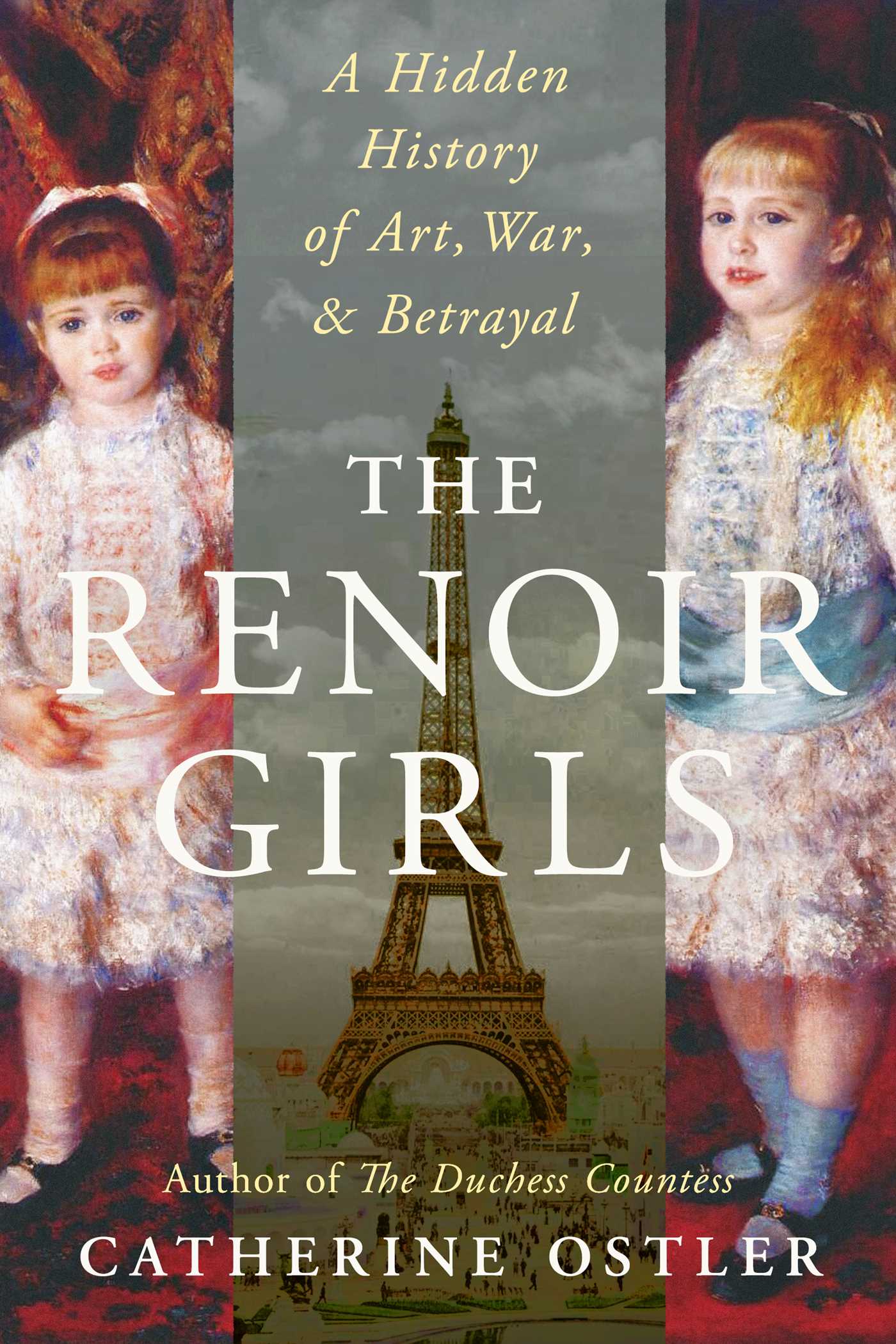
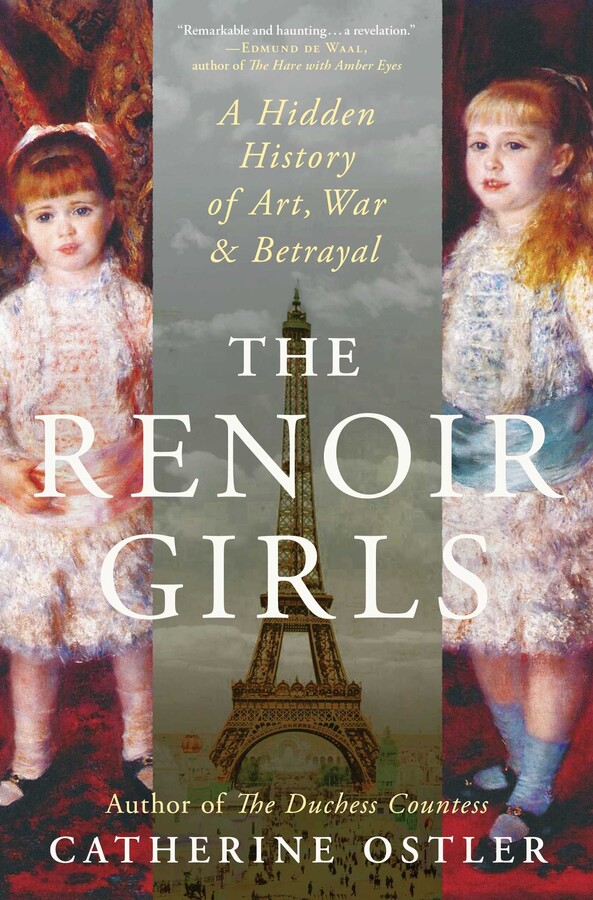
Three sisters, the daughters of a prominent French Jewish family, all painted as children by Pierre-Auguste Renoir. In the turbulent years from the Belle Epoque to World War II, one would marry an English aristocrat and escape; one would become a collaborator with the Nazis; one would die in Auschwitz. This is the remarkable hidden history of the lives behind Renoir’s beguiling portraits.
Paris, 1881. The artist Pierre-Auguste Renoir knocks on the door of a wealthy Jewish family’s home in the 8th arrondissement, the grandest quarter of Paris. He has arrived to paint the portrait of the family’s two youngest daughters. The parents, the Cahen d’Anvers, are bankers, collectors, philanthropists, and pillars of Parisian society. They go to balls, breed racehorses, and ride in the Bois de Boulogne with their aristocratic friends. But for the Jewish community, the undercurrents of Parisian sentiment are already moving in a sinister direction. The story of the Renoir girls will end in the duplicity and the horror of the Second World War.
With an extraordinary cast of characters, from the girls themselves, their mother’s lovers, a heroic British General; from the King of Spain to Dreyfus, Proust, and Maupassant—this is a story about one of the world’s most famous pictures, The Pink and the Blue. But really it is a story about Paris—one that prefers to be hidden. With access to never-before-seen letters, diaries, and personal recollections—it is a tale of privilege, beauty, and betrayal almost lost in the shimmering memory of a vanished world.
Paris, 1881. The artist Pierre-Auguste Renoir knocks on the door of a wealthy Jewish family’s home in the 8th arrondissement, the grandest quarter of Paris. He has arrived to paint the portrait of the family’s two youngest daughters. The parents, the Cahen d’Anvers, are bankers, collectors, philanthropists, and pillars of Parisian society. They go to balls, breed racehorses, and ride in the Bois de Boulogne with their aristocratic friends. But for the Jewish community, the undercurrents of Parisian sentiment are already moving in a sinister direction. The story of the Renoir girls will end in the duplicity and the horror of the Second World War.
With an extraordinary cast of characters, from the girls themselves, their mother’s lovers, a heroic British General; from the King of Spain to Dreyfus, Proust, and Maupassant—this is a story about one of the world’s most famous pictures, The Pink and the Blue. But really it is a story about Paris—one that prefers to be hidden. With access to never-before-seen letters, diaries, and personal recollections—it is a tale of privilege, beauty, and betrayal almost lost in the shimmering memory of a vanished world.
Excerpt
Chapter One: Renoir Calls CHAPTER ONE RENOIR CALLS
Between the bare horse-chestnut trees in the early spring of 1881 on the Avenue Montaigne, a wide, graceful street that leads southwest from the Champs-Élysées all the way to the Seine, steps a bearded figure in black, a large bag on his arm. He weaves past horse-drawn carriages on their way to the Bois de Boulogne, their harnesses wet from rain and glinting in the sun; carts, walkers with hats, canes, and the preoccupations of business; nannies with skittish children and yapping dogs. Too haphazard for a doctor, neither well-heeled nor quite upright enough for a social caller, he knocks on a grand door.
Inside the golden town house, a classical revival “petit hôtel”1 at no. 66, with its piano nobile, leafy frieze and pilasters, four urns atop the roof balustrade, a salon-as-studio awaits him: a thick, dark red woven Smyrna carpet, a fringed and tasseled profusion of draperies and gilded furniture that look part Second Empire, part seraglio.
Pierre-Auguste Renoir sets up his easel: the square palette fits neatly into the corner of his paintbox; he squeezes his miniature mountains of color, ground by hand by his dealer on Rue Pigalle, until they overlap and cover the wood beneath. A forest of brushes; a picnic of rags, linseed, and a glassful of turpentine at his side. A smooth coat of silver white dries on the canvas, adding luminosity to whatever is painted on top of it. He begins to mix color on canvas, painting pink or blue strokes with, in his brother Edmond’s words, “anxious rapidity,” each one the “zig-zag flight of a swallow”:
“Pensive, dreamy, a far-away look in his eyes, you’ve seen him run across the boulevard twenty times; forgetful, disorganized, he’ll come back ten times for the same thing without remembering to do it; always running on the street, always motionless indoors;… if you want to see his face light up… [and hear him] hum some gay refrain… try to catch him while he’s working.”2
Louis and Louise’s first family house, 66 Avenue Montaigne, Paris, where their three daughters were painted by Renoir
A call, a brush of silk, an ushering, a scramble: two small girls in lace scamper in. His eye takes in two sisters dressed in bright white, now holding hands, one in a pink satin sash, the other blue, a duet of sugar-almond-colored sweetness. In the picture we will see his love of eighteenth-century art, the peachy softness, the rococo bloom of Fragonard, Boucher, and Watteau. He will paint their spirit, the freshness of skin with good circulation, the literal picture of health, with their rosy color, their fair hair. There is nervous energy in the room. His brother says that, like a child, he experiences “eager curiosity and constant astonishment.”
Louis and Louise Cahen d’Anvers have commissioned this portrait of their two younger daughters. Perhaps, as was later said, the idea for this painting came from the widow Madame Mina Ephrussi, whom the girls adored. Mme. Ephrussi lives in a newly built house on Rue de Monceau, the area developed by the Pereire brothers,I with her sons, Ignace and Charles; the latter a bachelor art historian and collector who will become director of Paris’s leading art review, the Gazette des Beaux-Arts; an “exquisite man,”3 Alice told a journalist later in life. It is he, the scion of grain traders and bankers from Odessa, who first suggested to their mother that his friend Renoir should paint her children. And so, a year earlier, Renoir had painted the elder sister, Irène, with her ripples of red hair and faraway eyes. That picture, known as Little Irène, or “the girl with the blue ribbon,” led to the second commission.
Little Irène was submitted to the Salon of 1881. “An interesting portrait of a child by M Renoir,” recorded the Gazette des Beaux-Arts, accompanied by a sketch of the picture (titled Portrait of a Child) done for the publication, at Charles Ephrussi’s request, by Renoir himself.4
Renoir had been hoping for two more separate commissions for the younger sisters, not one. That might have been double the money, which would have been welcome, because Renoir, on the cusp of forty, was newly installed in an apartment in Montmartre, in the north of Paris. If the eighth arrondissement of Avenue Montaigne is high finance and high society—that part of the fashionable world known as the “gratin” (the browned cheese on top with the crunch and the flavor) or the Faubourg (after the Faubourg Saint-Germain, the most resplendent part of Paris)—Rue Houdon in the eighteenth arrondissement is quite different: a “bizarre land” that is the “home of every kind of artist,”5 a still part-rural hill outside the city, with windmills, vineyards, lush gardens, music, and raucous entertainment (the world’s first cabaret, Le Chat Noir, will open there in November). Renoir has become part of Manet’s Impressionist gang. Each Thursday or Sunday they meet at 5:30 p.m. in a café such as La Nouvelle-Athènes on Place Pigalle, with its globular lights shining through the smoke over marble tables. With Cézanne, Sisley, Degas, Pissarro, the critic Edmond Maître, the photographer Nadar, and Émile Zola the novelist, they have all become friends, brothers-in-art, so many of whom will redefine the rubric of painting through loose brushwork, color, light, and ambience.
Renoir has had some success, but not enough. In the middle of a period of intense productivity, he is accepting commission after commission, painting rich patrons and their families. Madame Georges Charpentier and Her Children (1878),II a picture Proust describes as rivaling “Titian at his best,” has been a hit at the annual art show, the Salon, in 1879. Proust wrote: “Will not posterity, when it looks at our time, find the poetry of an elegant home and beautifully dressed women in the drawing room of the publisher Charpentier as painted by Renoir, rather than in the portraits of the Princesse de Sagan or the Comtesse de la Rochefoucauld by Cot or Chaplin?”6 The peacocks of JaponismeIII on the wall cast an avian eye on the publisher’s wife, Marguerite Charpentier, in the venue of her literary salon frequented by Zola, Gustave Flaubert, and the diarist Edmond de Goncourt; with her two curly-haired, soft-cheeked, blue-silk-clad children: Paul, three—locks uncut, not yet in breeches—and Georgette, six, sitting on Porthos, the family’s Newfoundland dog. Mme. Charpentier wears a black silk gown with lace and white tulle at the neck and bodice by the foremost couturier of the day, the House of Worth. After the Salon, she hangs the painting on the wall of her town house, where everybody sees it.
The picture of Alice and Elisabeth, which requires many sittings, will emerge as a dazzlingly affectionate portrait of a radiant, transient childhood moment. “The little girls’ muslin dresses that look like dancers’ tutus,”7 notes Proust’s narrator of a work of his fictional Impressionist Elstir (who owes something to Renoir, as well as to Whistler, Monet, and Helleu).
Renoir’s feelings about the parents are less warm. His is a world of bohemians—dancers, rebels, actresses, taverns, rogues in boaters—and he is ill at ease among the crystal and silver, the patina, the millefeuille of money on the Avenue Montaigne. His paternal grandfather, François, had been left as a nameless baby on the steps of Limoges Cathedral in 1773, and adopted by the Renouard family, who gave him their name, later mistranscribed as Renoir. François’s son Léonard became a tailor and married a seamstress, Marguerite Merlet. Pierre-Auguste was Léonard and Marguerite’s middle child, and trained as a porcelain painter, once attempting to decorate Sèvres china faster than machinery to stem the tide of industrial revolution that threatened his livelihood. His porcelain past shows in the lucid colors, in the china-doll face of the younger sister, Alice, which resembles the “Bébé,” or “Triste” model of the Jumeau doll brand, the obsession of junior Paris in the 1880s. In Renoir’s painting, the girls are porcelain dolls with spirit.
What is a portrait? An exercise in likeness, a work of art, a study of character, a thing of beauty, a statement of identity? Renoir’s precarious existence depends on pleasing his patrons, who might refuse to pay him if they do not like his work, which must not only be beautiful but, as he complains, a perfect resemblance to their loving, subjective, parental eye. Renoir is on his way to becoming a fashionable portraitist, but for now his artistic freedom is still restricted by his patrons’ desires. As the new medium of photography commands the same price as his paintings, he needs to please. But beauty comes naturally to him. “A picture has to be pleasant, delightful and pretty—yes pretty. There are enough unpleasant things in the world without us producing more,” he once said.8
Like the infantas of Velázquez or Van Dyck’s children of Charles I, this painting shimmers with both innocence and privilege. It will become known as Pink and Blue because Alice, four, is illuminated by the pink glow of her silk slip, sash, socks, and hair ribbon; blue-sashed Elisabeth, six, seems more defiant. Alice is bored of posing; her only compensation is that she is wearing a new dress of point d’Irlande, hand-sewn Irish crochet lace.9
As a breadline-dwelling Catholic of working-class origin, Renoir is almost as different from those who have commissioned him as it is possible to be within Paris. His pictures encapsulate the nature of the city, in which new money and new art, bohemians and bankers are a magnet for each other, and runaways, romantics, and dreamers jostle alongside financiers and women of fashion.
The Cahen d’Anvers paterfamilias, Louis, is a second-generation Parisian banker: wise, respected, gentlemanly. The girls’ mother is a more exuberant figure: Louise Cahen d’Anvers, née Morpurgo of Trieste, is an aesthete, a lover of art, music, and literature. Her dandyish friend and advisor, the mining heir Charles Deudon, has introduced her to the handsome, clever, sensitive Charles Ephrussi. Ephrussi, in turn, has been sought out by Renoir in 1878 at the house of the collector Henri Cernuschi near Parc Monceau, where the art critic Théodore DuretIV has taken his painter friend to receptions in order to do exactly what he did—find someone to introduce him to rich patrons.
The artist: Pierre-Auguste Reno
Here is the Paris art world: where the artist’s need for money coincides with a patron’s desire for social power and status.
Renoir had come across the publisher Georges Charpentier at the auction house Hôtel Drouot, where the Impressionists had held their first organized sale, in 1875. Madame Charpentier became his patron, commissioning him first to paint family portraits in a panel on the stairwell at their house, 35 Rue de Grenelle, and then, in 1878, the picture of her and her children. The charm of this picture—which took a month to complete, and for which he was paid 1,500 francs—brought him attention. Charles Ephrussi, Charles Deudon, Édouard Manet, and many others came to see it at the Charpentier house, and Friday attendees at the Charpentier salon started commissioning him. The Charpentiers advised Renoir to submit pictures to the Salon of 1879 in his new style (the Impressionists had branched out alone, but their third independent exhibition, in 1877, had been a disaster). After much lobbying by the well-connected, “energetic, ambitious, determined”10 Madame Charpentier (who knew the jury, including the painter Jean-Jacques Henner), four Renoirs were accepted—Cézanne’s and Sisley’s work was rejected. But with pictures crammed up to the rafters, just being on display was not enough to create a stir. Of the four, only the Charpentier family portrait was hung in a prominent position. And so this depiction of childhood became a beacon not only of Renoir’s talent, but also of a new kind of taste, both domestic and fashionable; free, textured brushstrokes that somehow revealed character, so different from the mythological and historical subjects and sharp lines of the Academy painters.V
As the only working-class Impressionist, Renoir had a more obliging attitude than the others. He decorated Mme. Charpentier’s menus and place cards, for example. So close was he by now to the Charpentiers that he became, at his own suggestion, the fashion illustrator of their weekly magazine, La Vie Moderne. His brush so easily brings to life the color, the drape, the folds of dress—as the son of a tailor, he had been observing fabric since birth—as we see in his portraits of the Cahen d’Anvers sisters.VI We also see his aptitude for interior decoration: in his early career he was as familiar with painting houses as painting people. With his background in ceramics, he also painted murals, in his own words, “for at least twenty cafés in Paris,” wall panels, ceilings (for example, for Prince Georges Bibesco), and door panels, and made frames and sculptures. Even before he was a painter, he was a master of the decorative arts.
Renoir’s career was now on the rise—so noticeably that Cézanne wrote about its trajectory to his childhood friend Émile Zola—as a flurry of portrait commissions came to him. The requests were diverse. Most were from French Catholics, but subjects also came from the expansive web of interconnected Jewish families in Paris such as Marcel Bernstein, the banker-proprietor of the weekly, conservative Journal des Débats, and his wife, Ida Seligman; their cousins, the Ephrussi, the Foulds, the Grimpels, and the Nunès. And the Cahen d’Anvers. There were Protestants, too, such as Paul Bérard, the banker and foreign affairs attaché who became Renoir’s close friend.
In 1878 the Bérards invited Renoir to spend the summer at their eighteenth-century chateau, Wargemont, near Dieppe in Normandy. Between 1879 and 1885, he spent one to two months there each summer as if he were one of the family, painting forty pictures, including one of Louis Cahen d’Anvers’s younger brother, the composer Albert, a vital portrait of a smooth, smoking flâneur, completed in September 1881.
According to the artist Jacques-Émile Blanche—who had befriended Renoir when his mother had hired him to paint panels at their family house in Dieppe—Renoir’s face was “already lined and wrinkled with a sparse and ragged beard, brilliant teary eyes under bushy and fierce eyebrows.” He spoke “like a working-class laborer with a rasping, guttural Parisian accent,” with his peculiar, pointed hat, a pipe permanently in his mouth, chatting to staff as much as subject. Mme. Blanche considered him “too common” to teach her son to paint.11
Divided by belief system, expectations, and the tensions of class and money, Renoir and the Cahen d’Anvers were worlds apart but united in at least one thing other than their hopes of Paris: they were the keepers of secrets. In love, in parenthood.
On Renoir’s part, he was already the father of a ten-year-old daughter, Jeanne, who took her first communion in that same year of 1881. She had been rejected by her own mother, Lise Tréhot,VII once a Renoir model herself. Tréhot had had two illegitimate children with Renoir before they split: a boy, Pierre, given away and never heard of again, and Jeanne Marguerite, born in 1870. Although Lise gave her up to a foster mother, Renoir maintained covert contact. Her letters were never sent to his home. Did this introduce an element of longing, of paternal tenderness to this delicate painting of texture and light?
The Cahen d’Anvers had their own hidden world: the family life that seemed so flawless, the five children, the beautiful houses and elegant salons, contained whispers of affairs and rumors of disputed paternity, particularly of the younger siblings.
Patrons and artist were both quite new to Paris. Renoir’s family migrated to the capital in 1844, just five years before the arrival of the Cahen d’Anvers. Both the tailor’s family from Limoges and the financier’s family from Antwerp moved near the Louvre. Léonard and Marguerite Renoir and their five children settled into a poky, three-room, sixth-floor apartment at 23 Rue d’Argenteuil. Pierre-Auguste Renoir visited the Louvre as he grew up, studying pictures with his special copyist’s pass. Now a chain-smoking secret father with a voice like a “good-natured ogre”12 and a nervous tic—he continually rubbed his index finger under his nose—he was a complex man. But while he was anxious, calculating, nonconfrontational, his pictures were (to borrow the title of his son Jean’s filmVIII) a “grand illusion” of joy, beauty, and sensuality, indulgent and dreamlike. He was in love with painting, specifically with the Impressionist form of pervasive light and bold, indistinct strokes in place of defined lines. However disconcerting he could be in person, his pictures show only happiness. They do not contain the sufferings of the world, their creator, or their subjects.
In a city of ruined streets after the Franco-Prussian War of 1870–71, in which Prussia had defeated France and united Germany, a ruptured Paris, which under siege had turned on itself in devastation and loss after loss, the work of Renoir—indeed, the whole Impressionist vision—was a light-filled antidote, or fairy tale.
Renoir had suffered his own sorrow—the death in the war at just twenty-eight of his fellow Impressionist pioneer Frédéric Bazille, the man who had shared his own studio with himIX and introduced him to another early patron, the Romanian prince Georges Bibesco. Bazille agreed with his hero, Manet, that the rules of art had to change: “All those great classical compositions, that’s over and done with,” he told Renoir.13 Bibesco commissioned Renoir to paint the ceilings of his Paris house, bought some of his pictures, and took him out into the beau monde, where Renoir first saw some of his subjects, those bare-shouldered women in evening gowns, the darlings of society.
During the war Renoir was drafted into a cavalry regiment and trained horses in the Pyrenees. When he returned to Paris in 1871, it was said that he was found painting on the banks of the Seine by the national guardsmen, the Communards who took control of Paris between March and May of that year. They presumed he was a spy. He was released only because he was recognized by a friend of Bibesco’s.
Now, a decade after that war, Renoir had found love and was living with the dressmaker and sometime model Aline Charigot, eighteen years younger than him and from a working-class background similar to his own, and about whom he had told no one apart from his brother. Their financial instability meant he insisted that their affair remain hidden, just as he had with Lise Tréhot. Perhaps her presence in his life enabled him to be prolific and gave his pictures extra spirit. But he had neither creative nor personal freedom.
In spite of the secrecy, he did not exactly hide Aline away. There she is, in full view, in a picture he painted at the same time as the portrait of Alice and Elisabeth. And, strangely, this other picture also connects to the hidden life of Louise Cahen d’Anvers: Renoir’s patroness, the Parisian hostess and mother of five young children, has a rumored lover, painted into the picture with Aline. It is Charles Ephrussi.
Lover of artist and lover of patron are both seen in Luncheon of the Boating Party,X painted at the Maison Fournaise restaurant at Chatou on the Seine over a period of sixteen months from 1880. Pouting in a floral hat, Aline is in the foreground, playing with her pet dog, Kiki, opposite the painter-in-vest Gustave Caillebotte; in the background, top-hatted, red-bearded Charles Ephrussi talks to his secretary, the poet Jules Laforgue. The result has a spontaneous, bright, riveting beauty; brimming with life, it is one of the largest canvases Renoir ever painted and, even in his time, one of his most famous; you can hear the chat and the flirting and the wine-fueled warmth.
In Proust’s In Search of Lost Time the picture appears (in a hybrid with Renoir’s Moulin de la Galette) as a work by the fictional artist Elstir on show in the house of the Duc de Guermantes. Basin de Guermantes disapproves of Impressionism. When Marcel, the narrator, asks him the name of the man in the top hat in the picture—Charles SwannXI/Charles Ephrussi—Guermantes, indicating the hold that Swann/Ephrussi had over his wife’s decisions, replies:
It was he [Swann] who made Madame de Guermantes buy all that stuff. She is always too good-natured, afraid of hurting people’s feelings if she refuses to do things; between ourselves, I believe he’s landed us with a lot of daubs… the gentleman you mean has been a sort of Maecenas to M. Elstir—he launched him and has often helped him out of difficulties by commissioning pictures from him. As a compliment to this man—if you call it a compliment, it’s a matter of taste—he painted him standing about among that crowd, where with his Sunday-go-to-meeting look he creates a distinctly odd effect… [in his top hat] among all those bare-headed girls, he looks like a little country lawyer on the spree.14
Flattering or not—no doubt Ephrussi was pleased to be in the picture—there they all are: Ephrussi/MaecenasXII/Swann; Aline, friends, sunshine…
What does it tell us that Renoir immortalized the effervescent luncheon and the sugar-spun Cahen d’Anvers girls at the same time? That he was happy in love, and with his ramshackle life of patrons and artists, actresses and models, despite being financially insecure? He painted most of both with his “wrong” arm, having recently broken his right arm falling off his bicycle. By some miracle of effort and talent he became ambidextrous and his painting seemed only to benefit. But while the background—the glasses, the sailboats—is impressionistic, the figures themselves are well-defined; it has been argued that Luncheon of the Boating Party was his farewell to Impressionism, which he felt was not making him enough money.
Good husband, father, “loyal monarchist, practicing Christian” and, when it came to art, an “out and out gambler,” said Renoir of Paul Durand-Ruel, the entrepreneurial dealer who made Renoir’s career, and indeed the Impressionist movement. Durand-Ruel paid 6,000 francs for Luncheon of the Boating Party on February 14, 1881, and it was this payment that had enabled Renoir to move into his flat with Aline. One of Durand-Ruel’s guiding principles (alongside the necessity of solo exhibitions) was to link art to the world of finance, which could keep it afloat.
A much-needed commission, then, but after the picture of Alice and Elisabeth was finished, Renoir was weary. Asking the ever-present Charles Ephrussi to enter his pictures into the Salon in his absence, he headed for warmer climes, to Algeria, to seek a cure for both his pneumonia and his artistic malaise. Perturbed by the image-to-order market, he was in a “crisis of Impressionism,”15 and as far as portraiture was concerned, of confidence. On his arrival in Algiers on March 4 he wrote to Duret, “I left immediately upon finishing the portraits of the little Cahen girls, so tired that I can’t even tell you if the painting is good or bad.”16
In his struggle to complete the picture, to reconcile his aims as a painter, his desire for it to be in the Salon, and the need to please his client, he told his friend Jacques-Émile Blanche, “if I rework a head the next day I’m done for; but it’s a portrait, it’s necessary for a mother to recognize her daughter.”17 In other words, a portrait is more than a painting: the need for verisimilitude and approval limits artistic freedom.
The 1,500-franc payment from the Cahen d’Anvers arrived too slowly for Renoir’s liking. In February 1882, recovering from pneumonia again, in sun-splashed, rural L’Estaque near Marseille, where he was staying and working with Cézanne, he complained to his friend Deudon. He found the amount “pretty stingy.” AntisemitismXIII crept in: “I really give up with the Jews,” he wrote.18 In this, as we shall see, he was, unfortunately, aligned with the times. Jean Renoir described his father’s view of himself as a “cork in the current,”19 a man who moved in the common direction without remorse or resistance (a peculiar trait for someone who arguably changed the history of art). If Renoir blamed low and late payments on “Jewishness,” then this was part of the Parisian narrative about its Jewish emigrés.
If Louis Cahen d’Anvers paid slowly, it could have been—like Proust’s Basin de Guermantes—because he just did not like the picture his wife had ordered. Perhaps he thought it was (to use Guermantes’s word) “rubbish.” In the end, where Little Irène had been hung in a salon, the portrait of her younger sisters was relegated to the servants’ floor. Alice later believed her parents, who were traditional in taste, fans of the “nymphs of Nattier” and portraits of Léon Bonnat, found it too avant-garde. In this they were hardly alone. Art critic Albert Wolff wrote in Le Figaro in 1876 of the Impressionist’s palette: “Try to explain to M. Renoir that a woman’s torso is not a mass of decomposing flesh with green and purple spots that indicate the state of total putrefaction in a corpse!”20
Renoir had been an unlikely choice for the family in the first place. For Louis and Louise Cahen d’Anvers, Léon Bonnat was indeed always the preferred artist. The chosen portrait painter of French society, with whom he could merge like paint colors on canvas, Bonnat was a professor at the École des Beaux-Arts, and became a close friend of Louis. He was an almost scientific realist, one with a muted palette, a man who once had a cadaver nailed to a cross so he could copy it for a religious painting; so rigorous and productive, he became known as the official painter of the Third Republic. A definitively safe choice.
And yet Renoir, to others, was irresistible—the only Impressionist who flattered his subjects; as his friend Georges Rivière wrote in a piece called “To the Women”: “Wouldn’t you like to have in your own home a ravishing portrait where one can see the charm that floods your dear being?”21
Renoir had envied Bonnat’s position and success and sought to emulate it, but would soon abandon this path—scorning not just the Salon, but Charles Ephrussi and his Jewish patrons, the Cahen d’Anvers among them. He had “always felt like an outsider in the upper-class art world.”22
Behind this decorative Parisian tableau of pastel dresses and portrait commissions—of aesthetic display and artistic brilliance—lie secret tensions. Yet the city that had emerged from the recent trauma of war embraced its creative recovery. The art market had reignited, with newly built train lines bringing artists to Paris and canvases to the provinces. The state-sponsored Salon, then the most important art market in the world, was the way to bring pictures to public attention and raise prices, as many patrons would buy only from artists who had become stars there. Renoir had started trying to get into the Salon back in 1863. The Salon’s splendor—it was the whole art market in microcosm—lay in part in its cosmopolitan character.
Contemporary literature—Louise’s friend Paul Bourget, in his novel Cosmopolis (1892), Proust’s In Search of Lost Time, or Philippe Burty’s Grave Imprudence (1880), the story of a painter who falls in love with his society subject—recorded this milieu, the artists, writers, hostesses, and patrons mixed in a cassoulet of talent, money, affairs, and ambition.
But Renoir’s portrait of Alice and Elisabeth ended up unloved. Perhaps because of taste, lack of likeness, or something about the circumstances of its commission, rumors about which proliferated. Many years later, Alice and Elisabeth’s sister-in-law Sonia Cahen d’Anvers wrote that Charles Ephrussi had presented the picture to Louise as a surprise. This seems unlikely, as Louis paid for it, and the girls had to pose for it. But why did it become a family myth?
Perhaps because—what with the late payment, the lack of display; could it even have been, as the family would later suspect, something else entirely—that one or both of those children were not Louis’s, and so not Cahen d’Anvers at all?
But the story of the family starts much earlier than this painting or the rumors surrounding it; it starts in another city, far from Parisian light, in the riverside ghetto in Bonn.
Between the bare horse-chestnut trees in the early spring of 1881 on the Avenue Montaigne, a wide, graceful street that leads southwest from the Champs-Élysées all the way to the Seine, steps a bearded figure in black, a large bag on his arm. He weaves past horse-drawn carriages on their way to the Bois de Boulogne, their harnesses wet from rain and glinting in the sun; carts, walkers with hats, canes, and the preoccupations of business; nannies with skittish children and yapping dogs. Too haphazard for a doctor, neither well-heeled nor quite upright enough for a social caller, he knocks on a grand door.
Inside the golden town house, a classical revival “petit hôtel”1 at no. 66, with its piano nobile, leafy frieze and pilasters, four urns atop the roof balustrade, a salon-as-studio awaits him: a thick, dark red woven Smyrna carpet, a fringed and tasseled profusion of draperies and gilded furniture that look part Second Empire, part seraglio.
Pierre-Auguste Renoir sets up his easel: the square palette fits neatly into the corner of his paintbox; he squeezes his miniature mountains of color, ground by hand by his dealer on Rue Pigalle, until they overlap and cover the wood beneath. A forest of brushes; a picnic of rags, linseed, and a glassful of turpentine at his side. A smooth coat of silver white dries on the canvas, adding luminosity to whatever is painted on top of it. He begins to mix color on canvas, painting pink or blue strokes with, in his brother Edmond’s words, “anxious rapidity,” each one the “zig-zag flight of a swallow”:
“Pensive, dreamy, a far-away look in his eyes, you’ve seen him run across the boulevard twenty times; forgetful, disorganized, he’ll come back ten times for the same thing without remembering to do it; always running on the street, always motionless indoors;… if you want to see his face light up… [and hear him] hum some gay refrain… try to catch him while he’s working.”2
Louis and Louise’s first family house, 66 Avenue Montaigne, Paris, where their three daughters were painted by Renoir
A call, a brush of silk, an ushering, a scramble: two small girls in lace scamper in. His eye takes in two sisters dressed in bright white, now holding hands, one in a pink satin sash, the other blue, a duet of sugar-almond-colored sweetness. In the picture we will see his love of eighteenth-century art, the peachy softness, the rococo bloom of Fragonard, Boucher, and Watteau. He will paint their spirit, the freshness of skin with good circulation, the literal picture of health, with their rosy color, their fair hair. There is nervous energy in the room. His brother says that, like a child, he experiences “eager curiosity and constant astonishment.”
Louis and Louise Cahen d’Anvers have commissioned this portrait of their two younger daughters. Perhaps, as was later said, the idea for this painting came from the widow Madame Mina Ephrussi, whom the girls adored. Mme. Ephrussi lives in a newly built house on Rue de Monceau, the area developed by the Pereire brothers,I with her sons, Ignace and Charles; the latter a bachelor art historian and collector who will become director of Paris’s leading art review, the Gazette des Beaux-Arts; an “exquisite man,”3 Alice told a journalist later in life. It is he, the scion of grain traders and bankers from Odessa, who first suggested to their mother that his friend Renoir should paint her children. And so, a year earlier, Renoir had painted the elder sister, Irène, with her ripples of red hair and faraway eyes. That picture, known as Little Irène, or “the girl with the blue ribbon,” led to the second commission.
Little Irène was submitted to the Salon of 1881. “An interesting portrait of a child by M Renoir,” recorded the Gazette des Beaux-Arts, accompanied by a sketch of the picture (titled Portrait of a Child) done for the publication, at Charles Ephrussi’s request, by Renoir himself.4
Renoir had been hoping for two more separate commissions for the younger sisters, not one. That might have been double the money, which would have been welcome, because Renoir, on the cusp of forty, was newly installed in an apartment in Montmartre, in the north of Paris. If the eighth arrondissement of Avenue Montaigne is high finance and high society—that part of the fashionable world known as the “gratin” (the browned cheese on top with the crunch and the flavor) or the Faubourg (after the Faubourg Saint-Germain, the most resplendent part of Paris)—Rue Houdon in the eighteenth arrondissement is quite different: a “bizarre land” that is the “home of every kind of artist,”5 a still part-rural hill outside the city, with windmills, vineyards, lush gardens, music, and raucous entertainment (the world’s first cabaret, Le Chat Noir, will open there in November). Renoir has become part of Manet’s Impressionist gang. Each Thursday or Sunday they meet at 5:30 p.m. in a café such as La Nouvelle-Athènes on Place Pigalle, with its globular lights shining through the smoke over marble tables. With Cézanne, Sisley, Degas, Pissarro, the critic Edmond Maître, the photographer Nadar, and Émile Zola the novelist, they have all become friends, brothers-in-art, so many of whom will redefine the rubric of painting through loose brushwork, color, light, and ambience.
Renoir has had some success, but not enough. In the middle of a period of intense productivity, he is accepting commission after commission, painting rich patrons and their families. Madame Georges Charpentier and Her Children (1878),II a picture Proust describes as rivaling “Titian at his best,” has been a hit at the annual art show, the Salon, in 1879. Proust wrote: “Will not posterity, when it looks at our time, find the poetry of an elegant home and beautifully dressed women in the drawing room of the publisher Charpentier as painted by Renoir, rather than in the portraits of the Princesse de Sagan or the Comtesse de la Rochefoucauld by Cot or Chaplin?”6 The peacocks of JaponismeIII on the wall cast an avian eye on the publisher’s wife, Marguerite Charpentier, in the venue of her literary salon frequented by Zola, Gustave Flaubert, and the diarist Edmond de Goncourt; with her two curly-haired, soft-cheeked, blue-silk-clad children: Paul, three—locks uncut, not yet in breeches—and Georgette, six, sitting on Porthos, the family’s Newfoundland dog. Mme. Charpentier wears a black silk gown with lace and white tulle at the neck and bodice by the foremost couturier of the day, the House of Worth. After the Salon, she hangs the painting on the wall of her town house, where everybody sees it.
The picture of Alice and Elisabeth, which requires many sittings, will emerge as a dazzlingly affectionate portrait of a radiant, transient childhood moment. “The little girls’ muslin dresses that look like dancers’ tutus,”7 notes Proust’s narrator of a work of his fictional Impressionist Elstir (who owes something to Renoir, as well as to Whistler, Monet, and Helleu).
Renoir’s feelings about the parents are less warm. His is a world of bohemians—dancers, rebels, actresses, taverns, rogues in boaters—and he is ill at ease among the crystal and silver, the patina, the millefeuille of money on the Avenue Montaigne. His paternal grandfather, François, had been left as a nameless baby on the steps of Limoges Cathedral in 1773, and adopted by the Renouard family, who gave him their name, later mistranscribed as Renoir. François’s son Léonard became a tailor and married a seamstress, Marguerite Merlet. Pierre-Auguste was Léonard and Marguerite’s middle child, and trained as a porcelain painter, once attempting to decorate Sèvres china faster than machinery to stem the tide of industrial revolution that threatened his livelihood. His porcelain past shows in the lucid colors, in the china-doll face of the younger sister, Alice, which resembles the “Bébé,” or “Triste” model of the Jumeau doll brand, the obsession of junior Paris in the 1880s. In Renoir’s painting, the girls are porcelain dolls with spirit.
What is a portrait? An exercise in likeness, a work of art, a study of character, a thing of beauty, a statement of identity? Renoir’s precarious existence depends on pleasing his patrons, who might refuse to pay him if they do not like his work, which must not only be beautiful but, as he complains, a perfect resemblance to their loving, subjective, parental eye. Renoir is on his way to becoming a fashionable portraitist, but for now his artistic freedom is still restricted by his patrons’ desires. As the new medium of photography commands the same price as his paintings, he needs to please. But beauty comes naturally to him. “A picture has to be pleasant, delightful and pretty—yes pretty. There are enough unpleasant things in the world without us producing more,” he once said.8
Like the infantas of Velázquez or Van Dyck’s children of Charles I, this painting shimmers with both innocence and privilege. It will become known as Pink and Blue because Alice, four, is illuminated by the pink glow of her silk slip, sash, socks, and hair ribbon; blue-sashed Elisabeth, six, seems more defiant. Alice is bored of posing; her only compensation is that she is wearing a new dress of point d’Irlande, hand-sewn Irish crochet lace.9
As a breadline-dwelling Catholic of working-class origin, Renoir is almost as different from those who have commissioned him as it is possible to be within Paris. His pictures encapsulate the nature of the city, in which new money and new art, bohemians and bankers are a magnet for each other, and runaways, romantics, and dreamers jostle alongside financiers and women of fashion.
The Cahen d’Anvers paterfamilias, Louis, is a second-generation Parisian banker: wise, respected, gentlemanly. The girls’ mother is a more exuberant figure: Louise Cahen d’Anvers, née Morpurgo of Trieste, is an aesthete, a lover of art, music, and literature. Her dandyish friend and advisor, the mining heir Charles Deudon, has introduced her to the handsome, clever, sensitive Charles Ephrussi. Ephrussi, in turn, has been sought out by Renoir in 1878 at the house of the collector Henri Cernuschi near Parc Monceau, where the art critic Théodore DuretIV has taken his painter friend to receptions in order to do exactly what he did—find someone to introduce him to rich patrons.
The artist: Pierre-Auguste Reno
Here is the Paris art world: where the artist’s need for money coincides with a patron’s desire for social power and status.
Renoir had come across the publisher Georges Charpentier at the auction house Hôtel Drouot, where the Impressionists had held their first organized sale, in 1875. Madame Charpentier became his patron, commissioning him first to paint family portraits in a panel on the stairwell at their house, 35 Rue de Grenelle, and then, in 1878, the picture of her and her children. The charm of this picture—which took a month to complete, and for which he was paid 1,500 francs—brought him attention. Charles Ephrussi, Charles Deudon, Édouard Manet, and many others came to see it at the Charpentier house, and Friday attendees at the Charpentier salon started commissioning him. The Charpentiers advised Renoir to submit pictures to the Salon of 1879 in his new style (the Impressionists had branched out alone, but their third independent exhibition, in 1877, had been a disaster). After much lobbying by the well-connected, “energetic, ambitious, determined”10 Madame Charpentier (who knew the jury, including the painter Jean-Jacques Henner), four Renoirs were accepted—Cézanne’s and Sisley’s work was rejected. But with pictures crammed up to the rafters, just being on display was not enough to create a stir. Of the four, only the Charpentier family portrait was hung in a prominent position. And so this depiction of childhood became a beacon not only of Renoir’s talent, but also of a new kind of taste, both domestic and fashionable; free, textured brushstrokes that somehow revealed character, so different from the mythological and historical subjects and sharp lines of the Academy painters.V
As the only working-class Impressionist, Renoir had a more obliging attitude than the others. He decorated Mme. Charpentier’s menus and place cards, for example. So close was he by now to the Charpentiers that he became, at his own suggestion, the fashion illustrator of their weekly magazine, La Vie Moderne. His brush so easily brings to life the color, the drape, the folds of dress—as the son of a tailor, he had been observing fabric since birth—as we see in his portraits of the Cahen d’Anvers sisters.VI We also see his aptitude for interior decoration: in his early career he was as familiar with painting houses as painting people. With his background in ceramics, he also painted murals, in his own words, “for at least twenty cafés in Paris,” wall panels, ceilings (for example, for Prince Georges Bibesco), and door panels, and made frames and sculptures. Even before he was a painter, he was a master of the decorative arts.
Renoir’s career was now on the rise—so noticeably that Cézanne wrote about its trajectory to his childhood friend Émile Zola—as a flurry of portrait commissions came to him. The requests were diverse. Most were from French Catholics, but subjects also came from the expansive web of interconnected Jewish families in Paris such as Marcel Bernstein, the banker-proprietor of the weekly, conservative Journal des Débats, and his wife, Ida Seligman; their cousins, the Ephrussi, the Foulds, the Grimpels, and the Nunès. And the Cahen d’Anvers. There were Protestants, too, such as Paul Bérard, the banker and foreign affairs attaché who became Renoir’s close friend.
In 1878 the Bérards invited Renoir to spend the summer at their eighteenth-century chateau, Wargemont, near Dieppe in Normandy. Between 1879 and 1885, he spent one to two months there each summer as if he were one of the family, painting forty pictures, including one of Louis Cahen d’Anvers’s younger brother, the composer Albert, a vital portrait of a smooth, smoking flâneur, completed in September 1881.
According to the artist Jacques-Émile Blanche—who had befriended Renoir when his mother had hired him to paint panels at their family house in Dieppe—Renoir’s face was “already lined and wrinkled with a sparse and ragged beard, brilliant teary eyes under bushy and fierce eyebrows.” He spoke “like a working-class laborer with a rasping, guttural Parisian accent,” with his peculiar, pointed hat, a pipe permanently in his mouth, chatting to staff as much as subject. Mme. Blanche considered him “too common” to teach her son to paint.11
Divided by belief system, expectations, and the tensions of class and money, Renoir and the Cahen d’Anvers were worlds apart but united in at least one thing other than their hopes of Paris: they were the keepers of secrets. In love, in parenthood.
On Renoir’s part, he was already the father of a ten-year-old daughter, Jeanne, who took her first communion in that same year of 1881. She had been rejected by her own mother, Lise Tréhot,VII once a Renoir model herself. Tréhot had had two illegitimate children with Renoir before they split: a boy, Pierre, given away and never heard of again, and Jeanne Marguerite, born in 1870. Although Lise gave her up to a foster mother, Renoir maintained covert contact. Her letters were never sent to his home. Did this introduce an element of longing, of paternal tenderness to this delicate painting of texture and light?
The Cahen d’Anvers had their own hidden world: the family life that seemed so flawless, the five children, the beautiful houses and elegant salons, contained whispers of affairs and rumors of disputed paternity, particularly of the younger siblings.
Patrons and artist were both quite new to Paris. Renoir’s family migrated to the capital in 1844, just five years before the arrival of the Cahen d’Anvers. Both the tailor’s family from Limoges and the financier’s family from Antwerp moved near the Louvre. Léonard and Marguerite Renoir and their five children settled into a poky, three-room, sixth-floor apartment at 23 Rue d’Argenteuil. Pierre-Auguste Renoir visited the Louvre as he grew up, studying pictures with his special copyist’s pass. Now a chain-smoking secret father with a voice like a “good-natured ogre”12 and a nervous tic—he continually rubbed his index finger under his nose—he was a complex man. But while he was anxious, calculating, nonconfrontational, his pictures were (to borrow the title of his son Jean’s filmVIII) a “grand illusion” of joy, beauty, and sensuality, indulgent and dreamlike. He was in love with painting, specifically with the Impressionist form of pervasive light and bold, indistinct strokes in place of defined lines. However disconcerting he could be in person, his pictures show only happiness. They do not contain the sufferings of the world, their creator, or their subjects.
In a city of ruined streets after the Franco-Prussian War of 1870–71, in which Prussia had defeated France and united Germany, a ruptured Paris, which under siege had turned on itself in devastation and loss after loss, the work of Renoir—indeed, the whole Impressionist vision—was a light-filled antidote, or fairy tale.
Renoir had suffered his own sorrow—the death in the war at just twenty-eight of his fellow Impressionist pioneer Frédéric Bazille, the man who had shared his own studio with himIX and introduced him to another early patron, the Romanian prince Georges Bibesco. Bazille agreed with his hero, Manet, that the rules of art had to change: “All those great classical compositions, that’s over and done with,” he told Renoir.13 Bibesco commissioned Renoir to paint the ceilings of his Paris house, bought some of his pictures, and took him out into the beau monde, where Renoir first saw some of his subjects, those bare-shouldered women in evening gowns, the darlings of society.
During the war Renoir was drafted into a cavalry regiment and trained horses in the Pyrenees. When he returned to Paris in 1871, it was said that he was found painting on the banks of the Seine by the national guardsmen, the Communards who took control of Paris between March and May of that year. They presumed he was a spy. He was released only because he was recognized by a friend of Bibesco’s.
Now, a decade after that war, Renoir had found love and was living with the dressmaker and sometime model Aline Charigot, eighteen years younger than him and from a working-class background similar to his own, and about whom he had told no one apart from his brother. Their financial instability meant he insisted that their affair remain hidden, just as he had with Lise Tréhot. Perhaps her presence in his life enabled him to be prolific and gave his pictures extra spirit. But he had neither creative nor personal freedom.
In spite of the secrecy, he did not exactly hide Aline away. There she is, in full view, in a picture he painted at the same time as the portrait of Alice and Elisabeth. And, strangely, this other picture also connects to the hidden life of Louise Cahen d’Anvers: Renoir’s patroness, the Parisian hostess and mother of five young children, has a rumored lover, painted into the picture with Aline. It is Charles Ephrussi.
Lover of artist and lover of patron are both seen in Luncheon of the Boating Party,X painted at the Maison Fournaise restaurant at Chatou on the Seine over a period of sixteen months from 1880. Pouting in a floral hat, Aline is in the foreground, playing with her pet dog, Kiki, opposite the painter-in-vest Gustave Caillebotte; in the background, top-hatted, red-bearded Charles Ephrussi talks to his secretary, the poet Jules Laforgue. The result has a spontaneous, bright, riveting beauty; brimming with life, it is one of the largest canvases Renoir ever painted and, even in his time, one of his most famous; you can hear the chat and the flirting and the wine-fueled warmth.
In Proust’s In Search of Lost Time the picture appears (in a hybrid with Renoir’s Moulin de la Galette) as a work by the fictional artist Elstir on show in the house of the Duc de Guermantes. Basin de Guermantes disapproves of Impressionism. When Marcel, the narrator, asks him the name of the man in the top hat in the picture—Charles SwannXI/Charles Ephrussi—Guermantes, indicating the hold that Swann/Ephrussi had over his wife’s decisions, replies:
It was he [Swann] who made Madame de Guermantes buy all that stuff. She is always too good-natured, afraid of hurting people’s feelings if she refuses to do things; between ourselves, I believe he’s landed us with a lot of daubs… the gentleman you mean has been a sort of Maecenas to M. Elstir—he launched him and has often helped him out of difficulties by commissioning pictures from him. As a compliment to this man—if you call it a compliment, it’s a matter of taste—he painted him standing about among that crowd, where with his Sunday-go-to-meeting look he creates a distinctly odd effect… [in his top hat] among all those bare-headed girls, he looks like a little country lawyer on the spree.14
Flattering or not—no doubt Ephrussi was pleased to be in the picture—there they all are: Ephrussi/MaecenasXII/Swann; Aline, friends, sunshine…
What does it tell us that Renoir immortalized the effervescent luncheon and the sugar-spun Cahen d’Anvers girls at the same time? That he was happy in love, and with his ramshackle life of patrons and artists, actresses and models, despite being financially insecure? He painted most of both with his “wrong” arm, having recently broken his right arm falling off his bicycle. By some miracle of effort and talent he became ambidextrous and his painting seemed only to benefit. But while the background—the glasses, the sailboats—is impressionistic, the figures themselves are well-defined; it has been argued that Luncheon of the Boating Party was his farewell to Impressionism, which he felt was not making him enough money.
Good husband, father, “loyal monarchist, practicing Christian” and, when it came to art, an “out and out gambler,” said Renoir of Paul Durand-Ruel, the entrepreneurial dealer who made Renoir’s career, and indeed the Impressionist movement. Durand-Ruel paid 6,000 francs for Luncheon of the Boating Party on February 14, 1881, and it was this payment that had enabled Renoir to move into his flat with Aline. One of Durand-Ruel’s guiding principles (alongside the necessity of solo exhibitions) was to link art to the world of finance, which could keep it afloat.
A much-needed commission, then, but after the picture of Alice and Elisabeth was finished, Renoir was weary. Asking the ever-present Charles Ephrussi to enter his pictures into the Salon in his absence, he headed for warmer climes, to Algeria, to seek a cure for both his pneumonia and his artistic malaise. Perturbed by the image-to-order market, he was in a “crisis of Impressionism,”15 and as far as portraiture was concerned, of confidence. On his arrival in Algiers on March 4 he wrote to Duret, “I left immediately upon finishing the portraits of the little Cahen girls, so tired that I can’t even tell you if the painting is good or bad.”16
In his struggle to complete the picture, to reconcile his aims as a painter, his desire for it to be in the Salon, and the need to please his client, he told his friend Jacques-Émile Blanche, “if I rework a head the next day I’m done for; but it’s a portrait, it’s necessary for a mother to recognize her daughter.”17 In other words, a portrait is more than a painting: the need for verisimilitude and approval limits artistic freedom.
The 1,500-franc payment from the Cahen d’Anvers arrived too slowly for Renoir’s liking. In February 1882, recovering from pneumonia again, in sun-splashed, rural L’Estaque near Marseille, where he was staying and working with Cézanne, he complained to his friend Deudon. He found the amount “pretty stingy.” AntisemitismXIII crept in: “I really give up with the Jews,” he wrote.18 In this, as we shall see, he was, unfortunately, aligned with the times. Jean Renoir described his father’s view of himself as a “cork in the current,”19 a man who moved in the common direction without remorse or resistance (a peculiar trait for someone who arguably changed the history of art). If Renoir blamed low and late payments on “Jewishness,” then this was part of the Parisian narrative about its Jewish emigrés.
If Louis Cahen d’Anvers paid slowly, it could have been—like Proust’s Basin de Guermantes—because he just did not like the picture his wife had ordered. Perhaps he thought it was (to use Guermantes’s word) “rubbish.” In the end, where Little Irène had been hung in a salon, the portrait of her younger sisters was relegated to the servants’ floor. Alice later believed her parents, who were traditional in taste, fans of the “nymphs of Nattier” and portraits of Léon Bonnat, found it too avant-garde. In this they were hardly alone. Art critic Albert Wolff wrote in Le Figaro in 1876 of the Impressionist’s palette: “Try to explain to M. Renoir that a woman’s torso is not a mass of decomposing flesh with green and purple spots that indicate the state of total putrefaction in a corpse!”20
Renoir had been an unlikely choice for the family in the first place. For Louis and Louise Cahen d’Anvers, Léon Bonnat was indeed always the preferred artist. The chosen portrait painter of French society, with whom he could merge like paint colors on canvas, Bonnat was a professor at the École des Beaux-Arts, and became a close friend of Louis. He was an almost scientific realist, one with a muted palette, a man who once had a cadaver nailed to a cross so he could copy it for a religious painting; so rigorous and productive, he became known as the official painter of the Third Republic. A definitively safe choice.
And yet Renoir, to others, was irresistible—the only Impressionist who flattered his subjects; as his friend Georges Rivière wrote in a piece called “To the Women”: “Wouldn’t you like to have in your own home a ravishing portrait where one can see the charm that floods your dear being?”21
Renoir had envied Bonnat’s position and success and sought to emulate it, but would soon abandon this path—scorning not just the Salon, but Charles Ephrussi and his Jewish patrons, the Cahen d’Anvers among them. He had “always felt like an outsider in the upper-class art world.”22
Behind this decorative Parisian tableau of pastel dresses and portrait commissions—of aesthetic display and artistic brilliance—lie secret tensions. Yet the city that had emerged from the recent trauma of war embraced its creative recovery. The art market had reignited, with newly built train lines bringing artists to Paris and canvases to the provinces. The state-sponsored Salon, then the most important art market in the world, was the way to bring pictures to public attention and raise prices, as many patrons would buy only from artists who had become stars there. Renoir had started trying to get into the Salon back in 1863. The Salon’s splendor—it was the whole art market in microcosm—lay in part in its cosmopolitan character.
Contemporary literature—Louise’s friend Paul Bourget, in his novel Cosmopolis (1892), Proust’s In Search of Lost Time, or Philippe Burty’s Grave Imprudence (1880), the story of a painter who falls in love with his society subject—recorded this milieu, the artists, writers, hostesses, and patrons mixed in a cassoulet of talent, money, affairs, and ambition.
But Renoir’s portrait of Alice and Elisabeth ended up unloved. Perhaps because of taste, lack of likeness, or something about the circumstances of its commission, rumors about which proliferated. Many years later, Alice and Elisabeth’s sister-in-law Sonia Cahen d’Anvers wrote that Charles Ephrussi had presented the picture to Louise as a surprise. This seems unlikely, as Louis paid for it, and the girls had to pose for it. But why did it become a family myth?
Perhaps because—what with the late payment, the lack of display; could it even have been, as the family would later suspect, something else entirely—that one or both of those children were not Louis’s, and so not Cahen d’Anvers at all?
But the story of the family starts much earlier than this painting or the rumors surrounding it; it starts in another city, far from Parisian light, in the riverside ghetto in Bonn.
About The Author
JP Masclet
Catherine Ostler is an author and journalist who has been Editor-in-Chief of Tatler, the English Standard (London), the Evening Standard magazine (London), and Editor of The Times (London) Weekend. She has also written for a wide range of publications, including The Wall Street Journal, The Daily Telegraph (London), the Financial Times, and Vogue. She studied English at Oxford University. Her first book was the critically acclaimed The Duchess Countess: The Woman Who Scandalized Eighteenth-Century London.
Product Details
- Publisher: Atria Books (July 14, 2026)
- Length: 432 pages
- ISBN13: 9781668232484
Browse Related Books
Raves and Reviews
“The Renoir Girls is much more than an engrossing family saga about lucky people brought low. Its real subject is antisemitism, which starts as a background whisper and becomes a terrifying roar. This makes it essential reading for our times, a terrible warning about how racial hatred can lie dormant for decades before reappearing with a vengeance in times of political and financial chill.”
—Kathryn Hughes, The Times (UK), Book of the Week
“This book is an epic tale of a changing world that ends up all too close to our own . . . Some scenes will live with me for a long time, in their tragedy but also their revelations of courage.”
—Lara Feigel, The Observer
“Profoundly moving . . . With consummate skill and impressive research, Ostler tells the story. Reading the early chapters, when the Cahen d’Anvers family were at the pinnacle of Belle Epoque high life, I felt I was inside an Impressionist painting, dazzled by color and fun.”
—Ysenda Maxtone-Graham, Daily Mail, Book of the Week
“[A] story that is at once intimate and expansive, rooted in the particulars of a single family, yet reaching outward to encompass some of the defining events of modern European history. In the end, The Renoir Girls is less about a painting than about what lies beyond its frame: the passage of time, the shifting of identities, the sudden and often catastrophic turns of history.”
—Guy Walters, Independent
“[An] evocative work of narrative history . . . Miss Ostler has scoured family papers to add rich and telling detail to the sweep of her story . . . As befits such an involving and wide-ranging family saga, she even keeps a big twist in reserve for the very end.”
—Michael Prodger, Country Life
“The final reveal—which makes one gasp—only underlines the artifice of the world Ostler has portrayed, where almost limitless wealth, privilege, and familial connections proved in the end no match for the overwhelming evil of anti-Semitism.”
—Ariane Bankes, Spectator
“This is a remarkable and haunting book, bringing the lives of the three young Jewish sisters, painted by Renoir in fin de siècle Paris, into extraordinary focus. It is a revelation.”
—Edmund de Waal, author of The Hare with Amber Eyes
“[An] impressive biography. . . . A single painting foreshadows a tragic, expansive account of antisemitism and war.”
—Kirkus
“The Renoir Girls is a dazzling achievement: heartbreaking, glamorous, elegiac, revelatory, and utterly gripping. It is simultaneously a portrait of Belle Époque Paris, the chronicle of a powerful French family in a world of palaces, estates and the late 19th-century high society of grand aristocrats and bankers, a story of great love, forbidden affairs and family secrets, a biography of Renoir and his artistic milieu, a history of France from Second Empire to World War Two, and the story of French Jews from the court of Napoleon III to the killing camps of the Holocaust—and at its heart are the extraordinary lives of three sisters and a famous painting. A tale with echoes of Proust and The Hare with Amber Eyes, it is deeply researched, beautifully written, delicious, haunting, and horribly timely.”
—Simon Sebag Montefiore, author of The World: A Family History of Humanity
“The Renoir Girls is magnificent: a grand sweep of a book, an epic told through the lives of the Cahen d’Anvers, their triumphs and tragedies, their romances and passions. Leading the reader inside a glorious gilded world, Ostler introduces us to a fascinating set of outsiders, both the wealthy Jewish families and the artists. Her writing, truly beautiful and melodic, is a joy to read.”
—Hallie Rubenhold, author of The Five and Story of a Murder
“With The Renoir Girls, Catherine Ostler brilliantly exposes the darkness and latent violence beneath the glamour of Belle Époque Paris—revealing how antisemitism, social fracture, and the approaching catastrophe of war quietly undermine the surface elegance of a well-known painting.”
—Dame Hannah Rothschild DBE CBE
“Meticulously researched and beautifully written, this engrossing book takes you straight to the heart of Belle Époque France, a world of grace, wit, and elegance. No one could know, as they conducted their love affairs and enjoyed their waltzes, how close they were dancing to the seething pits of murderous racial hatred.”
—Andrew Roberts, author of Churchill: Walking with Destiny
“An exquisite portrait of splendor, sacrifice, and suffering. What begins with a single Renoir painting of two young girls unfolds into an elegant, poignant sweep of 20th-century European history. Ostler’s masterful prose and groundbreaking research create a book with the richness of a novel and the authority of deep scholarship.”
—Natalie Livingstone, author of The Women of Rothschild: The Untold Story of the World's Most Famous Dynasty
“I adore Ostler’s evocative and lyrical writing that takes us through pivotal, changing times in history—from the Belle Époque to the world wars—with revelations (and beautiful writing) on art, family, and scandal. Ostler’s deeply researched, scholarly but entertaining book is underpinned by a revelatory secret that will leave you gripped to the end.”
—Katy Hessel, author of The Story of Art Without Men
“Through the drama of a single painting, Catherine Ostler has brought together a compelling work of family biography, Belle Époque French culture, and history of art set against the terror of world war and generational poison of antisemitism. Drawing on new archival research and family testimony, this is both a rich, global history and an intense, personal chronicle all flowing from Renoir’s sublime portrait.”
—Dr. Tristram Hunt, Director of the Victoria and Albert Museum
“From Paris to London to São Paulo, The Renoir Girls is a spellbinding journey into the dark heart of Europe's twentieth century and into the sadness and secrets of one family in particular. With formidable research and beautiful prose, Catherine Ostler delights and devastates in equal measure. You will never look at these portraits the same way again.”
—James McAuley, author of The House of Fragile Things
“An exceptionally profound and eye-opening book that educates us—in the most haunting and compelling way—about art, France, religion, class, gender, and how the world came to be modern. Like all the greatest books, this is a story of endurance, tragedy, kindness, and love. Hugely enjoyable, beautifully written, skillful, deep, and kind.”
—Alain de Botton, author of The Course on Love
“The Renoir Girls is a helter-skelter ride from the glittering, high society whirl of Paris in the mid-nineteenth century to the bleak gates of Auschwitz and the Nazi death camps a century later. The connecting link is deftly provided by Renoir’s vivid portrait of two privileged children, ‘Pink and Blue’, as they journey through time from the exclusive, golden world of Proust to the dark ruins of Hitler’s Europe.”
—Rick Stroud, author of I Am Not Afraid of Looking into the Rifles
Resources and Downloads
High Resolution Images
-
Book Cover Image (jpg): The Renoir Girls
Hardcover 9781668232484
-
Author Photo (jpg): Catherine Ostler JP Masclet(0.1 MB)
Any use of an author photo must include its respective photo credit
Join our mailing list!
By clicking 'Sign me up' I acknowledge that I have read and agree to the privacy policy and terms of use.