Get our latest staff recommendations, award news and digital catalog links right to your inbox.
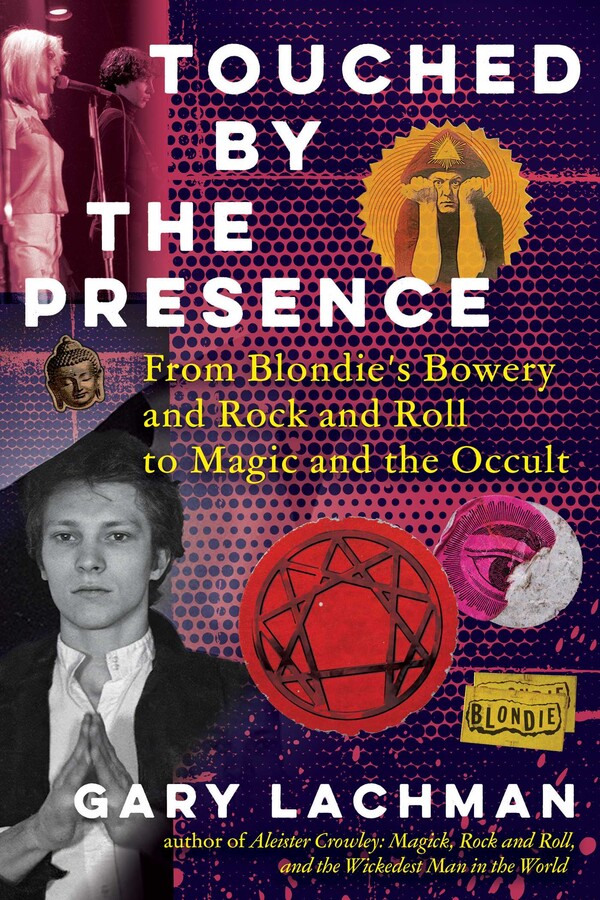
Touched by the Presence
From Blondie's Bowery and Rock and Roll to Magic and the Occult
By Gary Lachman
Published by Inner Traditions
Distributed by Simon & Schuster
Table of Contents
About The Book
A memoir of magic, rock and roll, and becoming who you are
• Traces the author’s journey from bassist and founding member of Blondie to writer on consciousness and the esoteric tradition
• Explores his involvement in Gurdjieff’s Fourth Way, Crowley’s Thelema, and his relationship with the bestselling author Colin Wilson
• Reveals how an early love of comic books, science fiction, and fantasy led him to the esoteric tradition
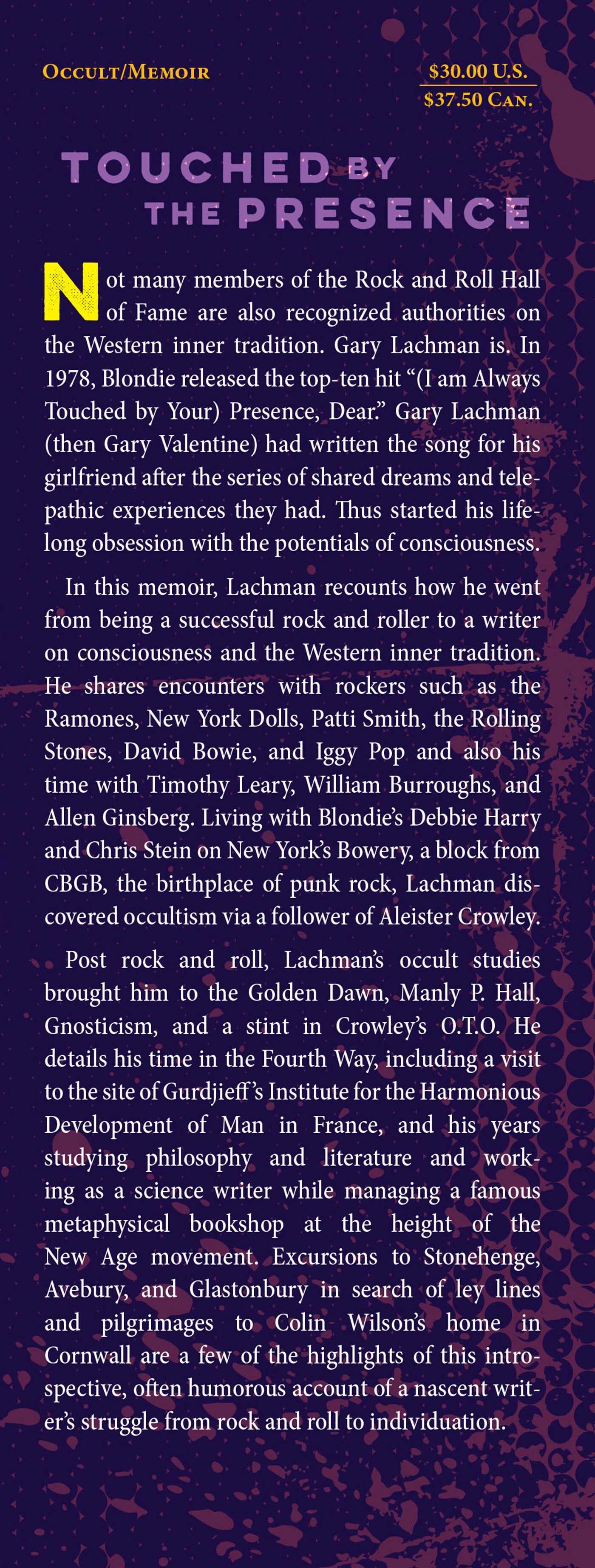
Not many members of the Rock and Roll Hall of Fame are also recognized authorities on the Western inner tradition. Gary Lachman is. In 1978, Blondie released the top-ten hit “(I am Always Touched by Your) Presence, Dear.” Gary Lachman (then Gary Valentine) had written the song for his girlfriend after the series of shared dreams and telepathic experiences they had. Thus started his lifelong obsession with the potentials of consciousness.
In this memoir, Lachman recounts how he went from being a successful rock and roller to a writer on consciousness and the Western inner tradition. He shares encounters with rockers such as the Ramones, New York Dolls, Patti Smith, the Rolling Stones, David Bowie, and Iggy Pop and also his time with Timothy Leary, William Burroughs, and Allen Ginsberg. Living with Blondie’s Debbie Harry and Chris Stein on New York’s Bowery, a block from CBGB, the birthplace of punk rock, Lachman discovered occultism via a follower of Aleister Crowley.
Post rock and roll, Lachman’s occult studies brought him to the Golden Dawn, Manly P. Hall, Gnosticism, and a stint in Crowley’s O.T.O. He details his time in the Fourth Way, including a visit to the site of Gurdjieff ’s Institute for the Harmonious Development of Man in France, and his years studying philosophy and literature and working as a science writer while managing a famous metaphysical bookshop at the height of the New Age movement. Excursions to Stonehenge, Avebury, and Glastonbury in search of ley lines and pilgrimages to Colin Wilson’s home in Cornwall are a few of the highlights of this introspective, often humorous account of a nascent writer’s struggle from rock and roll to individuation.
• Traces the author’s journey from bassist and founding member of Blondie to writer on consciousness and the esoteric tradition
• Explores his involvement in Gurdjieff’s Fourth Way, Crowley’s Thelema, and his relationship with the bestselling author Colin Wilson
• Reveals how an early love of comic books, science fiction, and fantasy led him to the esoteric tradition
Not many members of the Rock and Roll Hall of Fame are also recognized authorities on the Western inner tradition. Gary Lachman is. In 1978, Blondie released the top-ten hit “(I am Always Touched by Your) Presence, Dear.” Gary Lachman (then Gary Valentine) had written the song for his girlfriend after the series of shared dreams and telepathic experiences they had. Thus started his lifelong obsession with the potentials of consciousness.
In this memoir, Lachman recounts how he went from being a successful rock and roller to a writer on consciousness and the Western inner tradition. He shares encounters with rockers such as the Ramones, New York Dolls, Patti Smith, the Rolling Stones, David Bowie, and Iggy Pop and also his time with Timothy Leary, William Burroughs, and Allen Ginsberg. Living with Blondie’s Debbie Harry and Chris Stein on New York’s Bowery, a block from CBGB, the birthplace of punk rock, Lachman discovered occultism via a follower of Aleister Crowley.
Post rock and roll, Lachman’s occult studies brought him to the Golden Dawn, Manly P. Hall, Gnosticism, and a stint in Crowley’s O.T.O. He details his time in the Fourth Way, including a visit to the site of Gurdjieff ’s Institute for the Harmonious Development of Man in France, and his years studying philosophy and literature and working as a science writer while managing a famous metaphysical bookshop at the height of the New Age movement. Excursions to Stonehenge, Avebury, and Glastonbury in search of ley lines and pilgrimages to Colin Wilson’s home in Cornwall are a few of the highlights of this introspective, often humorous account of a nascent writer’s struggle from rock and roll to individuation.
Excerpt
1
Faster Than a Speeding Bullet
I am often asked how I went from being a “rock star” (although I never was a star, more of a satellite, and one with an eccentric orbit) to a writer on esotericism and the history of consciousness. This memoir is an attempt to answer that question. I was a musician from 1975 to 1982, performing on guitar and bass with Blondie, Iggy Pop, and my own band, The Know—the name inspired by my interest in Gnosticism. I returned to music for a few years in the late 1990s, from 1996 to 2000, stopping with the birth of my second son and the beginning of my career as a writer. I received a contract for my first book, Turn Off Your Mind, a revisionist view of the 1960s, in 1998—the year my first son was born—and by 2000 was working on my second, New York Rocker, an account of, as the subtitle says, “my life in the Blank Generation.” In recent times, I returned to playing music, once again, for several months in 2022. All told, I worked as a musician, songwriter, and performer for roughly ten years.
I became a full-time writer in 1996, when I moved to London, and I have been one ever since. I had written some articles and book reviews in the early ‘90s in Los Angeles, but was not yet making my living as a writer. If I count my years growing up in New Jersey, just across the Hudson from Manhattan, I lived in the New York area for roughly twenty-four years; five of those were spent in NYC proper. I lived in Los Angeles for a total of sixteen years. The rest of my life—at least, up until now—I have spent here in London, aside, of course, from periods of travel. I came to London shortly after I turned forty; the anniversary of my arrival here recently passed. I am now sixty-seven. I have been a writer for twenty-seven years and have twenty-five books to show for it.
I should mention that, along with being a musician and a writer, I worked for several years in retail, first at a video rental shop, then at a metaphysical bookstore, both in Los Angeles, in the 1980s and ‘90s. After this, I started a PhD track in English Literature at the University of Southern California, but dropped out after a year. I found academia severely limiting and by then the “political correctness” craze, now well established, had begun and I saw that as a white male of a certain age who had no interest in deconstructing anything, I would most likely never get a job.
I then worked for a year as a science writer for the University of California, Los Angeles. Given that I have no background in science, this was a position I should never have occupied. Yet I did so on the strength of my writing and ability to transmute dry, unappetizing scientific reports into readable prose, singing the praises of the molecular biology department and the great advances made by our astrophysicists to alumni and foundations targeted for donations and grants. I got the job after my wife saw an advertisement for it in the Los Angeles Times and insisted I apply. I left it after the collapse of our marriage, which lasted from 1992 to 1995—the marriage, not the collapse, although it, too, was protracted. It was following the breakup of my marriage that I left Los Angeles and moved to London. As should be obvious, my sons are the product of a later relationship.
From 1984 to 1990, I earned a degree in philosophy from California State University, Los Angeles. I had intended to carry on and eventually teach philosophy, my career move after rock and roll, something my professors found incomprehensible. But my marriage—to a colleague at the bookstore—got in the way.
I should point out that I am not an academic and that I hold no academic position, although I have taught online courses based on some of my books for the California Institute of Integral Studies. As an independent thinker, however, I have lectured quite a bit in the UK, Europe, the US, and as far afield as South America and Australia.
FOR SOME REASON THAT REMAINS OBSCURE, I’ve always wanted to be a writer. I was always fascinated by and interested in words—I read the dictionary when I was young, and English was my best subject in school, with history and art close runners-up. I did well in philosophy in later years, and won awards while studying it, but my interest was always in what is known as “continental philosophy,” the European variety that brought literature and art into the discussion—think of existentialism—rather than the Anglo-American analytic tradition of logical positivism and linguistics analysis, which I found rather dull and superficial. I remain abysmal at any math more complex than adding up a grocery bill. This meant I did not do that well in symbolic logic, which is a kind of philosophical algebra. Aside from astronomy, I was bored by science.
Comic books were my introduction to reading, and early on I wanted to be a comic book artist and write and draw my own comic. I did have a character, The Raven, and did draw a few panels and fill in the speech bubbles. But, although I could draw, this didn’t get very far. I did continue to draw intermittently in later years; when on tour as a musician I brought along a Rapidograph pen and a sketch book, and some tattered sketches from that time remain in a box in a closet. My last attempts at graphic art were some woodcuts I made during my marriage in the early ‘90s.
Later, when I started reading science fiction and fantasy—I was a great fan of H. P. Lovecraft and the Weird Tales set—I wrote stories. These, with much else, have vanished in the void. Actually, my first attempt at writing was a school play for Thanksgiving. In it, students working on a school play about Thanksgiving share a collective dream in which they are all transported back in time to the first Thanksgiving, an early sign of both the interest in dreams and the strange character of time that would inform my later work. This was in 1964, and I was in the third grade; I would have been eight going on nine.
But something happened in my adolescence. It was then that I began to want to be a poet. I can’t say why. The lyrics to rock tunes—Bob Dylan’s, John Lennon’s—no doubt played a part in this. I was yet to learn how to play guitar—when I did, I was self-taught—and I can remember coming across a paperback at a school book fair, which was an attempt to encourage my fellow students to read, something not needed in my case. I was—am—an unrepentant obsessive reader, having picked up the habit by the age of five, possibly earlier. The worst torture I can think of would be to lock me in a room bereft of anything interesting to read.
The book I found at the fair had song lyrics on one page and poetry on the other. So, the lyrics to Procol Harum’s “Homburg,” written by Keith Reid, were on one page, and T. S. Eliot’s “Love Song of J. Alfred Prufrock” were on another. The opening line of that poem still sends a shiver down my spine. “Let us go then, you and I . . .” (A similar frisson accompanies Coleridge’s “In Xanadu did Kubla Khan . . .”) Similarly, there were lyrics to, say Lennon and McCartney’s “A Day in the Life” facing something by e e cummings or Ezra Pound or Yeats. I was twelve at the time.
Pop music was all the rage and I must have felt that if I couldn’t play I could at least write lyrics.
For a time, I rewrote the lyrics to pop tunes.1 The melody would come into my head and I would accompany it with stream of consciousness impromptu lyrics of my own. I did write these down in a notebook that, again, like much else, has since disappeared. Years later, when, at eighteen, I left home and started living in New York, I began writing songs on a broken-down piano that made up part of the furniture in the storefront-turned-studio on East 10th Street, where I lived. Any poetry I was still writing turned into songs, and soon after this I joined a band and became a musician.
Faster Than a Speeding Bullet
I am often asked how I went from being a “rock star” (although I never was a star, more of a satellite, and one with an eccentric orbit) to a writer on esotericism and the history of consciousness. This memoir is an attempt to answer that question. I was a musician from 1975 to 1982, performing on guitar and bass with Blondie, Iggy Pop, and my own band, The Know—the name inspired by my interest in Gnosticism. I returned to music for a few years in the late 1990s, from 1996 to 2000, stopping with the birth of my second son and the beginning of my career as a writer. I received a contract for my first book, Turn Off Your Mind, a revisionist view of the 1960s, in 1998—the year my first son was born—and by 2000 was working on my second, New York Rocker, an account of, as the subtitle says, “my life in the Blank Generation.” In recent times, I returned to playing music, once again, for several months in 2022. All told, I worked as a musician, songwriter, and performer for roughly ten years.
I became a full-time writer in 1996, when I moved to London, and I have been one ever since. I had written some articles and book reviews in the early ‘90s in Los Angeles, but was not yet making my living as a writer. If I count my years growing up in New Jersey, just across the Hudson from Manhattan, I lived in the New York area for roughly twenty-four years; five of those were spent in NYC proper. I lived in Los Angeles for a total of sixteen years. The rest of my life—at least, up until now—I have spent here in London, aside, of course, from periods of travel. I came to London shortly after I turned forty; the anniversary of my arrival here recently passed. I am now sixty-seven. I have been a writer for twenty-seven years and have twenty-five books to show for it.
I should mention that, along with being a musician and a writer, I worked for several years in retail, first at a video rental shop, then at a metaphysical bookstore, both in Los Angeles, in the 1980s and ‘90s. After this, I started a PhD track in English Literature at the University of Southern California, but dropped out after a year. I found academia severely limiting and by then the “political correctness” craze, now well established, had begun and I saw that as a white male of a certain age who had no interest in deconstructing anything, I would most likely never get a job.
I then worked for a year as a science writer for the University of California, Los Angeles. Given that I have no background in science, this was a position I should never have occupied. Yet I did so on the strength of my writing and ability to transmute dry, unappetizing scientific reports into readable prose, singing the praises of the molecular biology department and the great advances made by our astrophysicists to alumni and foundations targeted for donations and grants. I got the job after my wife saw an advertisement for it in the Los Angeles Times and insisted I apply. I left it after the collapse of our marriage, which lasted from 1992 to 1995—the marriage, not the collapse, although it, too, was protracted. It was following the breakup of my marriage that I left Los Angeles and moved to London. As should be obvious, my sons are the product of a later relationship.
From 1984 to 1990, I earned a degree in philosophy from California State University, Los Angeles. I had intended to carry on and eventually teach philosophy, my career move after rock and roll, something my professors found incomprehensible. But my marriage—to a colleague at the bookstore—got in the way.
I should point out that I am not an academic and that I hold no academic position, although I have taught online courses based on some of my books for the California Institute of Integral Studies. As an independent thinker, however, I have lectured quite a bit in the UK, Europe, the US, and as far afield as South America and Australia.
FOR SOME REASON THAT REMAINS OBSCURE, I’ve always wanted to be a writer. I was always fascinated by and interested in words—I read the dictionary when I was young, and English was my best subject in school, with history and art close runners-up. I did well in philosophy in later years, and won awards while studying it, but my interest was always in what is known as “continental philosophy,” the European variety that brought literature and art into the discussion—think of existentialism—rather than the Anglo-American analytic tradition of logical positivism and linguistics analysis, which I found rather dull and superficial. I remain abysmal at any math more complex than adding up a grocery bill. This meant I did not do that well in symbolic logic, which is a kind of philosophical algebra. Aside from astronomy, I was bored by science.
Comic books were my introduction to reading, and early on I wanted to be a comic book artist and write and draw my own comic. I did have a character, The Raven, and did draw a few panels and fill in the speech bubbles. But, although I could draw, this didn’t get very far. I did continue to draw intermittently in later years; when on tour as a musician I brought along a Rapidograph pen and a sketch book, and some tattered sketches from that time remain in a box in a closet. My last attempts at graphic art were some woodcuts I made during my marriage in the early ‘90s.
Later, when I started reading science fiction and fantasy—I was a great fan of H. P. Lovecraft and the Weird Tales set—I wrote stories. These, with much else, have vanished in the void. Actually, my first attempt at writing was a school play for Thanksgiving. In it, students working on a school play about Thanksgiving share a collective dream in which they are all transported back in time to the first Thanksgiving, an early sign of both the interest in dreams and the strange character of time that would inform my later work. This was in 1964, and I was in the third grade; I would have been eight going on nine.
But something happened in my adolescence. It was then that I began to want to be a poet. I can’t say why. The lyrics to rock tunes—Bob Dylan’s, John Lennon’s—no doubt played a part in this. I was yet to learn how to play guitar—when I did, I was self-taught—and I can remember coming across a paperback at a school book fair, which was an attempt to encourage my fellow students to read, something not needed in my case. I was—am—an unrepentant obsessive reader, having picked up the habit by the age of five, possibly earlier. The worst torture I can think of would be to lock me in a room bereft of anything interesting to read.
The book I found at the fair had song lyrics on one page and poetry on the other. So, the lyrics to Procol Harum’s “Homburg,” written by Keith Reid, were on one page, and T. S. Eliot’s “Love Song of J. Alfred Prufrock” were on another. The opening line of that poem still sends a shiver down my spine. “Let us go then, you and I . . .” (A similar frisson accompanies Coleridge’s “In Xanadu did Kubla Khan . . .”) Similarly, there were lyrics to, say Lennon and McCartney’s “A Day in the Life” facing something by e e cummings or Ezra Pound or Yeats. I was twelve at the time.
Pop music was all the rage and I must have felt that if I couldn’t play I could at least write lyrics.
For a time, I rewrote the lyrics to pop tunes.1 The melody would come into my head and I would accompany it with stream of consciousness impromptu lyrics of my own. I did write these down in a notebook that, again, like much else, has since disappeared. Years later, when, at eighteen, I left home and started living in New York, I began writing songs on a broken-down piano that made up part of the furniture in the storefront-turned-studio on East 10th Street, where I lived. Any poetry I was still writing turned into songs, and soon after this I joined a band and became a musician.
Product Details
- Publisher: Inner Traditions (November 18, 2025)
- Length: 392 pages
- ISBN13: 9798888503119
Browse Related Books
Raves and Reviews
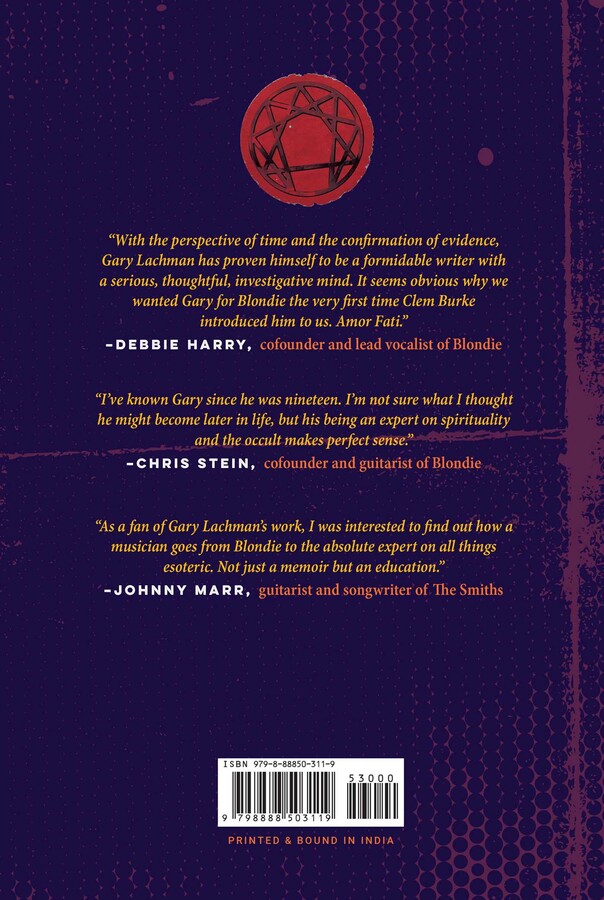
“With the perspective of time and the confirmation of evidence, Gary Lachman has proven himself to be a formidable writer with a serious, thoughtful, investigative mind. It seems obvious why we wanted Gary for Blondie the very first time Clem Burke introduced him to us. Amor Fati.”
– Debbie Harry, cofounder and lead vocalist of Blondie
“I’ve known Gary since he was nineteen. I’m not sure what I thought he might become later in life, but his being an expert on spirituality and the occult makes perfect sense.”
– Chris Stein, cofounder and guitarist of Blondie
“As a fan of Gary Lachman’s work, I was interested to find out how a musician goes from Blondie to the absolute expert on all things esoteric. Not just a memoir but an education.”
– Johnny Marr, guitarist and songwriter of The Smiths
“In these pages, we learn what has secretly driven Gary Lachman all these years—from rock music, through Nietzsche, a near electrocution, Faculty X, and Silver Age comics, to endless insights into magic, the occult, the evolution of consciousness, and superhuman powers. We learn what it means to be ‘touched by the presence.’ This is a profound read by a real reader and a real writer.”
– Jeffrey J. Kripal, author of How to Think Impossibly
“Gary Lachman is one of the world’s foremost historians of esoteric culture, having written seminal books about Blavatsky, Steiner, Swedenborg, Jung, Ouspensky, Colin Wilson, Aleister Crowley, and many others. His newest book, Touched by the Presence, is a deep dive into his mind and his incredible journey. This book describes an amazing transformation from an abusive childhood, to becoming a near-homeless vagabond, and then a Rock and Roll Hall of Fame inductee, to his present career as an intellectual of high standing. While the book is a tribute to Lachman’s creativity and his humanity, what stands out to me is his unwavering curiosity about the deepest philosophical problems facing contemporary humans.”
– Jeffrey Mishlove, Ph.D., host of the New Thinking Allowed YouTube channel
“In this compelling autobiography, Gary Lachman, former iconic pop musician turned author, vividly describes his inner and outer odyssey and the key people, movements, and books that have influenced him. He tells a riveting personal story that is full of fascinating observations on life, literature, culture, books, places, and more."
– Christopher McIntosh, author of Occult Germany, Occult Russia, and The Call of the Old Gods
“In Touched by the Presence, former Blondie rocker Gary Lachman has written a zestful and inspirational memoir. A late baby boomer who grew up in a dysfunctional New Jersey family, he discovered music as a path of escape during the vibrant 1970s counterculture that spurred his life pivot to writing lucid books on spirituality and consciousness. Highly recommended!”
– Edward Hoffman, Ph.D., author of Paths to Happiness
“Fluid and articulate, Touched by the Presence is at heart a bibliophile’s memoir, delivering wide-ranging assessments of 20th-century philosophers and literary thinkers by an avid young reader who devoured them while undergoing a major life transition from being a member of a world-famous band to a prolific writer on distinctly off-the-grid metaphysical subjects. Spanning twenty years from the 1970s through the 1990s, the story is as much about the books Lachman encounters on this journey as the people. And the satisfying Act I–style ending leaves him and us poised on the brink of this new life, wondering what comes next.”
– Victoria Nelson, author of On Writer’s Block
“I recommend Lachman’s story. Yet I have a feeling that, as a bonus, you will find your story. You may not be named the New Age Pope, but you’ll realice that the quest for gnosis makes life all the more interesting, as it has done for Lachman.”
– Miguel Conner, Quest Journal
Resources and Downloads
High Resolution Images
-
Book Cover Image (jpg): Touched by the Presence
Hardcover 9798888503119
Touched by the Presence
From Blondie's Bowery and Rock and Roll to Magic and the Occult
By Gary Lachman
Published by Inner Traditions
Distributed by Simon & Schuster
Join our mailing list!
By clicking 'Sign me up' I acknowledge that I have read and agree to the privacy policy and terms of use.