
Get our latest staff recommendations, award news and digital catalog links right to your inbox.
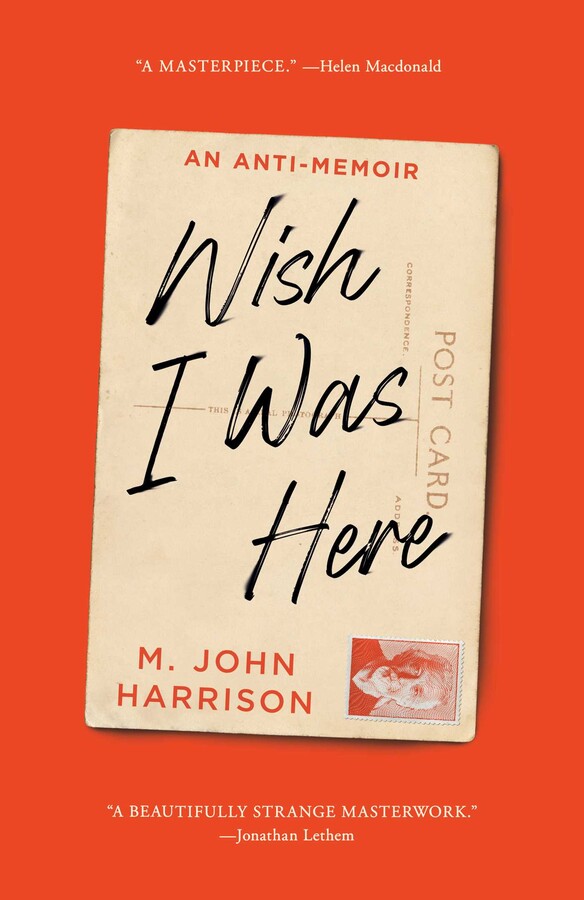
Wish I Was Here
Table of Contents
About The Book
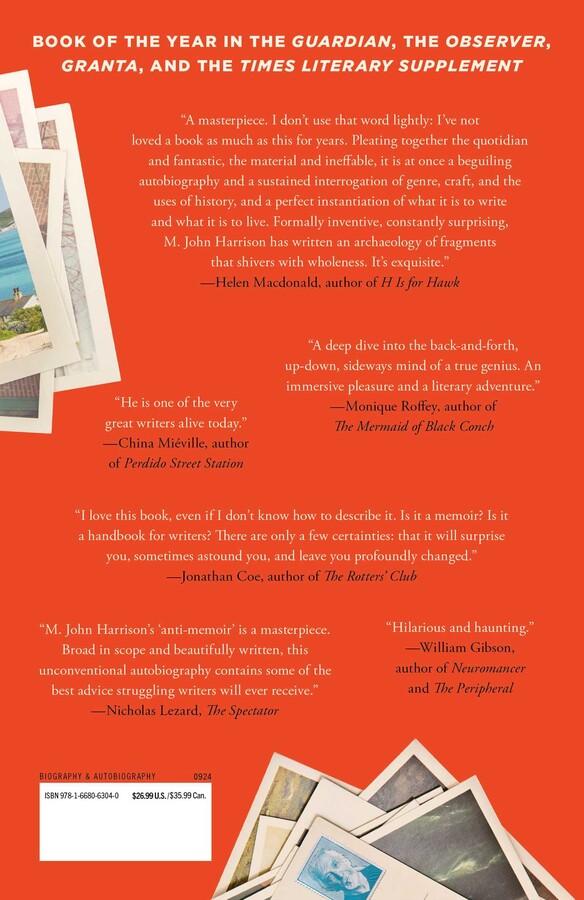
Named a Best Book of the Year by The Guardian, The Observer (London), Granata, and TLS, and a finalist for a World Fantasy Award.
Acclaimed master of speculative fiction, fantasy, space opera, and literary realism and one of the most celebrated living British authors M. John Harrison has crafted a “masterpiece” (Helen MacDonald, author of H Is for Hawk) with this anti-memoir about the joys and perils of the writing life.
M. John Harrison has produced one of the greatest bodies of fiction of any living British author. But is there even an M. John Harrison and if so, where do we find him?
This is the question the author asks in this memoir-as-mystery, turning for clues to forty years of notetaking: “A note or it never happened. A note or you never looked.”
Are these notebooks records of failed presence? How do they shine a light on a childhood in the industrial Midlands, a portrait of a young artist in counterculture London, on an adulthood of restless escape into hill and moorland landscapes? And do they tell us anything about the writing of books, each one so different from the last that it might have been written by another version of the author?
With aphoristic daring and laconic prose, this “infectiously engaging” (The Times Literary Supplement, London) anti-memoir will fascinate and delight. It confirms M. John Harrison still further in his status as the most original British writer of his generation.
“Wish I Was Here is a beautifully strange masterwork. It is as if M. John Harrison’s prose devises its own autobiography, while the figure of its author stands to one side tinkering at a eulogy for a dead cat, a manifesto against ruin porn, and a manual of operating procedures for creativity as funky as a Brian Eno card deck. How can this also produce a sublime fugue on memory and aging? Read it and see.” —Jonathan Lethem, author of Motherless Brooklyn and The Fortress of Solitude
Acclaimed master of speculative fiction, fantasy, space opera, and literary realism and one of the most celebrated living British authors M. John Harrison has crafted a “masterpiece” (Helen MacDonald, author of H Is for Hawk) with this anti-memoir about the joys and perils of the writing life.
M. John Harrison has produced one of the greatest bodies of fiction of any living British author. But is there even an M. John Harrison and if so, where do we find him?
This is the question the author asks in this memoir-as-mystery, turning for clues to forty years of notetaking: “A note or it never happened. A note or you never looked.”
Are these notebooks records of failed presence? How do they shine a light on a childhood in the industrial Midlands, a portrait of a young artist in counterculture London, on an adulthood of restless escape into hill and moorland landscapes? And do they tell us anything about the writing of books, each one so different from the last that it might have been written by another version of the author?
With aphoristic daring and laconic prose, this “infectiously engaging” (The Times Literary Supplement, London) anti-memoir will fascinate and delight. It confirms M. John Harrison still further in his status as the most original British writer of his generation.
“Wish I Was Here is a beautifully strange masterwork. It is as if M. John Harrison’s prose devises its own autobiography, while the figure of its author stands to one side tinkering at a eulogy for a dead cat, a manifesto against ruin porn, and a manual of operating procedures for creativity as funky as a Brian Eno card deck. How can this also produce a sublime fugue on memory and aging? Read it and see.” —Jonathan Lethem, author of Motherless Brooklyn and The Fortress of Solitude
Excerpt
1. Nowtbooks (1)
When I was younger I thought writing should be the struggle with what you are. Now I think it’s the struggle to find out who you were.
There are people who learn to dissociate early—to orbit whatever is happening to them without taking part. By late adolescence, we’re rarely losing height, let alone touching down. Memory never quite works for us. Our distance from events is already too great. I soon discovered that writing things down helps less to close that distance than you’d think. But notes make good source material, and when you keep notebooks they eventually begin to suggest something. About what, is not clear. But something, about something.
I liked a notebook spiral-bound: it was easier to police. I couldn’t bear hasty scribble, interlinears, strike-through, muddle. If I thought of a better sentence, I was compelled to tear out the whole page and begin again. I wanted the notes to be notes: I also wanted them to be pristine, finished, absolutely articulate little gems. Soon I was keeping two sets of accounts, the rough and the smooth, the instant and the perfected. Some notes didn’t seem worth the effort of polishing. These I labelled “nowts,” experiencing a vague resentment if ever I caught sight of them again. In the mid 1980s they would be transferred laboriously into their own computer files: dumped. Years after you have abandoned it, a note like that takes on a new, often uneasy semblance of life. The file is as warm to the touch as the radioactive container at the end of Robert Aldrich’s 1955 film Kiss Me Deadly: lift the lid and you could swear you hear, in a voice composed of both a whisper and a roar, the continuous repetition of a word.
Obviously there’s the fear of failing to remember, the fear of the loss of this or that detail, the fear that you’ll forget what you were shopping for. All of that is exactly what you’d expect. But the additional—the real—fear behind notebooking, the fear these fears disguise, is the fear of not having seen in the first place; and in that sense, keeping a notebook quickly becomes the act of seeing in itself. A note, or it never happened. A note, or you didn’t look. So write this down before it goes: a stag’s antlers imagined at the end of the garden, at the end of the day, among the browning leaves of last year’s iris! Write this: sand. Write this: a lacquer box. Write this: “Bought, contents unseen.” And this: “Some birds viewed from a distance.” Write that their wings are as flat as planks when they turn against the sky. Write that Friday approaches and recedes but it’s never where you are. Warm air, sunshine, rowan blossom like a confectioner’s shop, and further off, the junkman’s wonky bugle call.
Write a note, or this sunshine never fell through this window on to this minor, unnoticed, unreviewed event. A note, in a notebook, has this exact air of desperation to it. It invites yet refutes the act of reclamation.
Today I thought I might describe every single step of the staircase, every crack, flaw and grain in the oak as if it were a landscape. But if I can’t describe what’s outside the window—the way the winter sunshine falls on houses half a mile away while the High Street lies in shadow—how can I attempt something that much more complex? Close up, as far as language is concerned, the stairs exist off the edge of resolution, they are both the largest & the smallest structure in the universe.
I continue to be an observer who was never much good at observation, stuck with a means of communication which can’t carry enough information. Hence the constant retreat to metaphor. The attempt to push through into something else is always a failed attempt to be in the real. Metaphor is giving up too soon. There is also the question of what the superposition at the heart of any metaphor actually offers the reader. Push an analogy hard enough & it will break down; but metaphors just continue to point at something which never really claimed to be there, or be definable, in the first place. I love metaphor, and I wouldn’t be without it; it’s only that, every so often, a fifteen-year-old self of mine sits in a room in Warwickshire in 1960 and regrets it cannot use words to photograph & pass on to the reader the exact way the smoke rises from a cigarette.
Bear with me. I’m exploring some territory here. I’m looking for a password. My life built itself around guesses, moments of capture and hypnosis, things that never happen. To start with, these moments had a curious similarity in tone. They were equally distanced and unthreatening, as if it wasn’t actually me who was experiencing them. In a way, it wasn’t. The person who experienced them came later. My mistake was to think of him as me, as the identity I had constructed by living my life, by writing notes and then by writing notes about notes. By then I had an identity all right. But that’s another story. All anxieties contain their own mirrors, and you’re always looking for some space to inhabit between the two.
nowtbooks (1)
When I was younger I thought writing should be the struggle with what you are. Now I think it’s the struggle to find out who you were.
There are people who learn to dissociate early—to orbit whatever is happening to them without taking part. By late adolescence, we’re rarely losing height, let alone touching down. Memory never quite works for us. Our distance from events is already too great. I soon discovered that writing things down helps less to close that distance than you’d think. But notes make good source material, and when you keep notebooks they eventually begin to suggest something. About what, is not clear. But something, about something.
I liked a notebook spiral-bound: it was easier to police. I couldn’t bear hasty scribble, interlinears, strike-through, muddle. If I thought of a better sentence, I was compelled to tear out the whole page and begin again. I wanted the notes to be notes: I also wanted them to be pristine, finished, absolutely articulate little gems. Soon I was keeping two sets of accounts, the rough and the smooth, the instant and the perfected. Some notes didn’t seem worth the effort of polishing. These I labelled “nowts,” experiencing a vague resentment if ever I caught sight of them again. In the mid 1980s they would be transferred laboriously into their own computer files: dumped. Years after you have abandoned it, a note like that takes on a new, often uneasy semblance of life. The file is as warm to the touch as the radioactive container at the end of Robert Aldrich’s 1955 film Kiss Me Deadly: lift the lid and you could swear you hear, in a voice composed of both a whisper and a roar, the continuous repetition of a word.
Obviously there’s the fear of failing to remember, the fear of the loss of this or that detail, the fear that you’ll forget what you were shopping for. All of that is exactly what you’d expect. But the additional—the real—fear behind notebooking, the fear these fears disguise, is the fear of not having seen in the first place; and in that sense, keeping a notebook quickly becomes the act of seeing in itself. A note, or it never happened. A note, or you didn’t look. So write this down before it goes: a stag’s antlers imagined at the end of the garden, at the end of the day, among the browning leaves of last year’s iris! Write this: sand. Write this: a lacquer box. Write this: “Bought, contents unseen.” And this: “Some birds viewed from a distance.” Write that their wings are as flat as planks when they turn against the sky. Write that Friday approaches and recedes but it’s never where you are. Warm air, sunshine, rowan blossom like a confectioner’s shop, and further off, the junkman’s wonky bugle call.
Write a note, or this sunshine never fell through this window on to this minor, unnoticed, unreviewed event. A note, in a notebook, has this exact air of desperation to it. It invites yet refutes the act of reclamation.
Today I thought I might describe every single step of the staircase, every crack, flaw and grain in the oak as if it were a landscape. But if I can’t describe what’s outside the window—the way the winter sunshine falls on houses half a mile away while the High Street lies in shadow—how can I attempt something that much more complex? Close up, as far as language is concerned, the stairs exist off the edge of resolution, they are both the largest & the smallest structure in the universe.
I continue to be an observer who was never much good at observation, stuck with a means of communication which can’t carry enough information. Hence the constant retreat to metaphor. The attempt to push through into something else is always a failed attempt to be in the real. Metaphor is giving up too soon. There is also the question of what the superposition at the heart of any metaphor actually offers the reader. Push an analogy hard enough & it will break down; but metaphors just continue to point at something which never really claimed to be there, or be definable, in the first place. I love metaphor, and I wouldn’t be without it; it’s only that, every so often, a fifteen-year-old self of mine sits in a room in Warwickshire in 1960 and regrets it cannot use words to photograph & pass on to the reader the exact way the smoke rises from a cigarette.
Bear with me. I’m exploring some territory here. I’m looking for a password. My life built itself around guesses, moments of capture and hypnosis, things that never happen. To start with, these moments had a curious similarity in tone. They were equally distanced and unthreatening, as if it wasn’t actually me who was experiencing them. In a way, it wasn’t. The person who experienced them came later. My mistake was to think of him as me, as the identity I had constructed by living my life, by writing notes and then by writing notes about notes. By then I had an identity all right. But that’s another story. All anxieties contain their own mirrors, and you’re always looking for some space to inhabit between the two.
About The Author
Photograph by Hugo Glendinning.
M. John Harrison is an English author and literary critic. He has won the J. Tiptree Jr. Award, the Arthur C. Clarke Award, the Philip K. Dick Award, and the Goldsmiths Prize. He was also a judge for the Booker Prize in 2022. His work includes the Viriconium sequence of novels and short stories, Climbers, and the Kefahuchi Tract trilogy, which consists of Light, Nova Swing, and Empty Space.
Product Details
- Publisher: S&S/Saga Press (September 3, 2024)
- Length: 224 pages
- ISBN13: 9781668063040
Browse Related Books
Raves and Reviews
"Infectiously engaging, packed with rueful wisdom and a distinctive sense of mischief." -- Keith Miller, Times Literary Supplement, Book of the Year 2023
"Is M John Harrison the best writer at work today? He's certainly among the deftest and most original, producing immaculately odd sentences in any genre he chooses." --Olivia Laing, Summer Pick of 2023, Guardian
"Wish I Was Here by M John Harrison is a revival of the writer's memoir ... slippery and fascinating as any of his fiction." --Jonathan Coe, Summer Pick of 2023, Guardian
"Unusual and impressive, Wish I Was Here is also a writing manual of brilliance." --Sunday Times
"One of the best writers currently at work in English." -- Robert Macfarlane, author of The Wild Places
"Hilarious and haunting." -- William Gibson, author of Neuromancer
"He is one of the very great writers alive today." --China Miéville, author of Perdido Street Station
"Wish I Was Here is a masterpiece. I don't use that word lightly: I've not loved a book as much as this for years. Pleating together the quotidian and fantastic, the material and ineffable, it is at once a beguiling autobiography and a sustained interrogation of genre, craft, and the uses of history, and a perfect instantiation of what it is to write and what it is to live. Formally inventive, constantly surprising, M John Harrison has written an archaeology of fragments that shivers with wholeness. It's exquisite" -- Helen Macdonald, author of H is for Hawk
"Harrison is the shape-shifting master of absent and elusive things, many of them absent and eluding in Barnes and the Peak District. In this mesmerising book, the author - or rather his style - goes in search of what may have been his memories of different versions of his life. The result is an enchantment of instability, usually ungraspable, always intense." -- Neil MacGregor, author of Living with the Gods
"A deep dive into the back-and-forth, up-down, sideways mind of a true genius. An immersive pleasure and a literary adventure" -- Monique Roffey, author of The Mermaid of Black Conch
"An extraordinary writer and an extraordinary book. I don't know how to describe it, which is to say that I'll read it again, and again" -- Helen Castor, author of She-Wolves
"M. John Harrison puts to work a writerly consciousness and imaginativeness like no other. Wish I Was Here doesn't reinvent memoir; it quietly constructs an entire new ballpark." -- Isabel Waidner, author of Sterling Karat Gold
"I love this book, even if I don't know how to describe it. Is it a memoir? Is it a handbook for writers? As always with M John Harrison, you're never quite sure what you're reading or where it will take you next. There are only a few certainties: that it will surprise you, sometimes astound you, and leave you profoundly changed." -- Jonathan Coe, author of The Rotters’ Club
"What Wish I Was Here does triumphantly is to capture the feeling of living in the 21st century with all its anxieties ... wondrous and self-defining and defiant." --Guardian
"M. John Harrison, the best British writer you've never heard of, operates on the margins. Unusual and impressive, Wish I Was Here is also a writing manual of brilliance." --Sunday Times
"This book is old school experiment, several unrelated episodes from a literary reality show, a kind of negative biography with a big author-shaped hole in the middle waiting for the reader to fill based on all the evidence around it. It's also one of the best books I've read so far this year." -- International Times
"This is one of the most original books about writing that I have read, in part because Harrison is as profound about the art as he is helpful on the craft ... destabilising, witty, exhilarating - an important contribution to the genre's evolution." --i Paper
"So wholly original that a label doesn't do it justice ... Wish I Was Here will leave you bewildered." --New Statesman
"Harrison captures the stultifying and and generative landscape of post-industrial England better than anyone else." --Totally Dublin
"It's extraordinary. Profound, hilarious, precise, vagrant and speculative. And always intensely good company. The sort of book that makes writing seem possible again. (Or is it impossible?)" --Brian Dillon
"M. John Harrison's 'anti-memoir' is a masterpiece. Broad in scope and beautifully written, this unconventional autobiography contains some of the best advice struggling writers will ever receive." --Nicolas Lezard, The Spectator
“So wholly original that a label doesn’t do it justice”
– –New Statesman
"Is M John Harrison the best writer at work today? He's certainly among the deftest and most original, producing immaculately odd sentences in any genre he chooses." Olivia Laing, Summer Pick of 2023, Guardian
"Wish I Was Here by M John Harrison is a revival of the writer's memoir ... slippery and fascinating as any of his fiction." Jonathan Coe, Summer Pick of 2023, Guardian
Resources and Downloads
High Resolution Images
-
Book Cover Image (jpg): Wish I Was Here
Hardcover 9781668063040
-
Author Photo (jpg): M. John Harrison Photograph by Hugo Glendinning.(0.1 MB)
Any use of an author photo must include its respective photo credit
Wish I Was Here
Join our mailing list!
By clicking 'Sign me up' I acknowledge that I have read and agree to the privacy policy and terms of use.